Economics · Book club
The Ascent of Money: A Financial History of the World book club questions
Here are 12 book club questions for The Ascent of Money: A Financial History of the World by Niall Ferguson, ordered to open easily and end somewhere worth arguing about. Copy them, print them, or bring them up one at a time.
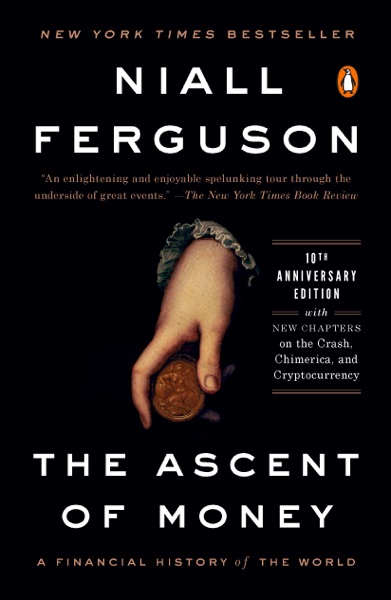
Niall Ferguson published The Ascent of Money in 2008, with timing that turned out to be acute: the book appeared just as the global financial crisis was unfolding, making its subject matter suddenly urgent for readers who had barely thought about the mechanics of credit default swaps or mortgage securitization.
Niall Ferguson · 2008 · 6h 45m
Full summary and key takeaways →The 12 questions
- 1.
Ferguson argues financial history is central to world history. Which example from the book most changed how you thought about a historical event?
- 2.
The book traces the pattern of innovation followed by crisis across multiple financial instruments. Does this pattern suggest financial crises are inevitable, and if so, what follows from that?
- 3.
Ferguson's coverage of the 2008 crisis was written as it unfolded. How does reading about a financial crisis in historical narrative form change how you understand it compared to news coverage?
- 4.
The bond market chapter shows how state borrowing capacity determines military power. Does that analysis hold in a world of nuclear weapons and economic sanctions?
- 5.
Insurance works by pooling and modeling risk. Where does the model break down, and what does that tell us about the limits of applying financial logic to genuinely uncertain events?
- 6.
Ferguson traces the Rothschild family's role in nineteenth-century finance. What does their story tell us about the relationship between private financial power and political power?
- 7.
Real estate has been the asset at the center of several of history's worst financial crises. Why does housing seem so resistant to the lessons of previous crashes?
- 8.
The stock company limited individual liability to enable large-scale enterprise. What are the arguments for and against limited liability as a feature of corporate structure?
- 9.
Globalized finance connects economies in ways that make crises contagious. What is the tradeoff between the benefits of financial integration and the risk of contagion?
- 10.
Ferguson is a historian who writes about economics. How does his historical method differ from an economist's approach to the same material?
- 11.
Which financial innovation do you think has had the most transformative effect on ordinary people's lives — credit, insurance, pensions, mortgages?
- 12.
The book ends with the 2008 crisis as an unresolved situation. What has the subsequent decade and a half told us about whether the underlying conditions were addressed?
How to run the discussion
- Pick six to eight, not all of them. An hour of real discussion covers fewer questions than anyone expects, and racing the list is what makes a book club feel like homework.
- Open with what people noticed, not what they concluded. Asking for a verdict first hardens opinions before anyone has heard each other.
- Let the disagreement run. The questions below that split a room are the ones worth the time; the ones everyone answers the same way can be skipped.
- Ask the quiet person a specific question. A direct, narrow question is far easier to answer than an open invitation to contribute.
Themes worth steering toward
If the conversation stalls, these are the threads that usually restart it.
Common questions
What are good book club questions for The Ascent of Money: A Financial History of the World?
Here are 12 book club questions for The Ascent of Money: A Financial History of the World by Niall Ferguson, ordered to open easily and end somewhere worth arguing about. The strongest openers ask what each reader noticed rather than what they concluded, and the discussion usually turns on financial history, banking, risk.
How long should a book club discussion of The Ascent of Money: A Financial History of the World last?
Most groups run 60 to 90 minutes of actual discussion. That is roughly six to eight questions, not all of them, so pick the ones that suit your group rather than working down the list in order.
What are the main themes in The Ascent of Money: A Financial History of the World?
Financial history, Banking, Risk, Capital markets, Globalization. Those are the threads most likely to divide a room, which makes them the useful places to steer a discussion that has gone quiet.
Picking the next one? See books like The Ascent of Money: A Financial History of the World or questions for other book club picks.
