Science · Book club
The Black Swan: The Impact of the Highly Improbable book club questions
Here are 12 book club questions for The Black Swan: The Impact of the Highly Improbable by Nassim Nicholas Taleb, ordered to open easily and end somewhere worth arguing about. Copy them, print them, or bring them up one at a time.
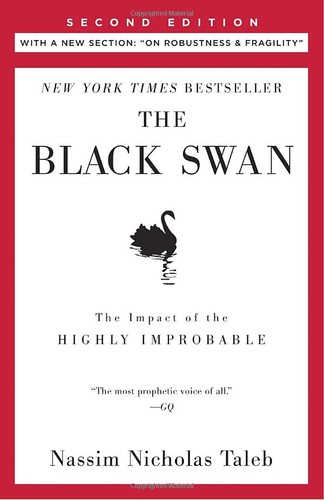
The Black Swan is Nassim Nicholas Taleb's argument that the most consequential events in history — financial crashes, technological breakthroughs, wars, pandemics — are not predictable outliers but structurally unpredictable ones.
Nassim Nicholas Taleb · 2007 · 7h 45m
Full summary and key takeaways →The 12 questions
- 1.
Taleb argues that the most important events are by definition the ones we failed to anticipate. Does that make planning irrelevant, or does it change what planning should look like?
- 2.
Think of a major change in your own life or career that you did not see coming. Did you construct a clean narrative afterward that made it feel inevitable? What did that narrative leave out?
- 3.
The Mediocristan versus Extremistan distinction is central to the book. Which domain does your industry or profession actually live in, and are you making decisions as if it were the other one?
- 4.
Silent evidence means we mostly learn from survivors. Who or what in your field are you not hearing from, and how might that gap distort your picture of what works?
- 5.
Taleb is sharply critical of academic economists and financial forecasters. Is his skepticism proportionate, or does it slide into a blanket dismissal that has its own blind spots?
- 6.
The turkey problem suggests that long streaks of success can be a warning sign rather than a confirmation. Where in your life are you most vulnerable to this kind of complacency?
- 7.
Taleb recommends holding a barbell portfolio: very safe on one end, very speculative on the other, nothing in the middle. How would that principle apply outside finance — to a career, a creative practice, a relationship?
- 8.
The narrative fallacy makes us feel we understand things we don't. What is a story you tell yourself about your own past that you've never seriously questioned?
- 9.
Taleb distinguishes between positive and negative Black Swans. What would it mean to deliberately expose yourself to more positive ones — and what would you have to give up to do it?
- 10.
The book was published in 2007, before the financial crisis. Does that timing change how you weigh Taleb's arguments? What would a critic say about how he used that event afterward?
- 11.
Taleb's tone is combative and often dismissive of people he disagrees with. Does the style strengthen or weaken the argument for you? Where does provocation help and where does it get in the way?
- 12.
If you accepted Taleb's framework fully, which expert opinions or institutions would you have to stop trusting? Are you willing to pay that cost?
How to run the discussion
- Pick six to eight, not all of them. An hour of real discussion covers fewer questions than anyone expects, and racing the list is what makes a book club feel like homework.
- Open with what people noticed, not what they concluded. Asking for a verdict first hardens opinions before anyone has heard each other.
- Let the disagreement run. The questions below that split a room are the ones worth the time; the ones everyone answers the same way can be skipped.
- Ask the quiet person a specific question. A direct, narrow question is far easier to answer than an open invitation to contribute.
Themes worth steering toward
If the conversation stalls, these are the threads that usually restart it.
Common questions
What are good book club questions for The Black Swan: The Impact of the Highly Improbable?
Here are 12 book club questions for The Black Swan: The Impact of the Highly Improbable by Nassim Nicholas Taleb, ordered to open easily and end somewhere worth arguing about. The strongest openers ask what each reader noticed rather than what they concluded, and the discussion usually turns on uncertainty, probability, epistemology.
How long should a book club discussion of The Black Swan: The Impact of the Highly Improbable last?
Most groups run 60 to 90 minutes of actual discussion. That is roughly six to eight questions, not all of them, so pick the ones that suit your group rather than working down the list in order.
What are the main themes in The Black Swan: The Impact of the Highly Improbable?
Uncertainty, Probability, Epistemology, Risk, Cognitive bias. Those are the threads most likely to divide a room, which makes them the useful places to steer a discussion that has gone quiet.
Picking the next one? See books like The Black Swan: The Impact of the Highly Improbable or questions for other book club picks.
