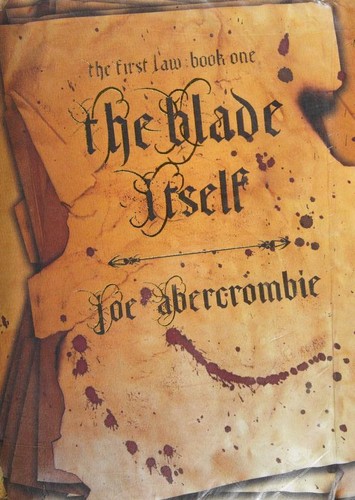
The Blade Itself by Joe Abercrombie is a 2006 fantasy book about moral ambiguity, war and its costs, power and cynicism. Grimdark fantasy at its best isn't nihilism — it's moral seriousness. Abercrombie uses genre conventions as targets precisely because they let him examine what those conventions normalize.
Summary
The Blade Itself is the first book of the First Law trilogy, a grimdark fantasy that opened with a deliberate challenge to the genre's conventions: the barbarian is not particularly heroic, the noble knight is not particularly noble, and the crippled torturer employed by the Inquisition is probably the most interesting person in the room. Abercrombie introduces three main viewpoint characters — Logen Ninefingers, Jezal dan Luthar, and Sand dan Glokta — along with the mysterious First of the Magi, Bayaz, who has plans for all of them that remain opaque through the first volume.
The book is genuinely about what violence does to people rather than what violence accomplishes for them. Logen is a feared barbarian warrior trying to escape his reputation and largely failing; Glokta is a former champion torturer who was himself tortured for years and now finds the work grimly apt; Jezal is a narcissistic young nobleman who is slowly being forced to confront that he is not the hero of his own story. Abercrombie cycles through these perspectives with considerable wit — the book is funnier than its reputation suggests — and the contrast between Jezal's self-regard and everyone else's assessment of him produces most of the dark comedy.
Abercrombie is working in the tradition that George R.R. Martin opened with A Song of Ice and Fire, but The First Law is more consistent in its pessimism and arguably more interested in character psychology than world-politics. The magic system is deliberately vague and potentially sinister. Bayaz, who presents as a helpful mentor, is given enough unsettling moments that the reader learns early not to trust the frame.
Volume one functions primarily as setup — the three main characters don't really converge until book two. Readers who find the first book too slow are usually told to push through, that the trilogy's conclusion rewards the patience. That is true, but volume one is worth reading as a standalone introduction to characters who become genuinely complex and surprising. For readers who want fantasy that takes seriously the question of what happens to people who do terrible things, this is essential.
Talk to The Blade Itself like its author wrote you back.
Get the ideas that fit your life — not generic summaries.
- Chat with the book
- Audiobook-style main ideas
- Adapts to your life and goals
- Helps you take action
Key takeaways
- 1.
Grimdark fantasy at its best isn't nihilism — it's moral seriousness. Abercrombie uses genre conventions as targets precisely because they let him examine what those conventions normalize.
- 2.
Glokta is one of the most compelling POV characters in modern fantasy: intelligent, broken, self-aware about the horror of what he does, and oddly sympathetic.
- 3.
The book's humor is dark but genuine. The contrast between Jezal's self-image and his actual character is played for comedy as much as critique.
- 4.
Violence in this world has costs. Logen's reputation as 'the Bloody-Nine' is not a badge of honor — it's a cage he can't escape regardless of what he wants to be.
- 5.
Bayaz functions as a deconstruction of the wise-mentor archetype. The novel seeds doubt about his motives early and rewards readers who hold onto that doubt.
- 6.
Class structure in the Union is treated with the same seriousness as magic and warfare. Who you are born is almost entirely determinative. Jezal's arc is partly about the violence that assumption does to everyone.
- 7.
The First Law trilogy is ultimately about manipulation at large scale — how powerful people use ordinary people without their knowledge. Volume one plants those seeds quietly.
- 8.
Abercrombie's prose is clean and fast. The action sequences are visceral and clearly choreographed, which is less common in epic fantasy than it should be.
Discussion questions
Use these on your own, with a book club, or as chat starters in Superbook. Book club version, ready to copy or print →
- 1.
Glokta is a torturer with the reader's sympathy for most of the book. How does Abercrombie manage that, and is it legitimate or a manipulation?
- 2.
Jezal is introduced as almost entirely unlikeable. How much do his qualities change through volume one, and does Abercrombie earn any warmth toward him?
- 3.
Logen is trying to leave violence behind and failing. Do you think the novel believes people can fundamentally change, or is it more deterministic than that?
- 4.
Bayaz presents as a helpful wizard but the book makes him quietly menacing. What specifically made you distrust him, and when did you first notice it?
- 5.
Abercrombie is often grouped with George R.R. Martin as grimdark fantasy. How does The First Law differ from A Song of Ice and Fire in what it's actually doing?
- 6.
The book is very funny in places — mostly at Jezal's expense. Does the humor undercut the darkness, complement it, or do both simultaneously?
- 7.
The world-building is deliberately sparse in volume one — no appendices, no map you'll consult constantly. Does restraint in world-building feel like trust in the reader or absence of depth?
- 8.
The First Law is sometimes described as a deconstruction of Tolkien-style fantasy. Is that a useful frame, or does it make Abercrombie sound more reactive than he is?
- 9.
What does the book seem to believe about heroism? Is there a character you'd describe as genuinely heroic, and what does that term even mean in this world?
- 10.
Abercrombie cycles between three very different POV characters. Which perspective felt most necessary to the book, and which could you have done without?
- 11.
The magic is deliberately vague and potentially dangerous. Does it bother you when magic in fantasy doesn't have clear rules?
- 12.
Volume one ends without resolving much. Does that feel like a complete reading experience or like having read an extended prologue?
Themes
Frequently asked questions
-
Is The Blade Itself worth reading?
Yes, especially for fantasy readers tired of clear heroes and clean resolutions. The character work is stronger than most epic fantasy, and Glokta alone is worth the read. Volume one is slow to converge, but the prose is fast and the characters are memorable from the first chapter.
-
Is this grimdark? How dark is it?
Yes, and very. Torture, military atrocity, moral corruption, and violence without glory are constant features. It is not gratuitous — Abercrombie is making points — but readers who find darkness in fiction exhausting should be warned. The humor is present but doesn't lighten the overall tone much.
-
Do I need to read all three books?
The full trilogy rewards the investment significantly more than the first book alone. Volume one is setup; the trilogy's conclusion is where the moral argument becomes clear. If you stop at book one, you've read a good but incomplete story.
-
Who shouldn't read this?
Readers who need characters to be rooting-for-able will struggle. Readers who want heroic fantasy with genuine good-versus-evil stakes will find this deliberately alienating. Readers who are put off by extended torture scenes should be aware that Glokta's sections include them in clinical detail.
-
Is there a TV adaptation?
No adaptation has been produced as of 2026, though rights have been optioned multiple times. The First Law's film rights have been under discussion for years without a greenlit project.