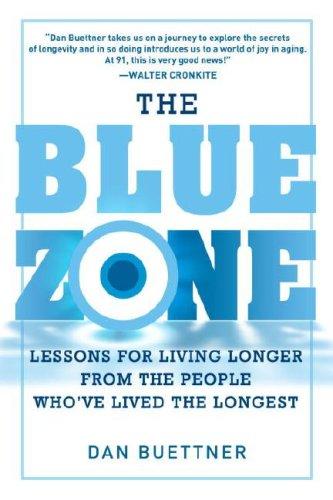
The Blue Zones by Dan Buettner is a 2008 health book about longevity, diet and lifestyle, community. All five blue zones share plant-dominant diets with legumes as a cornerstone — beans, lentils, and soybeans appear in every zone as a daily food.
Summary
The Blue Zones is Dan Buettner's investigation into five geographic regions where people live measurably longer and healthier lives than global averages: Sardinia (Italy), Okinawa (Japan), Loma Linda (California), the Nicoya Peninsula (Costa Rica), and Ikaria (Greece). Working with a team of researchers and demographers, Buettner spent years documenting the lifestyles, diets, social structures, and attitudes of the centenarians and near-centenarians in these communities, searching for common patterns that might explain their unusual longevity.
What emerges is not a single secret but a cluster of overlapping practices. Dietary patterns in all five zones emphasize plant foods — legumes in particular appear consistently across all five communities as the cornerstone of the diet. Meat is eaten but is a condiment or celebration food rather than a daily staple. Alcohol, where consumed, is moderate and social rather than solitary. No one in the blue zones is on a diet or counting calories; they live in food environments that produce healthy eating as a natural default.
The non-dietary factors are equally important. People in blue zones have strong senses of purpose — a reason to wake up in the morning that Okinawans call ikigai. They are embedded in social networks and have family and community at the center of their lives rather than the periphery. Most have daily movement built into their environment rather than structured exercise programs: Sardinian shepherds walk miles of hills as part of their work; Okinawan women meet in groups for daily conversation and mutual support. Stress management is achieved through ritual — prayer, naps, wine at sunset — rather than through optimization.
The book is organized by zone, with individual profiles of remarkable centenarians and summaries of the patterns researchers found in each community. Buettner synthesizes these into the "Power 9" — nine evidence-informed behaviors common to all blue zones. He is upfront that these are observational findings rather than controlled experiments, and the book reads more as a compelling portrait of what long, healthy lives actually look like than as a prescription. The message is systemic: you can't buy longevity in a supplement, but you can design your life, your home, and your social network in ways that make healthy behaviors the path of least resistance.
Talk to The Blue Zones like its author wrote you back.
Get the ideas that fit your life — not generic summaries.
- Chat with the book
- Audiobook-style main ideas
- Adapts to your life and goals
- Helps you take action
Key takeaways
- 1.
All five blue zones share plant-dominant diets with legumes as a cornerstone — beans, lentils, and soybeans appear in every zone as a daily food.
- 2.
Meat is present in blue zone diets but functions as a condiment or celebration food, not a staple — average consumption is roughly five times a week or less.
- 3.
Strong social networks are as predictive of longevity as dietary patterns; isolation is a health risk comparable to smoking in its effects on lifespan.
- 4.
Purpose — having a reason to get up in the morning — is associated with measurably longer lives across multiple blue zone communities.
- 5.
Natural movement built into daily environment matters more than structured exercise; blue zone centenarians walk, garden, and do manual work rather than going to gyms.
- 6.
The 80% rule from Okinawa — stopping eating when roughly 80% full, before satiety is fully registered — produces lifelong calorie moderation without conscious restriction.
- 7.
Stress is managed through daily rituals — prayer, naps, social gatherings — that provide regular downregulation rather than occasional vacation.
- 8.
Family and community are placed structurally first in blue zone cultures: multigenerational households, strong friend groups, and religious or social belonging buffer individuals from the health costs of isolation.
Discussion questions
Use these on your own, with a book club, or as chat starters in Superbook. Book club version, ready to copy or print →
- 1.
Buettner identifies nine common factors across the blue zones. Which of the Power 9 is most present in your life, and which is most absent?
- 2.
He argues that you cannot buy longevity but can design an environment that produces it. What would designing your home and daily routine for longevity actually look like?
- 3.
The social dimension of blue zone health is as strong as the dietary dimension. How does that shift your priorities if you've been focused primarily on what to eat?
- 4.
The 80% rule — eating to partial fullness — is practiced without tracking or counting. Can you tell when you're at 80% full? When did you last stop eating at that point?
- 5.
Blue zone centenarians eat plant-forward diets that emerged from traditional food cultures, not from health optimization. Does it matter to you whether a healthy diet is chosen deliberately or inherited culturally?
- 6.
Ikigai — a sense of purpose — is associated with longevity in Okinawa. How clearly can you articulate your own ikigai? What would change if you took it more seriously?
- 7.
Many blue zone communities are religious. How do you disentangle the health effects of belief, community, ritual, and stress reduction that tend to come together in religious practice?
- 8.
The book profiles individuals in their nineties and hundreds who remain engaged, mobile, and cognitively sharp. What in their lives do you think most accounts for that outcome?
- 9.
Loma Linda, California is a blue zone because of its Seventh-day Adventist community. What does a religious enclave in the United States sharing longevity characteristics with rural Sardinia tell you about what drives healthy aging?
- 10.
Buettner's observations are cross-sectional: he studies existing long-lived populations rather than following people over time. What does that limit in what we can conclude?
- 11.
If you could borrow one practice from each blue zone, what would your five-practice longevity plan look like?
- 12.
The book argues for reshaping your 'social moai' — your inner circle — to include people who reinforce healthy behaviors. Is that feasible for most people without losing existing relationships?
Themes
Frequently asked questions
-
What are the five Blue Zones?
Sardinia (Italy), Okinawa (Japan), Loma Linda (California), the Nicoya Peninsula (Costa Rica), and Ikaria (Greece). These are regions identified by demographic data as having unusually high concentrations of centenarians and low rates of the diseases common in industrialized countries.
-
What is the Power 9 in The Blue Zones?
Nine behaviors common to all blue zone populations: natural movement, purpose, stress management, the 80% eating rule, plant-based diets, moderate wine consumption, belonging to a faith community, family first, and maintaining strong social connections. Buettner argues these nine factors explain most of the longevity advantage.
-
Is The Blue Zones scientifically rigorous?
The observations are based on real demographic data and careful ethnographic research. The methodology is observational rather than experimental — you cannot randomly assign people to live in blue zones. The findings are consistent with what longitudinal epidemiological research shows about social connection, diet, and longevity, but the causal mechanisms are inferred rather than proved.
-
Can Blue Zone principles be applied in modern urban life?
Buettner argues yes, through what he calls the Blue Zones Project — municipal efforts to redesign environments so healthy choices become easier. On an individual level, the principles of social connection, plant-forward eating, and purpose apply regardless of geography, though they are easier to sustain when reinforced by community and environment.
-
What is the most important Blue Zones lesson?
That longevity is a byproduct of a particular way of living, not a goal that can be pursued in isolation. The centenarians Buettner studied were not optimizing for long life; they were embedded in communities, traditions, and environments that made healthy behavior the natural default.
Similar books

In Defense of Food
Michael Pollan
Being Mortal: Medicine and What Matters in the End
Atul Gawande
Why We Sleep
Matthew Walker
Outlive: The Science and Art of Longevity
Peter Attia
