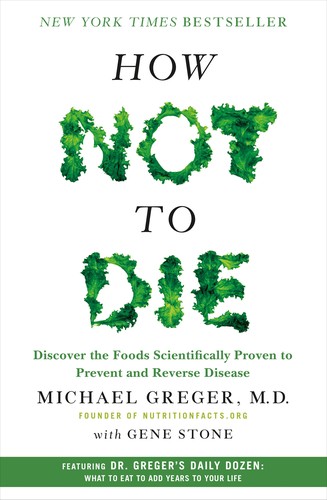
How Not to Die by Michael Greger is a 2015 health book about nutrition, disease prevention, plant-based diet. The fifteen leading causes of premature death in the United States are largely diet-related and largely preventable through whole-food, plant-based eating.
Summary
How Not to Die is Michael Greger's systematic argument that the fifteen leading causes of death in the United States are largely preventable through diet and lifestyle change. Greger is a physician and founder of NutritionFacts.org, and the book reads like the output of someone who has spent decades cataloguing nutritional research: each chapter covers a major disease, reviews the relevant science, and builds toward a dietary prescription. The tone is urgent and the conclusion is consistent — a whole-food, plant-based diet is the single most powerful intervention available for most chronic diseases.
The first half of the book moves through the fifteen killers one by one. Heart disease, cancer, diabetes, kidney disease, infections, brain disease — each gets a chapter that combines readable summaries of the research with specific foods and habits that the evidence links to risk reduction or increase. The chapters on heart disease and cancer are the most detailed, drawing on decades of epidemiological data and some intervention trials. Greger consistently highlights studies showing that populations eating predominantly plant-based diets have dramatically lower rates of the conditions that dominate Western medicine.
The second half introduces Greger's "Daily Dozen" — a checklist of food groups he recommends eating every day, including legumes, berries, cruciferous vegetables, whole grains, and flaxseeds. The logic here is less "eliminate everything bad" and more "crowd out the bad with the good." The Daily Dozen functions as a practical scaffold for people who accept the evidence but need structure.
The book is not without critics. Some researchers find Greger's reading of the evidence selective — he cites studies that support whole-food plant-based diets comprehensively and handles contradictory evidence lightly. The enthusiasm is infectious but occasionally outruns the data. That said, the core argument — that Western dietary patterns drive chronic disease and that moving toward more plants reduces risk — is not seriously contested in mainstream epidemiology. Readers who want nuance about what kind of animal products matter, or whether well-sourced fish or dairy has any redeeming role, will find the book less useful than those open to a more absolute prescription.
Talk to How Not to Die like its author wrote you back.
Get the ideas that fit your life — not generic summaries.
- Chat with the book
- Audiobook-style main ideas
- Adapts to your life and goals
- Helps you take action
Key takeaways
- 1.
The fifteen leading causes of premature death in the United States are largely diet-related and largely preventable through whole-food, plant-based eating.
- 2.
Heart disease has been shown to be not only preventable but reversible in some patients through dietary intervention — evidence that does not exist for most pharmaceutical treatments.
- 3.
Colorectal cancer risk is strongly linked to red and processed meat consumption; the evidence here is among the strongest in nutritional epidemiology.
- 4.
The Daily Dozen — beans, berries, other fruits, cruciferous vegetables, greens, other vegetables, flaxseeds, nuts, spices, whole grains, water, and exercise — provides a practical daily framework.
- 5.
Animal protein, particularly from dairy and processed meat, is associated with elevated IGF-1 levels, which appear to promote cancer cell growth.
- 6.
Chronic inflammation, driven largely by diet, is a common mechanism underlying most of the diseases covered in the book.
- 7.
Populations with the longest life expectancy and lowest rates of chronic disease eat diets centered on whole plant foods, with animal products as a condiment or occasional food.
- 8.
Diet is not a substitute for medical care, but it is an under-prescribed tool in clinical medicine, in part because doctors receive little nutritional training.
Discussion questions
Use these on your own, with a book club, or as chat starters in Superbook. Book club version, ready to copy or print →
- 1.
Greger argues that most chronic disease is preventable through diet. Does that feel empowering, overwhelming, or like it places too much blame on individuals?
- 2.
He acknowledges that plant-based eating is not a universal cure, but the overall message is confident. How do you evaluate nutritional science arguments that are strong in epidemiology but weaker in randomized trial evidence?
- 3.
Which of the fifteen diseases covered in the book is most relevant to your family history? What does Greger say about it, and does the evidence convince you?
- 4.
The Daily Dozen is prescriptive. Do you find checklists for eating helpful or anxiety-inducing? Why?
- 5.
Greger is clearly an advocate for a particular dietary philosophy. How does his advocacy affect your trust in his synthesis of the research?
- 6.
If you accepted every claim in the book, what would you actually change about how you eat? What's preventing you from making that change?
- 7.
He argues doctors are poorly trained in nutrition and therefore underutilize diet as medicine. Is that consistent with your experience of medical care?
- 8.
Some critics argue Greger cherry-picks evidence. How do you assess the credibility of a book that cites hundreds of studies but is written by an advocate rather than a neutral reviewer?
- 9.
The book covers global data showing populations that eat more plants live longer. Is that attributable purely to diet, or are there confounding factors?
- 10.
Which food on the Daily Dozen is hardest for you to eat consistently? What would make it easier?
- 11.
Greger covers processed meat as a Group 1 carcinogen. Has that classification changed how much of it you eat?
- 12.
The book's premise is that food is medicine. When does that framing help people, and when does it create unrealistic expectations or guilt?
Themes
Frequently asked questions
-
Is How Not to Die worth reading?
Worth reading if you want a comprehensive survey of the evidence linking diet to chronic disease and are open to a plant-based argument. Be aware that Greger is an advocate — the citations are real but his synthesis leans toward confirming a particular dietary philosophy. Cross-reference with less partisan sources if you want a fuller picture.
-
What does How Not to Die say about meat?
That red meat, processed meat in particular, is associated with increased risk of colorectal cancer, cardiovascular disease, and other conditions. Greger concludes that reducing or eliminating animal products is one of the most powerful steps you can take for long-term health. He does not distinguish meaningfully between different types or qualities of meat.
-
What is the Daily Dozen in How Not to Die?
A checklist of twelve food categories and one lifestyle recommendation that Greger suggests eating and doing daily. It includes beans, berries, other fruits, cruciferous vegetables, leafy greens, other vegetables, flaxseeds, nuts, herbs and spices, whole grains, beverages (mostly water), and exercise.
-
Is How Not to Die scientifically reliable?
The studies cited are real, but some researchers find the synthesis selective — Greger cites extensively in favor of plant-based diets and engages less critically with studies that complicate the picture. The core claim that whole plant foods reduce chronic disease risk is well-supported; specific claims about individual foods are variable in evidential quality.
-
Who should read How Not to Die?
People who want a dietary framework grounded in disease prevention rather than weight loss or aesthetics. Also useful for anyone with a family history of heart disease, cancer, or diabetes who wants to understand what the dietary research actually says. Less useful if you want a balanced review of the literature on omnivorous diets.