Science · Book club
The Book of Why book club questions
Here are 11 book club questions for The Book of Why by Judea Pearl, ordered to open easily and end somewhere worth arguing about. Copy them, print them, or bring them up one at a time.
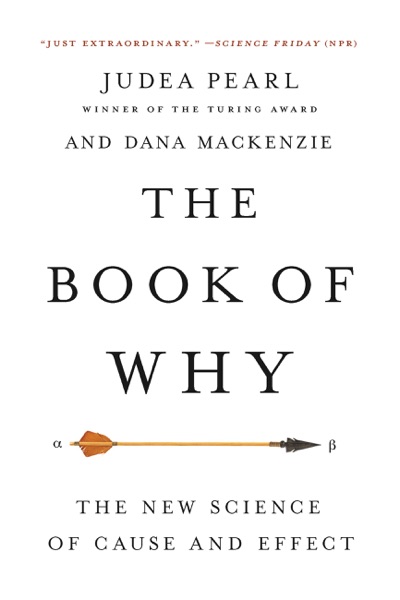
The Book of Why is Judea Pearl's argument that the dominant tradition in statistics — which insists on correlations and avoids causal claims — is a fundamental intellectual mistake, and that building a proper science of causality is the most important unsolved problem in both science and artificial intelligence.
Judea Pearl · 2018 · 6h 45m
Full summary and key takeaways →The 11 questions
- 1.
Pearl argues that avoiding causal language was a founding mistake of modern statistics. Do you find that argument convincing, or does it seem like an overstatement?
- 2.
Think of a headline you've seen recently that claimed a correlation. What causal question was the headline implying, and what would it actually take to answer that question?
- 3.
The ladder of causation distinguishes seeing, doing, and imagining. Can you think of decisions in your own life that required you to reason at each of these levels?
- 4.
Pearl says current AI can't reason causally. Does that match your experience with AI tools you've used? What kinds of questions does it seem unable to answer?
- 5.
Randomized controlled trials are the gold standard for medical evidence. Pearl discusses their limits. What important questions in health or policy seem impossible to randomize?
- 6.
Causal diagrams make assumptions explicit. In your own field, what causal assumptions are usually left implicit? What would happen if they were forced into the open?
- 7.
Pearl argues that counterfactual reasoning is the basis of moral judgment — assigning credit and blame requires imagining what would have happened otherwise. Do you find that plausible?
- 8.
The book traces the intellectual history of causality through statistics, genetics, and economics. Were you surprised by how long this debate has been going on?
- 9.
Pearl is openly polemical about AI researchers who think better pattern-matching will eventually produce human-like intelligence. Do you think he's right that causal structure is the missing piece?
- 10.
What is a causal claim in your professional domain that is widely assumed but rarely formally tested? What would it take to test it?
- 11.
Pearl writes that asking 'why' is uniquely human. Do you think that's true? What does a world look like in which machines can also genuinely ask why?
How to run the discussion
- Pick six to eight, not all of them. An hour of real discussion covers fewer questions than anyone expects, and racing the list is what makes a book club feel like homework.
- Open with what people noticed, not what they concluded. Asking for a verdict first hardens opinions before anyone has heard each other.
- Let the disagreement run. The questions below that split a room are the ones worth the time; the ones everyone answers the same way can be skipped.
- Ask the quiet person a specific question. A direct, narrow question is far easier to answer than an open invitation to contribute.
Themes worth steering toward
If the conversation stalls, these are the threads that usually restart it.
Common questions
What are good book club questions for The Book of Why?
Here are 11 book club questions for The Book of Why by Judea Pearl, ordered to open easily and end somewhere worth arguing about. The strongest openers ask what each reader noticed rather than what they concluded, and the discussion usually turns on causality, statistics, artificial intelligence.
How long should a book club discussion of The Book of Why last?
Most groups run 60 to 90 minutes of actual discussion. That is roughly six to eight questions, not all of them, so pick the ones that suit your group rather than working down the list in order.
What are the main themes in The Book of Why?
Causality, Statistics, Artificial intelligence, Scientific reasoning, Data and evidence. Those are the threads most likely to divide a room, which makes them the useful places to steer a discussion that has gone quiet.
Picking the next one? See books like The Book of Why or questions for other book club picks.
