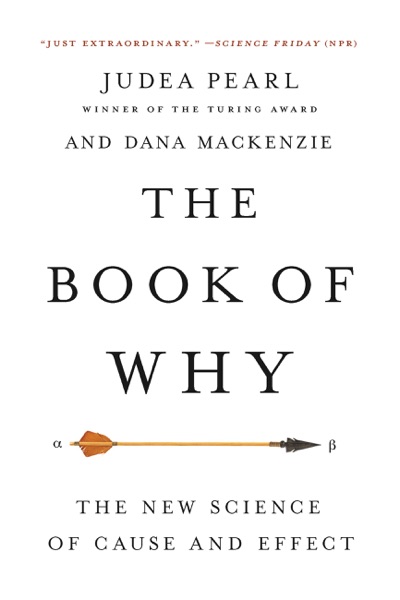
The Book of Why by Judea Pearl is a 2018 science book about causality, statistics, artificial intelligence. The ladder of causation has three rungs: association (seeing), intervention (doing), and counterfactual (imagining). Standard statistics is confined to the first rung.
Summary
The Book of Why is Judea Pearl's argument that the dominant tradition in statistics — which insists on correlations and avoids causal claims — is a fundamental intellectual mistake, and that building a proper science of causality is the most important unsolved problem in both science and artificial intelligence. Pearl is a computer scientist and winner of the Turing Award who spent decades developing the mathematical framework known as causal inference, and this book is his accessible account of that work, written with science journalist Dana Mackenzie.
Pearl organizes his argument around what he calls the "ladder of causation." The first rung is association: seeing, observing, asking what goes with what. The second is intervention: doing, asking what happens if I act. The third is counterfactual: imagining, asking what would have happened if things had been different. Standard statistics, Pearl argues, lives almost entirely on the first rung. It can identify correlations with great precision but cannot tell you whether smoking causes cancer, whether a drug causes recovery, or what would have happened had you taken a different path. To answer causal questions, you need causal tools.
The book traces the intellectual history of this problem with surprising drama. Pearl describes the debates between statisticians like Karl Pearson and Francis Galton, who built the entire edifice of modern statistics on the deliberate rejection of causal language, and the scientists — Sewall Wright in genetics, Phillip Wright in economics — who kept trying to sneak causality back in. The core technical contribution Pearl explains is the do-calculus and causal diagrams, tools that let you formally represent causal structures and derive what can be learned from observational data versus what requires intervention.
The implications for artificial intelligence are Pearl's most ambitious claim. Current machine learning systems, however powerful, operate on the first rung of the ladder. They identify patterns in data extraordinarily well, but they cannot reason about interventions or counterfactuals. Pearl argues this means current AI cannot reason the way humans do, and that building truly intelligent systems will require giving machines a causal model of the world — not just a statistical one. The book is partly a history, partly a technical tutorial, and partly a manifesto for a research agenda Pearl believes most of his field has been too timid to pursue.
Talk to The Book of Why like its author wrote you back.
Get the ideas that fit your life — not generic summaries.
- Chat with the book
- Audiobook-style main ideas
- Adapts to your life and goals
- Helps you take action
Key takeaways
- 1.
The ladder of causation has three rungs: association (seeing), intervention (doing), and counterfactual (imagining). Standard statistics is confined to the first rung.
- 2.
Correlation cannot establish causation — this is widely known. Pearl's contribution is providing the mathematical tools to establish causation from observational data under specified conditions.
- 3.
Causal diagrams (directed acyclic graphs) let researchers explicitly represent their assumptions about causal structure, making those assumptions visible and testable rather than buried in methodology.
- 4.
The 'do-calculus' is Pearl's formal framework for distinguishing observational claims (what happens when we see X) from interventional claims (what happens when we do X).
- 5.
Modern machine learning operates on association. No matter how much data a neural network processes, it cannot answer counterfactual questions without a causal model.
- 6.
The history of statistics is partly a story of deliberate avoidance of causal language — Pearl traces this to Pearson and Galton and argues it became an intellectual straitjacket.
- 7.
Randomized controlled trials are powerful precisely because randomization breaks confounding — but most important questions in medicine, economics, and social science cannot be randomized.
- 8.
Counterfactual reasoning is uniquely human: asking what would have happened, imagining alternate histories, assigning credit and blame. Pearl argues this capacity is the foundation of moral reasoning.
Discussion questions
Use these on your own, with a book club, or as chat starters in Superbook. Book club version, ready to copy or print →
- 1.
Pearl argues that avoiding causal language was a founding mistake of modern statistics. Do you find that argument convincing, or does it seem like an overstatement?
- 2.
Think of a headline you've seen recently that claimed a correlation. What causal question was the headline implying, and what would it actually take to answer that question?
- 3.
The ladder of causation distinguishes seeing, doing, and imagining. Can you think of decisions in your own life that required you to reason at each of these levels?
- 4.
Pearl says current AI can't reason causally. Does that match your experience with AI tools you've used? What kinds of questions does it seem unable to answer?
- 5.
Randomized controlled trials are the gold standard for medical evidence. Pearl discusses their limits. What important questions in health or policy seem impossible to randomize?
- 6.
Causal diagrams make assumptions explicit. In your own field, what causal assumptions are usually left implicit? What would happen if they were forced into the open?
- 7.
Pearl argues that counterfactual reasoning is the basis of moral judgment — assigning credit and blame requires imagining what would have happened otherwise. Do you find that plausible?
- 8.
The book traces the intellectual history of causality through statistics, genetics, and economics. Were you surprised by how long this debate has been going on?
- 9.
Pearl is openly polemical about AI researchers who think better pattern-matching will eventually produce human-like intelligence. Do you think he's right that causal structure is the missing piece?
- 10.
What is a causal claim in your professional domain that is widely assumed but rarely formally tested? What would it take to test it?
- 11.
Pearl writes that asking 'why' is uniquely human. Do you think that's true? What does a world look like in which machines can also genuinely ask why?
Themes
Frequently asked questions
-
What is The Book of Why about?
It's about the science of causality — how to determine whether one thing actually causes another, rather than merely correlating with it. Pearl argues that statistics deliberately abandoned causal reasoning and that fixing this is the central unsolved problem in both science and AI.
-
Is The Book of Why technical? Do I need a math background?
It is more technical than a typical popular science book, but Pearl and Mackenzie worked hard to make it accessible. High school algebra is helpful. The big ideas can be followed without the formulas, but skimming the mathematical sections will cost some understanding of why Pearl's tools are powerful.
-
What is Pearl's main criticism of machine learning?
That current AI operates purely at the level of association — finding patterns in data — and cannot reason about interventions or counterfactuals. Pearl argues this means machine learning cannot achieve human-level intelligence without a causal model of the world.
-
Who should read The Book of Why?
Scientists, data analysts, policymakers, and anyone who works with evidence-based claims. Also useful for anyone skeptical about correlation-versus-causation distinctions who wants the rigorous version of that skepticism rather than a slogan.
-
How does Pearl's work differ from standard statistics?
Standard statistics describes associations in data and studiously avoids causal claims. Pearl's causal calculus provides formal tools for making causal inferences under specified assumptions, distinguishing what observational data can and cannot tell you.
Similar books
Thinking, Fast and Slow
Daniel Kahneman
The Signal and the Noise
Nate Silver

The Art of Statistics: How to Learn from Data
David Spiegelhalter
How Not to Be Wrong: The Power of Mathematical Thinking
Jordan Ellenberg
