Economics · Book club
The Bottom Billion: Why the Poorest Countries Are Failing and What Can Be Done About It book club questions
Here are 12 book club questions for The Bottom Billion: Why the Poorest Countries Are Failing and What Can Be Done About It by Paul Collier, ordered to open easily and end somewhere worth arguing about. Copy them, print them, or bring them up one at a time.
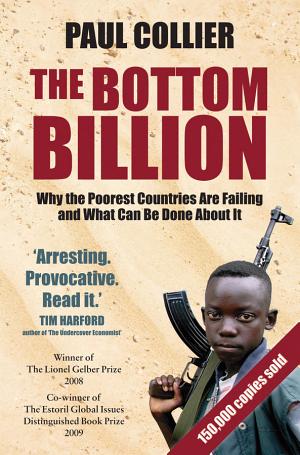
Paul Collier spent two decades as a development economist at the World Bank and Oxford before writing The Bottom Billion, and the book reflects that experience in a specific way: rather than offering a unified theory of why poor countries stay poor, it offers a careful, empirically grounded account of the different mechanisms — the traps — that keep the roughly fifty countries and one billion people in the most severe and persistent poverty from breaking out.
Paul Collier · 2007 · 5h 0m
Full summary and key takeaways →The 12 questions
- 1.
Collier distinguishes four traps rather than one unified theory of poverty. Does that analytical granularity make his prescriptions more or less convincing than a single-cause account?
- 2.
The finding that civil wars are driven by economic opportunity rather than grievance was deeply counterintuitive when published. What would it imply for how development organizations think about conflict prevention?
- 3.
Collier supports targeted military intervention in post-conflict countries. How do you evaluate that position, and what conditions would need to be met for it to be justified?
- 4.
The resource curse suggests that discovering natural wealth can make a country worse off. What institutional conditions would need to exist for resource wealth to be a genuine benefit?
- 5.
Collier is more supportive of aid than Easterly while sharing his concern about accountability. Where exactly do their positions diverge, and how do you weigh their disagreement?
- 6.
Trade preferences rather than aid are presented as the more powerful tool for long-term development. What political obstacles in rich countries make that shift difficult?
- 7.
The landlocked trap seems the least addressable by policy. Does that imply anything about which countries development organizations should prioritize?
- 8.
Collier addresses his argument explicitly to Western voters and policymakers. How does that rhetorical choice shape what he argues and what he leaves out?
- 9.
The post-conflict window of opportunity requires a decade of sustained engagement. What has been the track record of that kind of sustained commitment in practice?
- 10.
If the bottom billion's problems are primarily structural rather than a function of insufficient aid, what does that imply about the effectiveness of individual charitable giving?
- 11.
Collier combines positions typically associated with different political camps. Does that cross-cutting approach strengthen or weaken his credibility in a polarized debate?
- 12.
Which of the four traps do you find most compelling as an explanation of persistent poverty, and which do you find least supported by the evidence Collier presents?
How to run the discussion
- Pick six to eight, not all of them. An hour of real discussion covers fewer questions than anyone expects, and racing the list is what makes a book club feel like homework.
- Open with what people noticed, not what they concluded. Asking for a verdict first hardens opinions before anyone has heard each other.
- Let the disagreement run. The questions below that split a room are the ones worth the time; the ones everyone answers the same way can be skipped.
- Ask the quiet person a specific question. A direct, narrow question is far easier to answer than an open invitation to contribute.
Themes worth steering toward
If the conversation stalls, these are the threads that usually restart it.
Common questions
What are good book club questions for The Bottom Billion: Why the Poorest Countries Are Failing and What Can Be Done About It?
Here are 12 book club questions for The Bottom Billion: Why the Poorest Countries Are Failing and What Can Be Done About It by Paul Collier, ordered to open easily and end somewhere worth arguing about. The strongest openers ask what each reader noticed rather than what they concluded, and the discussion usually turns on development economics, poverty traps, conflict.
How long should a book club discussion of The Bottom Billion: Why the Poorest Countries Are Failing and What Can Be Done About It last?
Most groups run 60 to 90 minutes of actual discussion. That is roughly six to eight questions, not all of them, so pick the ones that suit your group rather than working down the list in order.
What are the main themes in The Bottom Billion: Why the Poorest Countries Are Failing and What Can Be Done About It?
Development economics, Poverty traps, Conflict, Governance, Foreign aid. Those are the threads most likely to divide a room, which makes them the useful places to steer a discussion that has gone quiet.
Picking the next one? See books like The Bottom Billion: Why the Poorest Countries Are Failing and What Can Be Done About It or questions for other book club picks.
