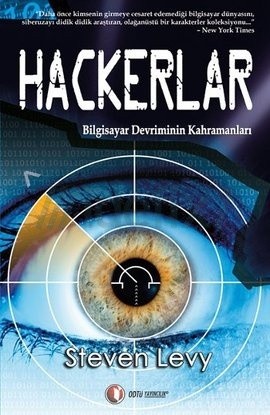
Hackers: Heroes of the Computer Revolution by Steven Levy is a 1984 science book about computing culture, hacker ethic, technology history. The hacker ethic — commitment to open access, judgment by technical merit, belief that information wants to be free — was formed at MIT in the 1960s and became the cultural foundation of the software industry.
Summary
Hackers: Heroes of the Computer Revolution is Steven Levy's account of the community of computer enthusiasts who drove the digital revolution from the late 1950s through the early 1980s — the original hackers of MIT's Tech Model Railroad Club and later AI lab, the hardware hackers of the Bay Area Homebrew Computer Club, and the software entrepreneurs who built the early PC industry. The book traces a culture and an ethic rather than a technology chronology.
The term "hacker" in Levy's usage has no criminal connotation. It means a person so passionate about computers that they will explore any system at any depth, finding elegant solutions to technical problems for the intrinsic pleasure of the craft. The hacker ethic, as Levy articulates it, holds that information wants to be free, that access to computers should be universal and total, that you can be judged only by your technical work, and that you can improve any system by taking it apart and rebuilding it better. This ethic, born in the MIT labs of the early 1960s, was countercultural and explicitly utopian.
The book follows the generations. The first generation — the MIT hackers — worked on room-filling mainframes, developed time-sharing systems, and built the early AI programs. The second generation — the hardware hackers around the Homebrew Computer Club in Silicon Valley in the mid-1970s — built the first personal computers. The third generation — the game hackers who built the early video game industry — made the first mass-market software.
Levy conducted many of the interviews himself and writes with obvious affection for the culture he's documenting. The book captures a specific moment before the commercialization of computing when the culture was small, idealistic, and genuinely revolutionary. It has been called the defining history of hacker culture and is frequently cited as a foundational text for understanding the origins of Silicon Valley and the open-source movement.
Talk to Hackers: Heroes of the Computer Revolution like its author wrote you back.
Get the ideas that fit your life — not generic summaries.
- Chat with the book
- Audiobook-style main ideas
- Adapts to your life and goals
- Helps you take action
Key takeaways
- 1.
The hacker ethic — commitment to open access, judgment by technical merit, belief that information wants to be free — was formed at MIT in the 1960s and became the cultural foundation of the software industry.
- 2.
The first hackers were not primarily interested in building useful tools. They were interested in the elegance of solutions and the experience of total mastery over a system.
- 3.
Personal computing emerged from hobbyist culture — particularly the Homebrew Computer Club — rather than from corporate R&D, which regarded personal computers as toys.
- 4.
The first personal computer software was a basic interpreter written by Bill Gates and Paul Allen for the Altair 8800. Its commercial distribution — which required users to buy rather than share it — was the first major conflict between the hacker ethic and commercial reality.
- 5.
Time-sharing — allowing multiple users to work on the same computer simultaneously through terminals — was a revolutionary idea that came from hacker culture before being adopted commercially.
- 6.
The MIT AI Lab culture was explicitly anti-hierarchical: any hacker could access any system, modify any program, and override any administrative decision if they had a good technical reason.
- 7.
Richard Stallman's founding of the GNU project and the free software movement was a direct response to the commercialization of software that ended the era of free sharing the MIT hackers had practiced.
- 8.
The best hackers were motivated by the intrinsic pleasure of craftsmanship and the respect of peers, not by money or external recognition — a motivation structure that produced extraordinary technical work.
Discussion questions
Use these on your own, with a book club, or as chat starters in Superbook. Book club version, ready to copy or print →
- 1.
The hacker ethic holds that information wants to be free. Does that principle still seem right in an era of intellectual property law and cybersecurity concerns?
- 2.
Levy argues that the best hacking is a form of craftsmanship and art. Does that characterization seem accurate to you, or does it romanticize what is ultimately a technical skill?
- 3.
The conflict between the original hacker culture and commercial software began with Gates's 1976 letter asking hobbyists to pay for his BASIC interpreter. Was he wrong?
- 4.
The Homebrew Computer Club was a community of enthusiasts who shared knowledge and schematics freely. Can that kind of community form around any technology, or was there something specific about personal computing in the 1970s?
- 5.
The MIT AI Lab was explicitly anti-hierarchical. What are the benefits and costs of that approach to organizing technical work?
- 6.
The book documents the transition from the hacker era to the commercial era. Was something valuable lost in that transition, or was commercialization the only way to get computers to everyone?
- 7.
Richard Stallman founded the free software movement in response to commercial restrictions on software. How has the free software / open source movement affected how we use technology today?
- 8.
The early hackers were almost entirely young white men. The book barely engages with that demographic uniformity. Does that reflect the time the book was written, or does it miss something important about the culture?
- 9.
Levy writes with obvious admiration for the hackers he profiles. Does that affection seem earned, or does it prevent him from seeing problems in the culture he's documenting?
- 10.
The hacker culture of the 1960s–70s is the direct ancestor of Silicon Valley culture. Which values from the original hacker ethic survived the transition to commercial tech, and which didn't?
- 11.
Do you think the original hacker ethic — open access, information freedom, judgment by technical merit — is compatible with running a large commercial company?
- 12.
The book was written in 1984, before the internet, the World Wide Web, and smartphones. Which subsequent development would most have interested the hackers Levy profiles?
Themes
Frequently asked questions
-
Does 'hacker' in this book mean someone who breaks into computers?
No. Levy is using the original meaning: a hacker is someone so passionate about computing that they explore any system deeply, looking for elegant solutions. The criminal connotation came later, partly from media coverage that conflated hacking with unauthorized computer access.
-
Is the book still accurate about the people it covers?
Substantially. Some of the personalities it profiles — Bill Gates, Steve Wozniak, Richard Stallman — became much more prominent after the book was written, and later accounts have modified or complicated Levy's portrayals. But the historical narrative has held up.
-
Is it a technical book?
No. It is a cultural and biographical history. Levy explains enough about what the hackers were doing to follow the narrative, but the book is fundamentally about people and values, not about how computers work.
-
What is the hacker ethic?
Levy articulates it as: information should be free; computers should be universally accessible; you should be judged by your code, not your background; systems can always be improved by taking them apart. This set of values drove the early computing culture and influenced the open-source movement.
-
Who are the most important figures in the book?
Richard Greenblatt and Bill Gosper at MIT, Steve Wozniak and Lee Felsenstein at Homebrew, and Richard Stallman across generations. Bill Gates appears as the antagonist — the person whose commercial letter about BASIC inaugurated the conflict between hacker culture and commercial software.
Similar books
The Innovators: How a Group of Hackers, Geniuses, and Geeks Created the Digital Revolution
Walter Isaacson

The Information: A History, a Theory, a Flood
James Gleick
Code: The Hidden Language of Computer Hardware and Software
Charles Petzold
Range: Why Generalists Triumph in a Specialized World
David Epstein
