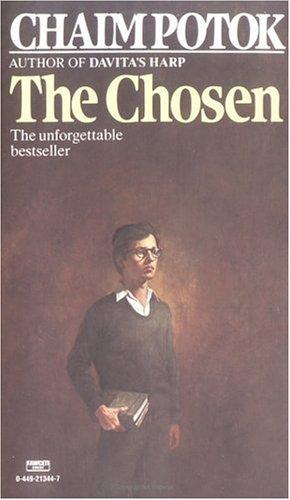
The Chosen by Chaim Potok is a 1967 religion & spirituality book about faith and doubt, father-son bonds, jewish identity. Potok presents religious tradition and intellectual openness not as opposites but as tensions that each community must negotiate differently.
Summary
The Chosen is set in Brooklyn in the 1940s and follows two Jewish boys — Reuven Malter, modern Orthodox and the son of a Talmud scholar, and Danny Saunders, the brilliant son of a Hasidic rebbe — who meet during a baseball game that turns violent and becomes an unlikely friendship. The novel tracks their relationship through World War II, the birth of the State of Israel, and the religious fractures those events opened inside Jewish communities.
At the center is one of the more unusual relationships in American fiction: Danny's father, Reb Saunders, raises his son in silence. He speaks to Danny only through Talmudic argument, never directly. Reb Saunders explains this near the end of the novel: a person cannot develop a soul unless they have suffered, and silence is the suffering he chose to give his prodigiously gifted son. This sounds brutal presented as a summary, but Potok treats it with complexity — the silence produces both a wound and, arguably, the depth of compassion the father intended.
Potok, himself a Conservative rabbi and scholar, writes from deep inside the world he describes without romanticizing it. The Hasidic and modern Orthodox communities are portrayed as genuinely different in their approach to learning, to secular culture, and to the Zionist project. These are not background details but the source of the novel's central tensions. Danny wants to study psychology at Columbia; his father expects him to inherit the leadership of a Hasidic dynasty. Reuven wants to become a rabbi; his father is a committed Zionist who believes the secular state of Israel is a religious imperative. None of these positions are simple.
The book is quiet by contemporary fiction standards — much of it is conversation and study — but the stakes feel high throughout. Potok takes seriously the idea that how you transmit a tradition matters as much as whether you transmit it, and that fathers who love their children can still cause them significant harm through the wrong kind of attention.
Talk to The Chosen like its author wrote you back.
Get the ideas that fit your life — not generic summaries.
- Chat with the book
- Audiobook-style main ideas
- Adapts to your life and goals
- Helps you take action
Key takeaways
- 1.
Potok presents religious tradition and intellectual openness not as opposites but as tensions that each community must negotiate differently.
- 2.
Danny's silence is Reb Saunders's attempt to give his son a soul — the conviction that compassion must be earned through suffering rather than explained.
- 3.
Friendship across significant religious and cultural difference requires both parties to hold their own convictions while genuinely engaging the other's.
- 4.
The birth of Israel divided American Jewish communities along lines that were both religious and generational. Potok does not resolve this — he portrays it.
- 5.
A father's love and a father's damage are not mutually exclusive. Reb Saunders is both a man who loves his son and one who has hurt him.
- 6.
Learning for its own sake — the Talmudic ideal — is put in genuine tension with learning as a path to secular competence. Both are treated as legitimate.
- 7.
The novel treats doubt as part of faith rather than its enemy. Reuven's father says a person without doubt cannot be fully honest.
- 8.
How a tradition is passed matters as much as what is passed. The novel is partly about the forms through which communities reproduce themselves.
Discussion questions
Use these on your own, with a book club, or as chat starters in Superbook. Book club version, ready to copy or print →
- 1.
Reb Saunders explains that he raised Danny in silence to give him a soul. Do you find that explanation convincing, or does it sound like a rationalization for a practice that caused harm regardless of intent?
- 2.
Reuven and Danny's friendship survives multiple ruptures, including a year of forced silence from Danny's father. What do you think makes a friendship durable enough to survive that kind of external pressure?
- 3.
The novel sets Hasidic Judaism against modern Orthodox Judaism as two different ways of inhabiting a tradition. What's the analog in your own community — religious or otherwise — between those who hold a tradition intact and those who adapt it?
- 4.
Potok's own biography includes leaving a Hasidic background for Conservative scholarship. How does knowing that affect how you read the novel's treatment of religious choice?
- 5.
Danny's genius is clear from early in the book. His father's plan for his life is equally clear. What responsibility do parents have to the ambitions of unusually gifted children?
- 6.
The novel is set during and just after World War II, with Holocaust news arriving gradually. How does the backdrop of mass death shape the debates about Jewish identity that the characters are having?
- 7.
Reuven's father, David Malter, is an outspoken Zionist who becomes physically ill from the effort of that cause. Do you admire his commitment or find it excessive?
- 8.
The Hasidic community in the novel is portrayed as wary of secular learning and Zionism. On the evidence of the book, what are they trying to protect, and are those things worth protecting?
- 9.
Silence as a parenting strategy is extreme, but the underlying idea — that discomfort produces depth — appears in milder forms in many approaches to raising children. Where do you draw the line between productive hardship and unnecessary harm?
- 10.
Potok writes very little about women. How does the novel's tight focus on fathers and sons shape what it can and cannot say about the world it describes?
- 11.
At the end, Danny chooses psychology over the rabbinate and Reuven chooses the rabbinate. Both disappoint someone. Have you made a choice that required disappointing someone you loved?
- 12.
The book was published in 1967. In what ways does it feel dated, and in what ways does it still read as contemporary?
Themes
Frequently asked questions
-
Is The Chosen based on a true story?
Not directly — it's a novel. But Potok drew extensively on his own experience growing up in Orthodox and Conservative Jewish communities in New York, and many of the tensions he describes between Hasidic and modern Orthodox Jews, and between American Jews and Zionism, were real and sharp in the 1940s.
-
How long does it take to read The Chosen?
Around five hours at average reading pace. The novel is 284 pages and moves steadily. It rewards slow reading because the theological conversations are substantive, but it's not dense in the way academic writing is.
-
What is The Chosen about?
Two Jewish boys from different religious traditions who become friends and navigate competing loyalties to their fathers, their communities, and their own intellectual and spiritual development, against the backdrop of World War II and the founding of Israel.
-
Who should read The Chosen?
Readers interested in Jewish history and culture, in coming-of-age fiction with genuine philosophical depth, or in novels about the relationship between fathers and sons. It's widely assigned in secondary schools, but adults who read it fresh — without the context of a required assignment — often find it more affecting.
-
Why does Danny's father raise him in silence?
Reb Saunders explains that he was afraid Danny's prodigious intellect would leave no room for his soul — for compassion and an awareness of other people's pain. Silence was his method of producing suffering sufficient to develop that capacity. It's a painful logic, but Potok presents it seriously rather than as simply abusive.