The Color of Magic by Terry Pratchett is a 1983 fantasy book about genre parody and subversion, incompetence and luck, tourist and native perspectives. Rincewind is one of fantasy fiction's great anti-heroes: definitively not the chosen one, constitutionally unsuited for adventure, and funny precisely because the narrative keeps shoving him into genre-heroic situations he refuses to play straight.
Summary
The Color of Magic is the first Discworld novel — but it is not where the series hits its stride, and Pratchett himself acknowledged this. Published in 1983, it is the novel in which he discovered what he was doing: a flat world balanced on the backs of four elephants standing on a great turtle, populated by gods, heroes, and wizards who are variously incompetent, corrupt, and entirely unaware that they are genre conventions come to life. The book follows Rincewind, a failed wizard who knows only one spell and uses it never, and Twoflower, the Discworld's first tourist — an earnest, perpetually cheerful insurance agent from a distant empire who insists on photographing everything with a device containing a small painter inside it.
The comedic engine of the book is the collision between Twoflower's genuine optimism and Rincewind's comprehensive cowardice, both of them moving through a world built from the bones of sword-and-sorcery fantasy and genre conventions that Pratchett dismantles with affection rather than contempt. The jokes work on two levels: pure farce — Rincewind's luggage chasing enemies on small wooden legs — and structural parody of heroic fantasy's assumptions, where the designated hero has no heroic qualities whatsoever and survives entirely through accident and the narrative contrivance he can sometimes sense pressing against him.
What distinguishes The Color of Magic from most fantasy parody is that Pratchett is not just pointing at the genre and laughing. There is a warmth and genuine love for what he is subverting that became clearer as Discworld expanded across 41 novels. The satire grows sharper, more political, and more emotionally serious in later books — Death becomes one of literature's most remarkable supporting characters; Granny Weatherwax develops into a genuine moral philosopher in wizard's clothing. In this first book the foundations are laid lightly: the worldbuilding is provisional, the humor is more carnivalesque than pointed, and the plotting is episodic almost to the point of picaresque.
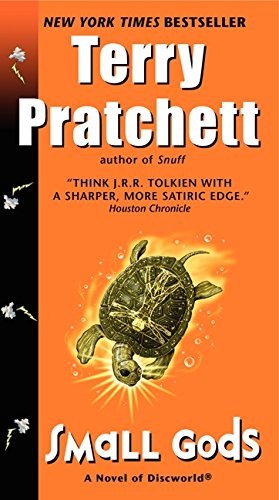
The Color of Magic is best read as the beginning of something rather than a complete thing. Readers who want Pratchett at his best should continue to Small Gods, Guards! Guards!, or Mort. Readers who want the pleasures of Discworld's origin — the first encounter with the world, the voice beginning to find itself — will enjoy this as exactly what it is: a writer discovering his universe and clearly having enormous fun doing so.
Talk to The Color of Magic like its author wrote you back.
Get the ideas that fit your life — not generic summaries.
- Chat with the book
- Audiobook-style main ideas
- Adapts to your life and goals
- Helps you take action
Key takeaways
- 1.
Rincewind is one of fantasy fiction's great anti-heroes: definitively not the chosen one, constitutionally unsuited for adventure, and funny precisely because the narrative keeps shoving him into genre-heroic situations he refuses to play straight.
- 2.
Twoflower functions as a satirical device: the naive outsider who sees the world's conventions clearly because he hasn't been taught to stop questioning them.
- 3.
The Discworld's magical logic — the way spells work, the nature of magic-users' institutions, the behavior of gods — is a sustained commentary on the genre conventions of 1980s fantasy fiction.
- 4.
Pratchett's humor in The Color of Magic is more verbal than philosophical; the denser moral satire that defines the later books is only beginning to emerge here.
- 5.
Death's cameos in this and subsequent Discworld novels eventually developed into one of the great sustained literary characters of the twentieth century — but that requires reading past this first book.
- 6.
The Luggage — Twoflower's sentient, murderous, loyal chest — is the series' most purely comic creation and one of its most beloved characters.
- 7.
The episodic structure reflects Pratchett's origins in short fiction and newspaper parody; later Discworld novels are much more tightly plotted.
- 8.
The Color of Magic established the physical and philosophical rules of Discworld — the flat world, the turtle, the multiple suns — that enabled 40 subsequent novels of increasing depth and complexity.
Discussion questions
Use these on your own, with a book club, or as chat starters in Superbook. Book club version, ready to copy or print →
- 1.
Rincewind is the designated protagonist but is conspicuously missing every quality traditionally associated with heroism. What does it mean to follow a coward through a heroic narrative? Does it change what you root for?
- 2.
Twoflower's optimism and inability to perceive danger is played for comedy, but it is also a sincere virtue in a world of cynics. Is the book more on his side than it initially appears?
- 3.
Pratchett is clearly satirizing 1980s sword-and-sorcery fantasy — Robert E. Howard, Michael Moorcock, Fritz Leiber. How much of that satire survives for readers who haven't read the source material?
- 4.
The gods of Discworld play games with mortal lives because they are bored. Is that funnier or more disturbing than the absent or indifferent gods of other fantasy traditions?
- 5.
The Color of Magic was the first Discworld novel but is widely regarded as not the best place to start the series. If you are reading it as an entry point, how does it compare to what you expected from what you'd heard about Discworld?
- 6.
Pratchett uses the footnote as a comic device throughout the series. How does the use of footnotes change the texture of the reading experience? Does it feel playful or disruptive?
- 7.
The world being flat and balanced on a turtle is played straight as a cosmological fact. What does it say about the genre that this feels entirely natural as a premise?
- 8.
Compare Rincewind's relationship with his own cowardice to other fantasy protagonists who define themselves against heroic conventions. Is his self-awareness about his own nature a form of honesty, or is it just abdication?
- 9.
Later Discworld novels use the comedic framework to address serious subjects — war, religion, gender, racism, death. Are there hints of that seriousness in this first book, or is it pure farce?
- 10.
Twoflower brings the concept of insurance to Discworld — the idea of betting against catastrophe. Pratchett uses this to satirize a particular modern economic mindset. Does that satire land, or does it feel dated?
- 11.
If you've read other Discworld novels, where does The Color of Magic fit in the overall arc of the series? If this is your first, does it make you want to continue?
Themes
Frequently asked questions
-
Is The Color of Magic the best place to start Discworld?
It is the chronological starting point but not where Pratchett's satirical voice fully develops. Many readers recommend starting with Guards! Guards!, Mort, or Small Gods instead, then reading The Color of Magic for context. If you want to begin at the beginning, it is enjoyable, but manage expectations: it is more picaresque comedy than the layered satire of the later books.
-
Do I need to read all 41 Discworld novels in order?
No. Pratchett organized Discworld into loosely connected sub-series — the Watch books, the Witches books, the Death books, the Rincewind books — each of which can largely be read independently. The books do reward reading in some order within each sub-series, but the overall sequence is not necessary.
-
What is Discworld about?
Officially, it is a satirical fantasy series set on a flat world. In practice, it is about being human — the humor is the delivery mechanism for observations about religion, politics, death, progress, and how societies work and fail. The comedy deepens into something more serious across the series.
-
Is the humor dated?
The 1980s sword-and-sorcery parody is more opaque to readers who haven't read the source material. But Pratchett's broader social satire — especially in the later books — ages very well, and much of his writing about human folly feels more current than when he wrote it.
-
Who might not enjoy The Color of Magic?
Readers who want a serious, plot-driven fantasy rather than comic picaresque. The book is primarily a vehicle for jokes and the plotting is loose. If the comedy lands for you, continue; if it doesn't, this is probably not the right series.