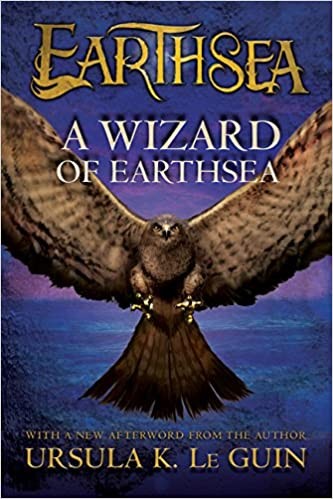
A Wizard of Earthsea by Ursula K. Le Guin is a 1968 fantasy book about shadow and self-knowledge, pride and its consequences, names and power. The shadow Ged releases is not an external enemy — Le Guin makes clear it is an aspect of himself he split off through pride, and that facing it requires confronting his own darkness rather than defeating it.
Summary
A Wizard of Earthsea is Ursula K. Le Guin's 1968 fantasy novel about Ged, a boy of exceptional magical talent from the island of Gont, who studies at a school for wizards and, through pride and competitive anger, unleashes a nameless shadow on the world. The book follows him across the Earthsea archipelago as he first flees and then turns to hunt the shadow — and the nature of what the shadow is, and what confronting it requires, is the novel's central revelation. It is short — under 200 pages — and one of the most precisely crafted books in fantasy literature.
Le Guin's cosmology is built around balance: the Equilibrium, the idea that every act of magic disturbs the natural order and must be weighed carefully. Ged's catastrophe comes from using magic for showing off — for proving himself against a rival — rather than in genuine need. The book is interested in the difference between power as self-assertion and power as responsibility, and it arrives at conclusions that feel genuinely Taoist in their orientation: the strongest action is often no action; the deepest knowledge begins with knowing yourself.
What makes the book endure is Le Guin's prose, which is spare and formal in the manner of myth without feeling archaic or cold. She is describing a world as a storyteller passing down a legend, not as a novelist immersed in character interiority, and the voice matches that register perfectly. The magic of true names — the idea that every thing has an essential name in the Old Speech that reveals and controls its nature — is not just a plot device but a philosophical claim about language and identity that runs throughout all six Earthsea books.
At under 200 pages, A Wizard of Earthsea is the right length. It does what it sets out to do and stops. Compared to the thousand-page epics that dominate contemporary fantasy, it can feel thin on first encounter — but the density of thought per page is higher than almost anything written since. It is appropriate for readers of all ages but especially rewarding for adults who come to it having accumulated the self-knowledge they didn't have when they were young.
Talk to A Wizard of Earthsea like its author wrote you back.
Get the ideas that fit your life — not generic summaries.
- Chat with the book
- Audiobook-style main ideas
- Adapts to your life and goals
- Helps you take action
Key takeaways
- 1.
The shadow Ged releases is not an external enemy — Le Guin makes clear it is an aspect of himself he split off through pride, and that facing it requires confronting his own darkness rather than defeating it.
- 2.
The system of true names — every person and thing having an essential name that gives power over it — is Le Guin's most enduring invention and a serious philosophical claim about language, identity, and power.
- 3.
Le Guin's Earthsea is built around balance rather than heroism: the right use of magic is conservation and precision, not display, and the greatest wizards are those who know when not to act.
- 4.
The novel's Jungian architecture is overt: the shadow is the Jungian Shadow, the self-knowledge required to integrate it is the Jungian individuation process. Le Guin was explicit about this influence.
- 5.
The prose voice — legendary, slightly impersonal, forward-moving — is a deliberate aesthetic choice that makes the book feel like it has always existed rather than been recently invented.
- 6.
Earthsea is a world of islands and seas where the protagonist is dark-skinned; Le Guin was making a statement in 1968 about whose stories get to be the important ones, and the book bears that intention visibly.
- 7.
The school for wizards at Roke is one of fantasy fiction's earliest and most influential versions of the magical academy, predating Hogwarts by nearly thirty years.
- 8.
The book's brevity is not a limitation: Le Guin understood precisely what she was writing and wrote exactly that, which is rarer and harder than it looks.
Discussion questions
Use these on your own, with a book club, or as chat starters in Superbook. Book club version, ready to copy or print →
- 1.
The shadow Ged releases is described as the dark side of himself — the fear, the anger, the pride that he refused to acknowledge. How does the book distinguish between having a shadow and being defeated by it?
- 2.
Ged's catastrophe comes from competing with a peer in a way that was reckless and unnecessary. Is the book saying that competition is always dangerous, or that there's a particular kind of competitive pride that is?
- 3.
The Equilibrium — Le Guin's idea that magic disturbs a natural balance — makes wizards cautious and conservative rather than heroic. How does that philosophical constraint change the feel of the fantasy?
- 4.
Le Guin wrote Earthsea with deliberately dark-skinned protagonists at a time when that was unusual for fantasy. Does knowing the intentionality behind that choice change how you read the book?
- 5.
The magic of true names carries a philosophical claim: knowing something's true name gives you power over it. What does Le Guin mean by that, beyond the literal plot mechanic? Is it a serious idea?
- 6.
The book is written in the register of myth — distant, formal, past-tense, legendary. How does that voice affect the experience compared to fantasy written in close third-person or first-person?
- 7.
At the end of the novel, Ged integrates his shadow rather than destroying it. What does that mean, practically? Is there an equivalent process in real life that the book is describing?
- 8.
The Earthsea sequence extends to six books and Le Guin significantly revised her thinking about gender and society in the later volumes. Does A Wizard of Earthsea feel dated in any way on its own terms?
- 9.
Ged's closest relationships in the book — with Vetch, with the Archmage — are defined by mutual respect rather than warmth or affection. How does Le Guin use those relationships to develop character?
- 10.
Compare A Wizard of Earthsea to other coming-of-age fantasy protagonists — Vin in Mistborn, Harry Potter, Lyra Belacqua. What does Le Guin do differently with the coming-of-age structure?
- 11.
The book is sometimes taught in schools as a young adult novel and sometimes shelved with adult literary fiction. Where does it actually belong? Does the distinction matter?
- 12.
If the core of the book is that self-knowledge is the precondition for real power, what does Le Guin think genuine self-knowledge looks like? Does the ending demonstrate it, or only point toward it?
Themes
Frequently asked questions
-
Is A Wizard of Earthsea a children's book?
It was originally published in a children's imprint and works beautifully for young readers. But it is a serious literary novel that rewards adult reading — its Jungian themes and philosophical argument about power and self-knowledge become richer with age. Most readers who return to it as adults find more in it than they did as children.
-
Do I need to read the full Earthsea series?
Each book stands largely on its own. The first three form a loose trilogy. Le Guin significantly revised her vision of Earthsea in the later books, particularly around gender. Reading the full series is rewarding but not required to appreciate the first book.
-
Why is this book considered a classic?
Because it does something that most fantasy does not: it uses the genre's conventions to work through a serious psychological and philosophical argument, and it does so with prose of unusual precision. It also appeared early enough to influence nearly everything that followed.
-
Is A Wizard of Earthsea hard to read?
No — it is one of the most accessible works in serious fantasy. The prose is clear and the plot is linear. The depth is not in complexity but in resonance; the book rewards reflection after reading more than careful attention during.
-
Who might not enjoy this book?
Readers who want action-heavy plot, elaborate world-building, or the kinetic pace of contemporary fantasy. The book is short, quiet, and mythologically paced. If the journey itself is less interesting than the world it moves through, this may feel thin.