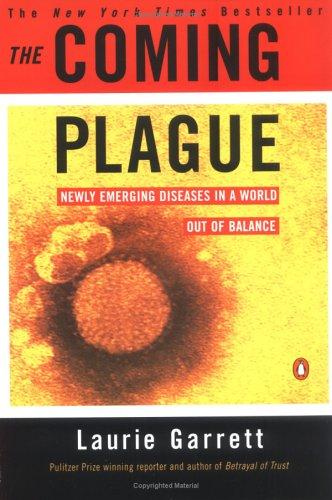
The Coming Plague by Laurie Garrett is a 1994 science book about emerging diseases, epidemics, public health. The 1960s optimism that infectious disease was essentially conquered was unfounded. The conditions for new epidemic pathogens were intensifying even as that optimism peaked.
Summary
The Coming Plague, published in 1994, is Laurie Garrett's argument that the era of conquest over infectious disease declared in the 1960s was a dangerous illusion, and that the conditions for catastrophic new pandemics were already in place. The book is enormous — nearly 750 pages — and covers an extraordinary range of outbreaks, pathogens, and public health failures across decades and continents. Garrett was a science journalist and had reported on many of the events she describes; the book reads like sustained investigative journalism with an epidemiological framework underneath.
The central argument is ecological and systemic. Garrett traces how deforestation, urbanization, antibiotic overuse, disrupted ecosystems, collapsing public health infrastructure in developing countries, and the HIV epidemic together created the conditions for new and dangerous pathogens to emerge and spread. She is not predicting a single specific event; she is describing a category of risk that follows from the intersection of these trends. The book was published the same year as The Hot Zone, and together they shaped a decade of public conversation about infectious disease risk.
Garrett devotes extensive attention to specific outbreaks: Ebola in Zaire, Lassa fever in Nigeria and Sierra Leone, Hantavirus pulmonary syndrome in the American Southwest, the resurgence of cholera in Latin America, and drug-resistant tuberculosis. Each chapter is dense with epidemiological detail, including the kind of fieldwork specifics — what the health workers were wearing, what the hospital conditions were, what the political pressures on public health officials looked like — that give the book its texture. She is consistently attentive to the institutional and political obstacles to effective response.
The most prophetic sections concern antibiotic resistance. Garrett argues at length that the combination of agricultural antibiotic use, overprescription in human medicine, and the economic disincentives to develop new antibiotics had created a trajectory toward untreatable bacterial infections. Three decades later, antimicrobial resistance is a recognized global health crisis and Garrett's analysis looks more accurate than prescient. The Coming Plague is long and dense enough that many readers will use it as a reference rather than reading cover to cover, but it rewards serious engagement.
Talk to The Coming Plague like its author wrote you back.
Get the ideas that fit your life — not generic summaries.
- Chat with the book
- Audiobook-style main ideas
- Adapts to your life and goals
- Helps you take action
Key takeaways
- 1.
The 1960s optimism that infectious disease was essentially conquered was unfounded. The conditions for new epidemic pathogens were intensifying even as that optimism peaked.
- 2.
Emerging infectious diseases follow ecological disruption. Deforestation, urbanization, and habitat fragmentation bring humans into contact with novel pathogens.
- 3.
Antibiotic resistance was already a foreseeable crisis in 1994. Agricultural overuse and economic incentives that discourage new antibiotic development created the trajectory.
- 4.
Collapsing public health infrastructure in developing countries — inadequate hospital conditions, reuse of needles, limited surveillance — creates the conditions for amplification of outbreak events.
- 5.
HIV demonstrated that a virus could move from a small reservoir population to pandemic scale over decades without triggering adequate response until millions were infected.
- 6.
Drug-resistant tuberculosis is among the most dangerous global health threats, and the social conditions that generate it — poverty, overcrowding, incomplete treatment — are structural.
- 7.
Effective outbreak response requires international cooperation and early detection. National public health systems acting in isolation are consistently inadequate.
- 8.
The economic incentives of pharmaceutical companies do not align with the public health need to develop treatments for diseases that predominantly affect poor populations.
Discussion questions
Use these on your own, with a book club, or as chat starters in Superbook. Book club version, ready to copy or print →
- 1.
Garrett published The Coming Plague in 1994. What did she get right, what did she overstate, and what did she miss?
- 2.
The book argues that antibiotic resistance was an emerging crisis three decades ago. Why has the response been so slow despite the warnings?
- 3.
Garrett traces how hospital conditions in resource-poor settings amplified several outbreaks. What would adequate international health infrastructure investment look like?
- 4.
She argues that the conquest-of-disease narrative of the 1960s was dangerous because it led to neglect of public health systems. Where do you see similar premature triumphalism today?
- 5.
The HIV sections argue that political and social taboos delayed response by years. What are the equivalent taboos that might delay response to the next pandemic?
- 6.
Garrett gives a lot of space to the economic disincentives for developing new antibiotics and treatments for tropical diseases. Is there a market solution to that problem, or does it require public funding?
- 7.
Which outbreak case in the book was most surprising to you? What made it surprising?
- 8.
The book is very long and extremely detailed. Is that the right format for a warning about systemic risk? What does the length cost you as a reader?
- 9.
How do you evaluate Garrett's claim that the conditions for a major pandemic were already in place in 1994? What would she need to be wrong about for that claim to fail?
- 10.
She emphasizes the role of ecological disruption repeatedly. Does that framing change how you think about environmental policy as a public health issue?
- 11.
The political obstacles to effective public health response appear in almost every case study. What makes public health such a politically difficult domain?
- 12.
Reading this book after COVID-19: which of Garrett's warnings most directly predicted what happened in 2020?
Themes
Frequently asked questions
-
Is The Coming Plague still worth reading?
Yes, particularly in light of COVID-19. Its argument about the structural conditions that produce pandemic risk has only become more relevant, and reading a 1994 warning that was largely ignored gives essential context for understanding why pandemic preparedness remains inadequate.
-
How long is The Coming Plague?
Nearly 750 pages, which is approximately fourteen to fifteen hours at average reading pace. It's one of the longer serious books in popular science. Many readers use it as a reference, reading specific outbreak chapters rather than cover to cover.
-
What makes The Coming Plague different from The Hot Zone?
Preston's Hot Zone is narrative-driven and focuses on a single outbreak cluster. Garrett's book is broader and more analytical, covering dozens of outbreaks across decades with a consistent structural argument. Hot Zone reads like a thriller; The Coming Plague reads like an investigation.
-
Who should read The Coming Plague?
People with serious interest in infectious disease epidemiology, public health policy, or global health. It rewards readers willing to engage with its length and density. Casual readers looking for a quick overview would be better served by a shorter book.
-
What is the most important warning in The Coming Plague?
Antibiotic resistance, arguably. Garrett's argument that the economic structure of pharmaceutical development was generating untreatable bacteria has proven accurate, and it's a slower-moving crisis than a dramatic outbreak — which makes it easier to ignore.