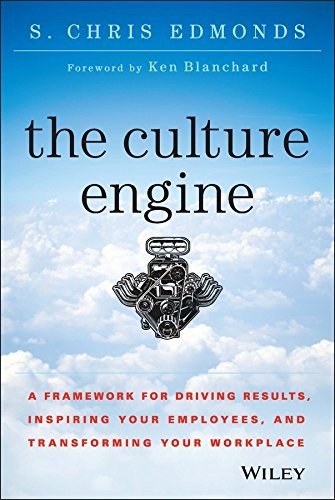
The Culture Engine by S. Chris Edmonds is a 2014 business book about organizational culture, leadership, values. Culture change requires more than values statements. Specific, observable behaviors must be defined and held consistently — not just posted on a wall.
Summary
The Culture Engine is S. Chris Edmonds' practical guide to building what he calls an "organizational constitution" — a documented set of purpose, values, strategies, and behaviors that gives teams a clear framework for how they work, not just what they produce. The book's central premise is that most organizations manage performance closely but leave culture to chance, and that the predictable result is environments where talented people underperform or leave because the implicit social rules are unclear, inconsistently enforced, or misaligned with the stated values.
Edmonds' key tool is the organizational constitution, which has four elements. The purpose statement defines why the team exists beyond producing revenue. The values and behaviors section gets specific — not just "we value integrity" but "we tell the truth even when it's uncomfortable" with observable behavioral examples. The strategies describe how the organization will achieve its goals. The goals define what winning looks like. The explicit behavioral standards are the part most organizations skip, and Edmonds argues this is where culture change actually happens: when specific behaviors are defined, modeled by leaders, and applied consistently.
The book is structured as a how-to guide more than an argument. Each chapter introduces a component of the constitution and walks through the process for building it, with examples from teams Edmonds has worked with as a consultant. The writing is direct and practical, aimed at managers and HR professionals who want to implement culture work rather than understand its theoretical foundations. It covers stakeholder buy-in, the mechanics of leader modeling, and how to align performance management with cultural standards.
The limitation is depth. The organizational constitution framework is useful and underused, but the book doesn't engage deeply with why culture change is so hard in practice — the psychological and political resistance that slows or kills most culture initiatives. Readers who want that dimension should pair this with Schein or Kotter. What The Culture Engine does well is give practitioners a concrete, workable template that is more specific than most culture books attempt.
Talk to The Culture Engine like its author wrote you back.
Get the ideas that fit your life — not generic summaries.
- Chat with the book
- Audiobook-style main ideas
- Adapts to your life and goals
- Helps you take action
Key takeaways
- 1.
Culture change requires more than values statements. Specific, observable behaviors must be defined and held consistently — not just posted on a wall.
- 2.
An organizational constitution has four components: purpose, values and behaviors, strategies, and goals. The behaviors section is what most organizations omit.
- 3.
Leaders must model the cultural behaviors they want to see before they can hold others accountable for them. Credibility comes from consistency, not proclamation.
- 4.
Culture that is left to develop informally will develop — but it will reflect the dominant behaviors of whoever has the most influence, which may not be the organization's stated values.
- 5.
Alignment between the stated culture and the managed performance systems is necessary. When recognition, promotion, and accountability contradict stated values, the real values are revealed.
- 6.
Employee engagement is not a program. It's an outcome of a clear and fair culture where people understand what's expected and see consistent consequences for behavior.
- 7.
The process of building the constitution matters as much as the content. Involving the team in defining shared behaviors creates ownership that top-down mandates can't produce.
- 8.
Holding behavioral standards consistently across levels is the single hardest and most important element. Exceptions for high performers or senior leaders corrode the entire system.
Discussion questions
Use these on your own, with a book club, or as chat starters in Superbook. Book club version, ready to copy or print →
- 1.
Does your team have explicit behavioral standards, or are the expectations implicit? What is the cost of that ambiguity?
- 2.
What is your organization's stated purpose, and does it actually explain why people show up for work rather than just what the company sells?
- 3.
Edmonds argues leaders must model the culture before managing it. Where do you see the biggest gap between what your leaders say and what they do?
- 4.
If you were to write the behavioral standards for your ideal team culture, what are the first three specific behaviors you would include?
- 5.
What happens in your organization when a high performer violates a cultural expectation? What does that response teach everyone else?
- 6.
Have you ever been part of building a team's shared purpose or values? What was gained by the process itself, separate from the output?
- 7.
Edmonds says culture change often fails because it stays at the level of values without reaching behavior. Where do you see that pattern in organizations you know?
- 8.
What recognition and reward systems in your organization currently reinforce behaviors that contradict the stated culture?
- 9.
If a new employee at your organization could only observe for a week before reading any culture documents, what would they conclude the culture actually is?
- 10.
The book focuses heavily on managers. What is the role of individual contributors in shaping team culture?
- 11.
What would it take to implement something like an organizational constitution in your current team, and what obstacles would you face first?
Themes
Frequently asked questions
-
Is The Culture Engine worth reading if I've read Good to Great or Drive?
Yes, because it operates at a more tactical level than either of those books. Where Good to Great and Drive explain what great cultures look like and what motivates people, The Culture Engine gives you a step-by-step process for documenting and managing cultural standards in a real team.
-
How long does it take to read The Culture Engine?
Around three to four hours. It's written for practitioners and reads quickly. The chapters are short and organized around implementation steps rather than theory.
-
What is an organizational constitution?
A documented framework with four elements: the team's purpose, its values stated as specific observable behaviors, its strategic approach, and its goals. Edmonds argues that documenting all four — and especially the behaviors — makes culture manageable in ways that vague values statements don't allow.
-
Who should read The Culture Engine?
Team leaders, managers, and HR professionals who want to make culture work tangible and measurable rather than aspirational. Most useful for people who already believe culture matters and want a practical implementation guide.
-
What does the book say about accountability?
That holding behavioral standards consistently — especially across levels — is the highest-leverage action a leader can take for culture. When senior people are exempt from the standards they've established, the culture collapses faster than if the standards had never been set.