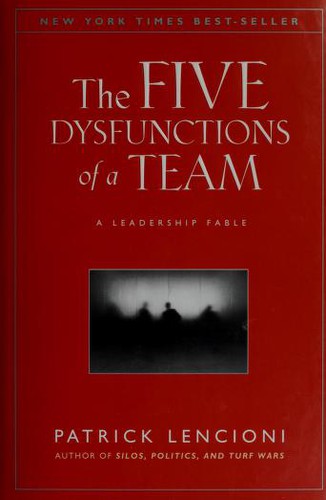
The Five Dysfunctions of a Team by Patrick Lencioni is a 2002 business book about teamwork, trust, leadership. The five dysfunctions — absence of trust, fear of conflict, lack of commitment, avoidance of accountability, inattention to results — form a cascade. Fixing the top without fixing the base doesn't work.
Summary
The Five Dysfunctions of a Team is Patrick Lencioni's argument that most teams fail not because of strategy, talent, or resources, but because of five specific, predictable behavioral problems that compound on each other. Lencioni delivers the argument through a business fable — a newly hired CEO named Kathryn takes over a struggling Silicon Valley technology company and spends the book diagnosing and working through team dysfunction with her leadership group. The fable format is deliberately simple, and the model that follows it is the real payload.
The five dysfunctions form a pyramid. At the base is absence of trust, which Lencioni defines not as reliability but as the willingness to be vulnerable with teammates — to admit mistakes, acknowledge weaknesses, and ask for help without fear. Without that foundation, teams avoid genuine conflict, which is the second dysfunction. Fear of conflict leads to artificial harmony: meetings where real disagreements never surface and decisions never get truly bought into, producing the third dysfunction, lack of commitment. Teams that won't commit can't hold each other accountable, the fourth dysfunction, and teams that avoid accountability ultimately lose sight of collective results in favor of individual status and departmental interest — the fifth dysfunction.
The model is coherent and the sequencing matters. Lencioni insists that you cannot shortcut to accountability if trust is broken, because the earlier dysfunctions make the later ones structurally inevitable. The fable illustrates each dysfunction with specific behaviors — a team member who dominates with technical expertise rather than engaging, executives who protect their own divisions in the quarterly review, offsite retreats that produce energy but no follow-through — that most readers will recognize immediately.
The book has real limits. The fable is thin as fiction, and the model is simple enough that some readers will find it underdeveloped compared to the academic literature on group dynamics and psychological safety. It works best as a diagnostic framework and a shared vocabulary for teams that already sense something is wrong. Lencioni's practical exercises — personal histories, team effectiveness exercises, real-time permission to name dysfunction — are more immediately useful than the underlying theory. For a management team trying to identify why their meetings feel hollow, the model is a productive starting point.
Talk to The Five Dysfunctions of a Team like its author wrote you back.
Get the ideas that fit your life — not generic summaries.
- Chat with the book
- Audiobook-style main ideas
- Adapts to your life and goals
- Helps you take action
Key takeaways
- 1.
The five dysfunctions — absence of trust, fear of conflict, lack of commitment, avoidance of accountability, inattention to results — form a cascade. Fixing the top without fixing the base doesn't work.
- 2.
Trust in Lencioni's model means vulnerability-based trust: the willingness to say 'I was wrong,' 'I need help,' or 'your idea is better than mine.' Reliability alone isn't enough.
- 3.
Healthy conflict is ideological and productive, not personal. Teams that avoid it produce artificial harmony where real decisions get made in the hallway rather than in the room.
- 4.
Commitment doesn't require consensus. It requires that everyone felt genuinely heard. A team can disagree and commit; what breaks commitment is unvoiced disagreement that festers.
- 5.
Peer accountability is more powerful than manager accountability. When teammates hold each other to shared standards, the pressure is more consistent and more credible than top-down enforcement.
- 6.
Attention to collective results means that team-level success takes priority over individual recognition or departmental metrics. Dysfunction sets in when executives optimize for their own division's numbers.
- 7.
The fable format makes the model immediately recognizable. Most readers will identify a real colleague or team meeting in Kathryn's leadership group before the halfway point.
- 8.
Simple models spread. The pyramid's value is partly that any team can hold all five dysfunctions in their head at once and use them as a shared vocabulary for naming what's going wrong.
Discussion questions
Use these on your own, with a book club, or as chat starters in Superbook. Book club version, ready to copy or print →
- 1.
Which of the five dysfunctions feels most present in a team you're currently part of? What specific behavior makes it visible?
- 2.
Lencioni defines trust as vulnerability, not reliability. Are there people on your team with whom you'd comfortably admit a mistake? What makes that safe or unsafe?
- 3.
Think of a recent meeting where the real disagreement never surfaced. What was the cost of that silence?
- 4.
Kathryn argues that teams can commit to a decision without full consensus. When have you seen that work? When does it fail?
- 5.
What does accountability look like on the best team you've been part of? Who enforced it, and how?
- 6.
Lencioni claims most executives protect their own department's results over the company's collective results. Where have you seen that trade-off made, even subtly?
- 7.
The model puts trust at the foundation. If trust is genuinely broken on a team, what would actually have to happen to rebuild it — not just say it's repaired?
- 8.
Personal history exercises and Myers-Briggs debriefs are Lencioni's first practical recommendations. Do you think knowing more about your teammates would change how you work with them?
- 9.
Think of a team with obvious talent and resources that underperformed. Looking at the five dysfunctions, which one was probably the root?
- 10.
Lencioni's fable shows a CEO driving culture change from the top. When dysfunction comes from the leader rather than the team, what changes about how you'd apply his model?
- 11.
How do you personally respond to being held accountable by a peer rather than a manager? Is that more or less uncomfortable, and why?
- 12.
The book was published in 2002. Which of its ideas feel more relevant now than they did then, and which feel more dated?
Themes
Frequently asked questions
-
What is The Five Dysfunctions of a Team about?
It's a business fable about a CEO who takes over a dysfunctional leadership team and uses a five-layer model to diagnose and repair what's broken. The five dysfunctions are absence of trust, fear of conflict, lack of commitment, avoidance of accountability, and inattention to results, each one making the next inevitable.
-
Is The Five Dysfunctions of a Team worth reading?
Yes, especially if your team already suspects something is wrong but hasn't named it. The model is simple enough to remember and apply immediately. If you want a rigorous theoretical treatment of team dynamics, look elsewhere — but as a shared vocabulary and diagnostic tool, it's unusually effective.
-
How long does it take to read The Five Dysfunctions of a Team?
Around four hours. The book is short by business standards — under 250 pages — and the fable format moves quickly. Most readers finish in a single sitting or across two evenings.
-
Who should read this book?
Managers and executives who sense their team is underperforming but can't put a finger on why. It's particularly useful for leadership teams preparing for an offsite or trying to reset after a period of conflict. Individual contributors looking for a framework to push upward will also find it useful.
-
What's the most actionable idea in the book?
The commitment clarity question: before leaving any meeting, name the decision that was made and who is responsible for it. Teams that can't answer that question cleanly almost always have a commitment problem, and naming it in real time is the first step to fixing it.