Psychology · Book club
The Design of Everyday Things book club questions
Here are 11 book club questions for The Design of Everyday Things by Donald Norman, ordered to open easily and end somewhere worth arguing about. Copy them, print them, or bring them up one at a time.
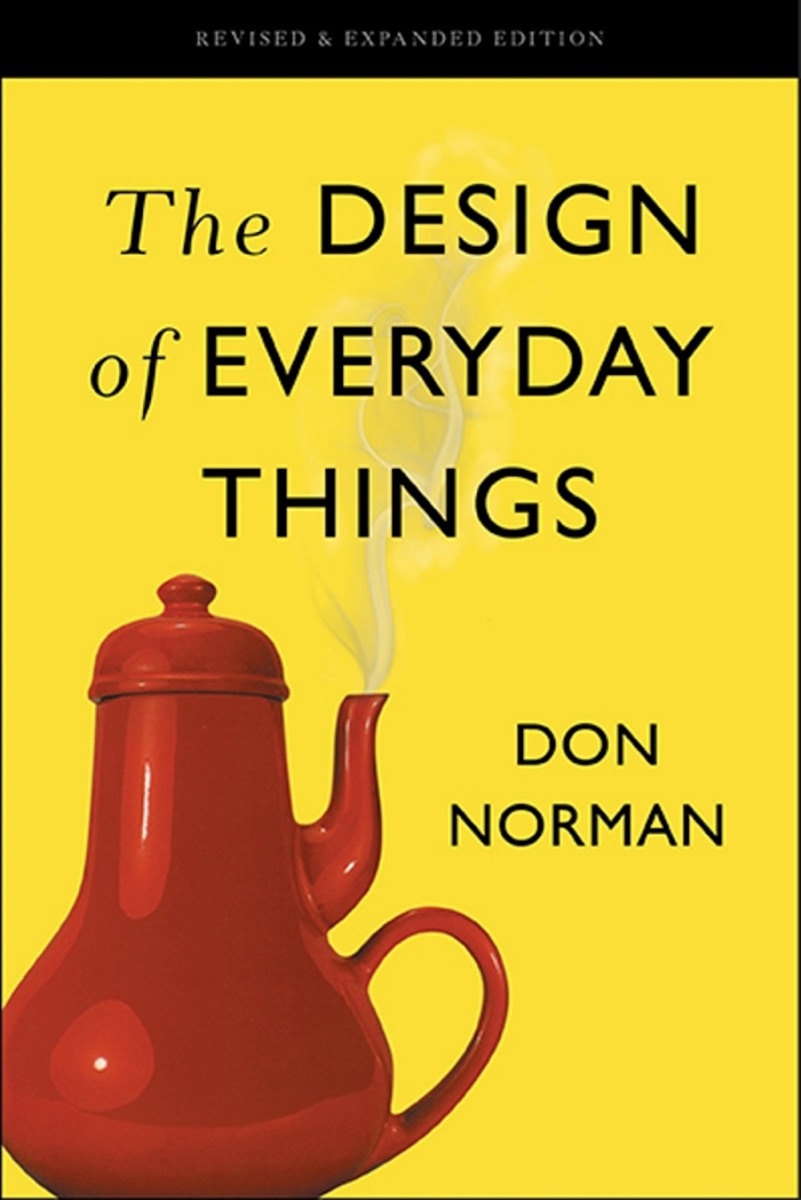
The Design of Everyday Things began as The Psychology of Everyday Things when first published in 1988, and Donald Norman revised it substantially for a 2013 edition that updated the examples for a digital age.
Donald Norman · 1988 · 5h 15m
Full summary and key takeaways →The 11 questions
- 1.
Norman argues that blaming the user for errors is almost always wrong. Think of a recent time you were frustrated by a product. Was the problem your error or a design failure?
- 2.
Pick one object in the room you're in. What affordances does it communicate? Does it have any false affordances — things that suggest it can do something it can't?
- 3.
Norman writes about 'doors that look like they should push but actually pull.' Where does your workplace or home have the equivalent of that design failure?
- 4.
How does the idea of conceptual models help explain the difficulty of learning new software? What conceptual model did you arrive with that turned out to be wrong?
- 5.
The book distinguishes slips from mistakes. In your own work, which kind of error do you make more often? How does the environment you work in help or hinder you?
- 6.
Norman updates the 1988 edition for the digital age. Where do you see the affordances framework applying — or breaking down — in app or software interfaces you use regularly?
- 7.
Feedback is one of Norman's key principles. Think of a digital interface that gives you good feedback versus one that gives you almost none. What's the difference in your experience of using them?
- 8.
Norman suggests that good design feels obvious in retrospect but is actually very hard to achieve. Can you think of a product that achieves this? What makes it work?
- 9.
The book's constraints chapter discusses physical, cultural, semantic, and logical constraints. Which type of constraint do you rely on most in the systems you use?
- 10.
Norman's framework is about everyday objects as much as digital interfaces. How does thinking about affordances and signifiers change how you look at physical objects in your environment?
- 11.
If you had to redesign one thing in your home or workplace using Norman's principles, what would you choose, and what would you change?
How to run the discussion
- Pick six to eight, not all of them. An hour of real discussion covers fewer questions than anyone expects, and racing the list is what makes a book club feel like homework.
- Open with what people noticed, not what they concluded. Asking for a verdict first hardens opinions before anyone has heard each other.
- Let the disagreement run. The questions below that split a room are the ones worth the time; the ones everyone answers the same way can be skipped.
- Ask the quiet person a specific question. A direct, narrow question is far easier to answer than an open invitation to contribute.
Themes worth steering toward
If the conversation stalls, these are the threads that usually restart it.
Common questions
What are good book club questions for The Design of Everyday Things?
Here are 11 book club questions for The Design of Everyday Things by Donald Norman, ordered to open easily and end somewhere worth arguing about. The strongest openers ask what each reader noticed rather than what they concluded, and the discussion usually turns on design, human-centered thinking, cognitive psychology.
How long should a book club discussion of The Design of Everyday Things last?
Most groups run 60 to 90 minutes of actual discussion. That is roughly six to eight questions, not all of them, so pick the ones that suit your group rather than working down the list in order.
What are the main themes in The Design of Everyday Things?
Design, Human-centered thinking, Cognitive psychology, Usability, Error and failure. Those are the threads most likely to divide a room, which makes them the useful places to steer a discussion that has gone quiet.
Picking the next one? See books like The Design of Everyday Things or questions for other book club picks.
