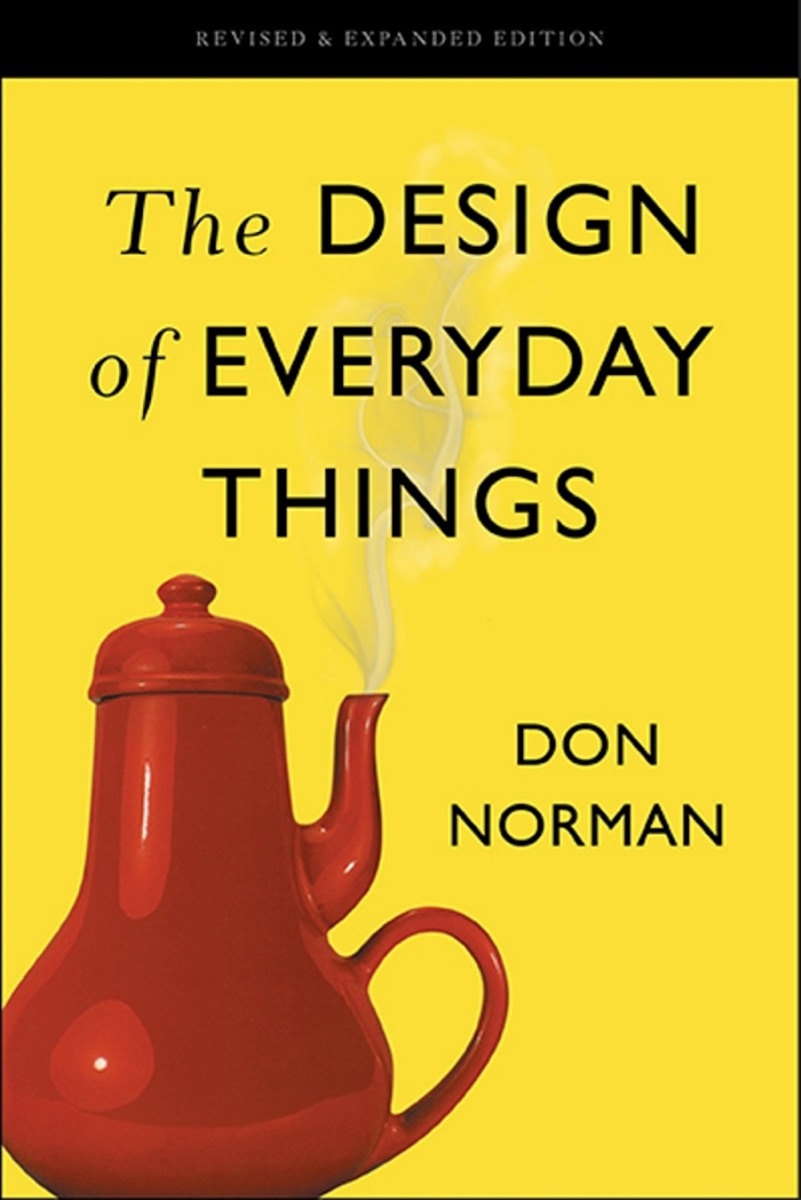
The Design of Everyday Things by Donald Norman is a 1988 psychology book about design, human-centered thinking, cognitive psychology. When a user fails to operate something correctly, the first question should be whether the design failed them, not whether they failed the design. Most errors are design problems in disguise.
Summary
The Design of Everyday Things began as The Psychology of Everyday Things when first published in 1988, and Donald Norman revised it substantially for a 2013 edition that updated the examples for a digital age. The argument has not changed: most design that frustrates users fails because designers blame the user for errors that are actually the designer's fault. When a door is pushed when it should be pulled, when an oven knob controls the wrong burner, when a software interface crashes a new user on their first attempt — these are design failures, not human failures.
Norman builds his argument on a set of core concepts from cognitive psychology. Affordances are the properties of an object that suggest how it can be used — a handle affords pulling, a button affords pressing. Signifiers are the cues that communicate these affordances. Feedback is the system's response that tells the user what just happened. Mental models are the user's understanding of how a system works, which may or may not match the actual system. Good design aligns these elements so that users can figure out how to operate something without instructions, and so that when things go wrong, the error is obvious and recoverable.
The most useful chapter for most readers deals with the nature of human error. Norman distinguishes slips (doing the wrong thing while intending the right thing) from mistakes (having the wrong intention). Most design tries to prevent slips by putting up barriers — locked menus, confirmation dialogs, warning labels. Norman argues this is the wrong approach. Better design makes wrong actions hard to take in the first place, makes the current state visible at all times, and makes errors reversible when they do occur.
The book influenced the entire field of human-computer interaction and is standard reading in design schools. Its weakness is the same as its strength: the concepts are simple enough to apply broadly, which means the book explains the same ideas in many examples across its length. First-time readers often find the middle sections repetitive. But the framework itself — affordances, signifiers, feedback, conceptual models, constraints, mappings — remains the most practical vocabulary available for thinking about whether something is well-designed or not.
Talk to The Design of Everyday Things like its author wrote you back.
Get the ideas that fit your life — not generic summaries.
- Chat with the book
- Audiobook-style main ideas
- Adapts to your life and goals
- Helps you take action
Key takeaways
- 1.
When a user fails to operate something correctly, the first question should be whether the design failed them, not whether they failed the design. Most errors are design problems in disguise.
- 2.
Affordances are the properties of an object that suggest how it can be used. A good handle tells you where to grab it. A well-designed button tells you it can be pressed.
- 3.
Signifiers make affordances perceivable. Good design communicates possibilities and constraints without requiring the user to read a manual.
- 4.
Conceptual models are the mental images users build of how a system works. The more closely the system's actual behavior matches those models, the easier it is to use.
- 5.
Feedback tells the user what just happened. Without feedback, errors compound invisibly. Good design responds immediately and clearly to every user action.
- 6.
Norman distinguishes slips (right intention, wrong execution) from mistakes (wrong intention). They call for different design responses — slips call for better controls, mistakes call for better information.
- 7.
Forcing functions and constraints are design's safety net. They make wrong actions physically impossible or highly inconvenient, rather than relying on the user to remember not to make them.
- 8.
The emotional dimension of design matters. An object that delights its user will be used more, tolerated more, and repaired rather than discarded. Aesthetics and usability are not in conflict.
Discussion questions
Use these on your own, with a book club, or as chat starters in Superbook. Book club version, ready to copy or print →
- 1.
Norman argues that blaming the user for errors is almost always wrong. Think of a recent time you were frustrated by a product. Was the problem your error or a design failure?
- 2.
Pick one object in the room you're in. What affordances does it communicate? Does it have any false affordances — things that suggest it can do something it can't?
- 3.
Norman writes about 'doors that look like they should push but actually pull.' Where does your workplace or home have the equivalent of that design failure?
- 4.
How does the idea of conceptual models help explain the difficulty of learning new software? What conceptual model did you arrive with that turned out to be wrong?
- 5.
The book distinguishes slips from mistakes. In your own work, which kind of error do you make more often? How does the environment you work in help or hinder you?
- 6.
Norman updates the 1988 edition for the digital age. Where do you see the affordances framework applying — or breaking down — in app or software interfaces you use regularly?
- 7.
Feedback is one of Norman's key principles. Think of a digital interface that gives you good feedback versus one that gives you almost none. What's the difference in your experience of using them?
- 8.
Norman suggests that good design feels obvious in retrospect but is actually very hard to achieve. Can you think of a product that achieves this? What makes it work?
- 9.
The book's constraints chapter discusses physical, cultural, semantic, and logical constraints. Which type of constraint do you rely on most in the systems you use?
- 10.
Norman's framework is about everyday objects as much as digital interfaces. How does thinking about affordances and signifiers change how you look at physical objects in your environment?
- 11.
If you had to redesign one thing in your home or workplace using Norman's principles, what would you choose, and what would you change?
Themes
Frequently asked questions
-
What is The Design of Everyday Things about?
It argues that most design that frustrates users is the designer's fault, not the user's. Norman uses concepts from cognitive psychology — affordances, signifiers, feedback, and mental models — to explain what makes something easy or hard to use, and how to do it right.
-
Is the 1988 edition or the 2013 revision better?
The 2013 revision is generally preferable. Norman updated examples to include digital interfaces and software, added material on emotional design, and corrected some terminology. The original introduced the term 'affordances' in a way that confused the field; the revision clarifies it.
-
Is The Design of Everyday Things only for designers?
No. It's most often assigned in design programs, but it's useful for anyone who builds products, writes software, manages processes, or creates systems that other people use. Engineers and product managers often find it as useful as designers.
-
What's the most memorable concept in the book?
The Norman door — a door that looks like it should push when it should pull. It's become a piece of design vocabulary for any interface that sends the wrong signal about how it works. Once you know the term, you spot Norman doors everywhere.
-
Does the book hold up after forty years?
The core framework holds up well. Some examples feel dated, and the digital chapters of the 2013 edition are already showing their age relative to current AI and voice interfaces. But the underlying principles about human cognition and error haven't changed.
Similar books
Thinking, Fast and Slow
Daniel Kahneman
Blink: The Power of Thinking Without Thinking
Malcolm Gladwell
Hooked: How to Build Habit-Forming Products
Nir Eyal
Indistractable: How to Control Your Attention and Choose Your Life
Nir Eyal
