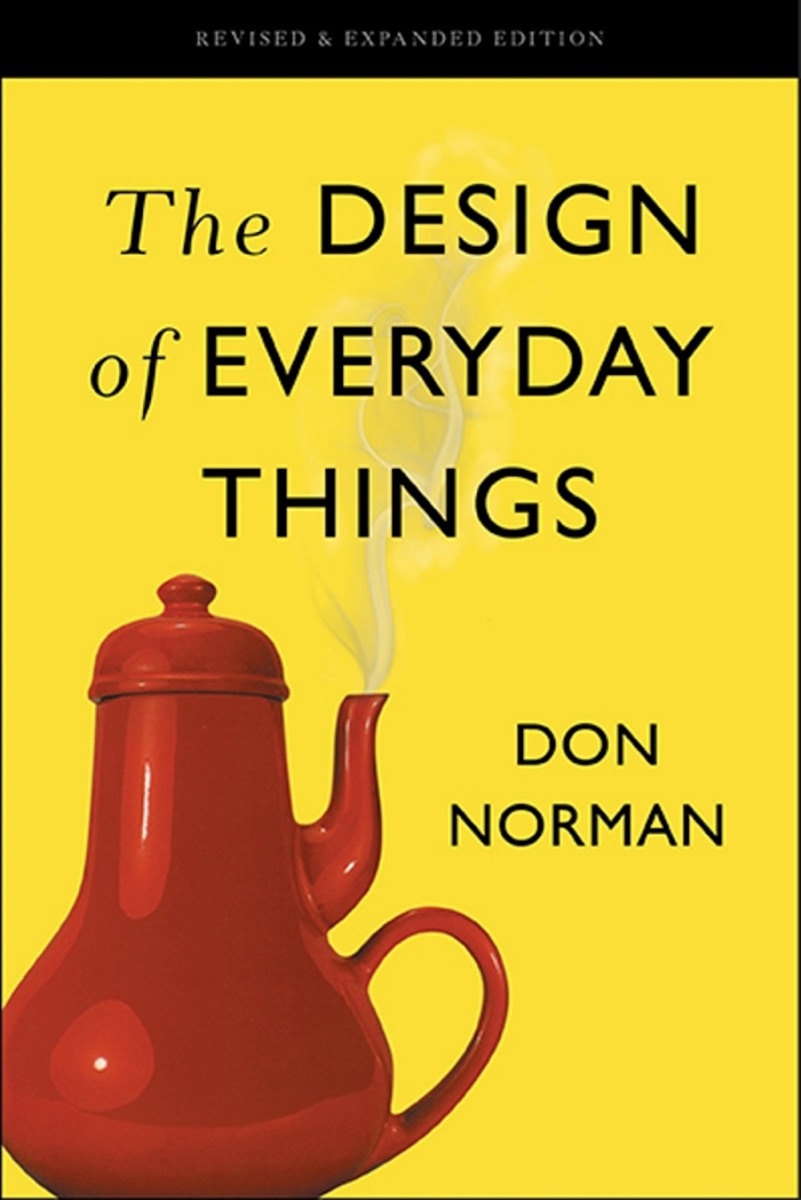
Talk to The Design of Everyday Things like its author wrote you back.
Get the ideas that fit your life — not generic summaries.
- Chat with the book
- Audiobook-style main ideas
- Adapts to your life and goals
- Helps you take action
What it argues
The Design of Everyday Things began as The Psychology of Everyday Things when first published in 1988, and Donald Norman revised it substantially for a 2013 edition that updated the examples for a digital age. The argument has not changed: most design that frustrates users fails because designers blame the user for errors that are actually the designer's fault. When a door is pushed when it should be pulled, when an oven knob controls the wrong burner, when a software interface crashes a new user on their first attempt — these are design failures, not human failures.
Norman builds his argument on a set of core concepts from cognitive psychology. Affordances are the properties of an object that suggest how it can be used — a handle affords pulling, a button affords pressing. Signifiers are the cues that communicate these affordances. Feedback is the system's response that tells the user what just happened. Mental models are the user's understanding of how a system works, which may or may not match the actual system. Good design aligns these elements so that users can figure out how to operate something without instructions, and so that when things go wrong, the error is obvious and recoverable.
What it gets right
- 1.
When a user fails to operate something correctly, the first question should be whether the design failed them, not whether they failed the design. Most errors are design problems in disguise.
- 2.
Affordances are the properties of an object that suggest how it can be used. A good handle tells you where to grab it. A well-designed button tells you it can be pressed.
- 3.
Signifiers make affordances perceivable. Good design communicates possibilities and constraints without requiring the user to read a manual.
What it covers
Who wrote it
Donald Norman is a cognitive scientist and design theorist who served as vice president of Advanced Technology at Apple and later co-founded the Nielsen Norman Group, one of the leading UX research consultancies. He taught at the University of California San Diego and held visiting positions at Harvard and other institutions. Originally a cognitive psychologist, Norman's work brought human factors and cognitive science into mainstream product design. The Design of Everyday Things, first published in 1988 and revised in 2013, is the most widely assigned text in design education and a foundational document of the human-centered design movement.
