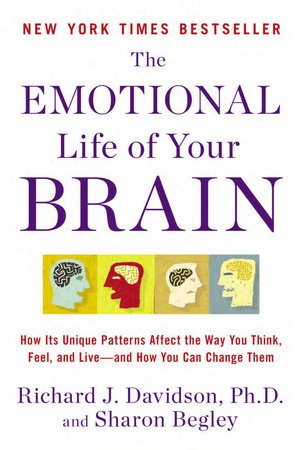
The Emotional Life of Your Brain by Richard J. Davidson and Sharon Begley is a 2012 psychology book about neuroscience, emotional style, brain plasticity. Emotional style — your stable, characteristic patterns of emotional response — has measurable neural signatures in specific brain circuits rather than being a purely psychological abstraction.
Summary
Richard Davidson spent decades in a field where discussing emotions in relation to brain science was considered soft and suspect. His early mentor told him directly that studying emotion would derail his career. Davidson persisted anyway, and the research program he built at the University of Wisconsin became one of the most productive in the history of affective neuroscience. This book, written with science journalist Sharon Begley, is his account of what he found and what it means for how people understand and can change their own emotional lives.
The central concept is emotional style: not the transient moods we experience but the stable, characteristic patterns by which individuals respond to emotional experience. Davidson identifies six dimensions — Resilience (how quickly you recover from adversity), Outlook (how long positive emotion persists), Social Intuition (how well you read social cues), Self-Awareness (how accurately you perceive your own emotional states), Sensitivity to Context (how well you modulate emotion to fit the situation), and Attention (how focused or scattered your attention is under normal conditions). Each dimension has a measurable neural signature, and each person has a characteristic position on each dimension — a profile that constitutes their emotional style.
The book's most significant scientific claim is that emotional style is not fixed. Davidson's research on neuroplasticity, including studies with long-term meditators and controlled trials of mindfulness and cognitive behavioral training, shows that the neural circuits underlying emotional style are plastic throughout life. The prefrontal cortex, hippocampus, amygdala, and their interconnections can change measurably in response to sustained mental practice. The Buddhist monk Matthieu Ricard, whose brain Davidson scanned repeatedly over years, provides some of the most striking data: long-term meditation appears to generate sustained shifts in prefrontal asymmetry associated with positive emotional tone, in a way that brief states of happiness do not.
Davidson is careful about what the plasticity findings do and don't imply. They do not mean that personality is infinitely malleable or that any meditation program will produce dramatic changes quickly. They mean that the brain's emotional circuitry is far more responsive to experience than the previous consensus held, and that deliberate mental practice aimed at specific dimensions of emotional style can produce real, lasting, and measurable effects. The book ends with practical suggestions for changing each of the six dimensions, mapped to what the neuroscience actually supports rather than to popular wellness mythology.
Talk to The Emotional Life of Your Brain like its author wrote you back.
Get the ideas that fit your life — not generic summaries.
- Chat with the book
- Audiobook-style main ideas
- Adapts to your life and goals
- Helps you take action
Key takeaways
- 1.
Emotional style — your stable, characteristic patterns of emotional response — has measurable neural signatures in specific brain circuits rather than being a purely psychological abstraction.
- 2.
Davidson identifies six dimensions of emotional style: Resilience, Outlook, Social Intuition, Self-Awareness, Sensitivity to Context, and Attention. Each has its own neurobiological substrate.
- 3.
Emotional style is distinct from personality, mood, and emotional disorder. It is the foundation from which moods and disorders arise, shaped by both genetics and experience.
- 4.
The brain circuits underlying emotional style are neuroplastic — they can and do change in response to sustained experience, including deliberate mental practice.
- 5.
Prefrontal asymmetry is one of Davidson's most replicable findings: greater left-side activation is associated with positive emotional tone and faster recovery from adversity; greater right-side activation with the opposite.
- 6.
Long-term meditators show measurably different neural responses to stress, pain, and positive stimuli — and the changes are proportional to lifetime hours of practice.
- 7.
Self-Awareness as an emotional style dimension refers specifically to how accurately your reported emotional states reflect actual physiological activation — some people are chronically out of sync.
- 8.
Targeted mental training — specific meditation practices, cognitive exercises, and behavioral interventions — can shift individuals' positions on specific dimensions of emotional style.
Discussion questions
Use these on your own, with a book club, or as chat starters in Superbook. Book club version, ready to copy or print →
- 1.
Davidson identifies six dimensions of emotional style. After reading his descriptions, where do you think you fall on each one, and does the profile feel accurate to your experience?
- 2.
The book argues that emotional style has neural signatures — that how you respond emotionally is a matter of brain structure as much as upbringing or character. How does that framing affect your sense of responsibility for your own emotional patterns?
- 3.
Davidson was told early in his career that studying emotion was not serious science. What fields or questions in your own domain are currently dismissed the way his work was, and do you think the dismissal is warranted?
- 4.
Resilience — how quickly you recover from adversity — is one of the six dimensions. What does your characteristic recovery time look like, and what conditions seem to lengthen or shorten it?
- 5.
The book distinguishes Self-Awareness as the accuracy of your self-perception about internal states, not just emotional vocabulary. Do you think your reported emotional states accurately track your actual physiological reactions?
- 6.
Davidson's plasticity findings suggest emotional style can change. If you could shift your position on one dimension in a useful direction, which one would it be and why?
- 7.
Matthieu Ricard's data — decades of meditation producing measurable and stable neural changes — is used as evidence for plasticity. Does that finding inspire or intimidate you?
- 8.
Sensitivity to Context is the ability to modulate your emotional responses appropriately to the situation. Where in your life are you worst at reading the social or situational requirements?
- 9.
The book distinguishes what the neuroscience supports from popular wellness culture. Are there mental health or mindfulness practices you've been sold that you think lack the evidence base Davidson describes?
- 10.
Davidson argues that Outlook — how long positive emotion lasts — is plastic and can be trained. What would it mean practically for your daily life if your baseline positive tone shifted upward?
- 11.
How does having six specific, independently variable dimensions change how you think about someone you know whose emotional style differs significantly from yours?
- 12.
If brain circuits change in response to sustained mental practice, what practices in your life are most likely changing your emotional circuits — in directions you'd choose if you were deliberate about it?
Themes
Frequently asked questions
-
What is emotional style?
Davidson's term for the stable, characteristic patterns by which individuals respond to emotional experiences. It has six dimensions, each with a measurable neural basis, and it underlies the more transient moods and emotions we notice from moment to moment.
-
Is The Emotional Life of Your Brain worth reading?
Yes, especially if you're interested in the neuroscience behind emotional experience. Davidson writes with intellectual honesty about what the research does and doesn't show, and the personal narrative about his career gives the science context that pure research summaries lack.
-
What are the six dimensions of emotional style?
Resilience, Outlook, Social Intuition, Self-Awareness, Sensitivity to Context, and Attention. Each dimension is independent, has its own neural signature, and is present at some point along a spectrum rather than as a binary category.
-
Can emotional style actually be changed?
Yes, according to Davidson's research. The brain circuits underlying emotional style are neuroplastic. Targeted practices — specific forms of meditation, cognitive training, and behavioral exercises — can shift people's positions on particular dimensions, with effects proportional to sustained practice.
-
Who should read this book?
People interested in how neuroscience and psychology intersect, anyone working on their own emotional patterns through therapy or meditation, and clinicians who want a research-based framework for thinking about stable emotional dispositions. The science is rigorous without requiring a neuroscience background to follow.
Similar books
Thinking, Fast and Slow
Daniel Kahneman
The Body Keeps the Score
Bessel van der Kolk
Behave: The Biology of Humans at Our Best and Worst
Robert M. Sapolsky

Incognito: The Secret Lives of the Brain
David Eagleman
