Psychology · Book club
The Emotional Life of Your Brain book club questions
Here are 12 book club questions for The Emotional Life of Your Brain by Richard J. Davidson and Sharon Begley, ordered to open easily and end somewhere worth arguing about. Copy them, print them, or bring them up one at a time.
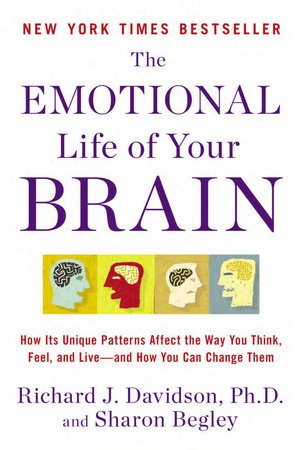
Richard Davidson spent decades in a field where discussing emotions in relation to brain science was considered soft and suspect.
Richard J. Davidson and Sharon Begley · 2012 · 5h 40m
Full summary and key takeaways →The 12 questions
- 1.
Davidson identifies six dimensions of emotional style. After reading his descriptions, where do you think you fall on each one, and does the profile feel accurate to your experience?
- 2.
The book argues that emotional style has neural signatures — that how you respond emotionally is a matter of brain structure as much as upbringing or character. How does that framing affect your sense of responsibility for your own emotional patterns?
- 3.
Davidson was told early in his career that studying emotion was not serious science. What fields or questions in your own domain are currently dismissed the way his work was, and do you think the dismissal is warranted?
- 4.
Resilience — how quickly you recover from adversity — is one of the six dimensions. What does your characteristic recovery time look like, and what conditions seem to lengthen or shorten it?
- 5.
The book distinguishes Self-Awareness as the accuracy of your self-perception about internal states, not just emotional vocabulary. Do you think your reported emotional states accurately track your actual physiological reactions?
- 6.
Davidson's plasticity findings suggest emotional style can change. If you could shift your position on one dimension in a useful direction, which one would it be and why?
- 7.
Matthieu Ricard's data — decades of meditation producing measurable and stable neural changes — is used as evidence for plasticity. Does that finding inspire or intimidate you?
- 8.
Sensitivity to Context is the ability to modulate your emotional responses appropriately to the situation. Where in your life are you worst at reading the social or situational requirements?
- 9.
The book distinguishes what the neuroscience supports from popular wellness culture. Are there mental health or mindfulness practices you've been sold that you think lack the evidence base Davidson describes?
- 10.
Davidson argues that Outlook — how long positive emotion lasts — is plastic and can be trained. What would it mean practically for your daily life if your baseline positive tone shifted upward?
- 11.
How does having six specific, independently variable dimensions change how you think about someone you know whose emotional style differs significantly from yours?
- 12.
If brain circuits change in response to sustained mental practice, what practices in your life are most likely changing your emotional circuits — in directions you'd choose if you were deliberate about it?
How to run the discussion
- Pick six to eight, not all of them. An hour of real discussion covers fewer questions than anyone expects, and racing the list is what makes a book club feel like homework.
- Open with what people noticed, not what they concluded. Asking for a verdict first hardens opinions before anyone has heard each other.
- Let the disagreement run. The questions below that split a room are the ones worth the time; the ones everyone answers the same way can be skipped.
- Ask the quiet person a specific question. A direct, narrow question is far easier to answer than an open invitation to contribute.
Themes worth steering toward
If the conversation stalls, these are the threads that usually restart it.
Common questions
What are good book club questions for The Emotional Life of Your Brain?
Here are 12 book club questions for The Emotional Life of Your Brain by Richard J. Davidson and Sharon Begley, ordered to open easily and end somewhere worth arguing about. The strongest openers ask what each reader noticed rather than what they concluded, and the discussion usually turns on neuroscience, emotional style, brain plasticity.
How long should a book club discussion of The Emotional Life of Your Brain last?
Most groups run 60 to 90 minutes of actual discussion. That is roughly six to eight questions, not all of them, so pick the ones that suit your group rather than working down the list in order.
What are the main themes in The Emotional Life of Your Brain?
Neuroscience, Emotional style, Brain plasticity, Well-being, Mindfulness. Those are the threads most likely to divide a room, which makes them the useful places to steer a discussion that has gone quiet.
Picking the next one? See books like The Emotional Life of Your Brain or questions for other book club picks.
