Science · Book club
The End of Everything (Astrophysically Speaking) book club questions
Here are 12 book club questions for The End of Everything (Astrophysically Speaking) by Katie Mack, ordered to open easily and end somewhere worth arguing about. Copy them, print them, or bring them up one at a time.
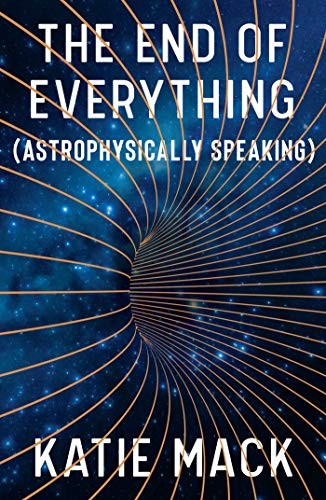
The End of Everything is cosmologist Katie Mack's tour through the five leading theories about how the universe will eventually cease to exist.
Katie Mack · 2020 · 4h 45m
Full summary and key takeaways →The 12 questions
- 1.
Mack presents five plausible endings without declaring one correct. How do you respond to genuine scientific uncertainty at this scale — as a puzzle to be solved, or as vertigo?
- 2.
The Heat Death scenario involves the universe becoming cold, dark, and inert over an unimaginably long timescale. Does contemplating that timescale change how you feel about anything on a human scale?
- 3.
Vacuum Decay could happen anywhere, at any moment, with no warning. How does a risk that is genuinely impossible to mitigate or detect change how you think about existential risk?
- 4.
Mack uses humor throughout a book about annihilation. Is that an appropriate tone, or does it feel like deflection? What tone would you prefer?
- 5.
The fact that we can calculate how the universe ends — despite being a tiny feature of it — strikes Mack as remarkable. Do you share that sense of wonder, or does the sheer scale make it hard to feel anything personal?
- 6.
Dark energy accelerates the expansion of space, but its physical nature is completely unknown. How comfortable are you with the fact that an unknown quantity drives the most important dynamical feature of the universe?
- 7.
Many of the end scenarios take place so far in the future that no current forms of life could survive. Does that make them irrelevant, or is there something worth caring about in knowing the shape of deep time?
- 8.
The book distinguishes between what physics rules out and what remains possible. In everyday reasoning, how do you handle the difference between 'impossible' and 'we don't know yet'?
- 9.
Mack describes cosmology as a field where the most interesting questions are genuinely unanswered. Which of the five end scenarios do you find most scientifically plausible and why?
- 10.
If Vacuum Decay occurred in a distant galaxy right now, we would have no warning until it arrived at light speed. How does the existence of undetectable, unavoidable threats change your intuitions about safety?
- 11.
The Bounce scenario suggests the universe might cycle through expansions and contractions. What would it mean for there to have been universes before ours?
- 12.
Mack is a working cosmologist writing for a general audience. Does knowing the author is an active researcher change how you read the uncertainty she describes?
How to run the discussion
- Pick six to eight, not all of them. An hour of real discussion covers fewer questions than anyone expects, and racing the list is what makes a book club feel like homework.
- Open with what people noticed, not what they concluded. Asking for a verdict first hardens opinions before anyone has heard each other.
- Let the disagreement run. The questions below that split a room are the ones worth the time; the ones everyone answers the same way can be skipped.
- Ask the quiet person a specific question. A direct, narrow question is far easier to answer than an open invitation to contribute.
Themes worth steering toward
If the conversation stalls, these are the threads that usually restart it.
Common questions
What are good book club questions for The End of Everything (Astrophysically Speaking)?
Here are 12 book club questions for The End of Everything (Astrophysically Speaking) by Katie Mack, ordered to open easily and end somewhere worth arguing about. The strongest openers ask what each reader noticed rather than what they concluded, and the discussion usually turns on cosmology, fate of the universe, astrophysics.
How long should a book club discussion of The End of Everything (Astrophysically Speaking) last?
Most groups run 60 to 90 minutes of actual discussion. That is roughly six to eight questions, not all of them, so pick the ones that suit your group rather than working down the list in order.
What are the main themes in The End of Everything (Astrophysically Speaking)?
Cosmology, Fate of the universe, Astrophysics, Dark energy, Entropy. Those are the threads most likely to divide a room, which makes them the useful places to steer a discussion that has gone quiet.
Picking the next one? See books like The End of Everything (Astrophysically Speaking) or questions for other book club picks.
