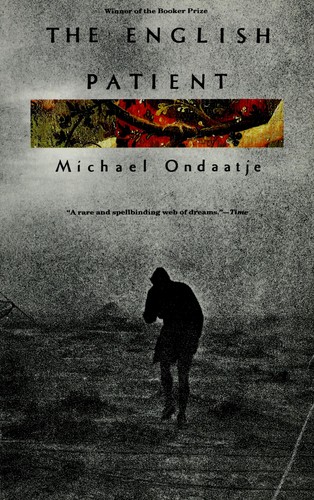
The English Patient by Michael Ondaatje is a 1992 literary fiction book about memory and identity, war's aftermath, love and obsession. The novel treats national identity as a kind of violence — the English patient's rejection of borders and nationhood is both his freedom and the source of the catastrophe he causes.
Summary
The English Patient is set at the end of the Second World War, in a damaged Italian villa north of Florence. A Canadian nurse named Hana tends to a severely burned man — the "English patient" — who is nearly unrecognizable and whose identity is unclear. Two other figures arrive: Kip, a young Sikh sapper defusing German bombs throughout the Italian countryside, who becomes Hana's lover; and Caravaggio, a Canadian thief turned spy with a personal connection to the damaged man. Over the course of the novel, through memory and story, the burned man's identity — and his catastrophic love affair in the North African desert before the war — is gradually revealed.
What the novel is doing beneath its plot is something more ambitious: examining how identity, nationality, and borders dissolve under the pressures of war and passion. The English patient has spent years mapping the desert — a landscape that resists the imperial impulse to name and claim — and he has had an affair that destroyed multiple lives. Ondaatje is interested in people for whom conventional belonging has become impossible: Hana, traumatized by loss; Kip, fighting for an empire that doesn't consider him its equal; Caravaggio, a man without a stable identity.
The prose is Ondaatje's most distinctive feature — lyrical, fragmented, non-linear, moving between timelines without warning in a way that mirrors the burned man's memory. Some sentences are close to poetry; the physical descriptions of desert geography are among the most unusual in English-language fiction. The novel won the Booker Prize in 1992 (sharing it with Barry Unsworth's Sacred Hunger) and was the basis for Anthony Minghella's 1996 film.
The English Patient is beautiful and demands slow reading — it can't be consumed like a plot-driven novel. The chronological jumps and lyrical density are features of its meaning, not obstacles to it. Readers expecting a straightforward war narrative or a conventional love story will be disoriented. Readers willing to be immersed in its particular atmosphere — part excavation of the past, part meditation on belonging — often find it unforgettable.
Talk to The English Patient like its author wrote you back.
Get the ideas that fit your life — not generic summaries.
- Chat with the book
- Audiobook-style main ideas
- Adapts to your life and goals
- Helps you take action
Key takeaways
- 1.
The novel treats national identity as a kind of violence — the English patient's rejection of borders and nationhood is both his freedom and the source of the catastrophe he causes.
- 2.
Ondaatje's non-linear structure enacts memory rather than just describing it: the reader reassembles the burned man's story in the same way the characters do, incompletely and out of sequence.
- 3.
The North African desert is more than setting — it's the novel's counter-symbol, a space that resists mapping, that undoes the imperial logic the characters are caught inside.
- 4.
Kip's position — a colonized subject fighting for the colonizing power — is the novel's sharpest political edge, and his final scene is its most explicit political statement.
- 5.
The love affair at the novel's heart is obsessive and destructive; Ondaatje doesn't redeem it as noble romance — it's love that burns everything around it.
- 6.
The villa is a space outside normal time — four people suspended between the war's logic and whatever comes next. Much of the novel's emotional power comes from that suspension.
- 7.
Each of the four major characters is marked by some form of mutilation or loss: the patient's burned body, Hana's grief, Caravaggio's hands, Kip's impossible position. The novel treats this as the condition war produces.
- 8.
The ending, particularly Kip's reaction to the bombing of Hiroshima, breaks the novel's lyrical spell deliberately — a rupture that asks whether the beauty of the preceding pages was a kind of avoidance.
- 9.
Ondaatje is a Sri Lankan-born Canadian writer, and the novel's concerns about belonging, rootlessness, and the violence of borders carry a biographical charge.
Discussion questions
Use these on your own, with a book club, or as chat starters in Superbook. Book club version, ready to copy or print →
- 1.
The English patient insists he has no nationality. Is that presented as liberation or self-delusion? The novel seems ambivalent.
- 2.
Kip's abrupt departure and the brief Hiroshima coda feel formally different from the rest of the novel. What is Ondaatje doing with that rupture?
- 3.
The love affair between Almásy and Katharine is destructive to everyone around them. Does the novel invite you to sympathize with it or to judge it?
- 4.
Ondaatje's prose is highly lyrical and fragmented. Did the style work for you, or did it feel like an obstacle to engagement with the characters?
- 5.
The novel circles around acts of mapping — literally, in the desert surveying, and metaphorically. What does mapping represent in the novel?
- 6.
Hana is arguably the novel's moral center — she is trying to care rather than destroy. Does she have enough interiority, or does she exist mainly to tend to the other characters?
- 7.
Caravaggio knows the English patient's identity before the reader does. What is the effect of that gap — knowing that he knows?
- 8.
The villa functions as a suspended space outside normal time and consequence. Have you encountered that structure in other novels? How does it work here?
- 9.
The novel won the Booker in 1992 and the film won nine Oscars in 1996. Does the film adaptation improve or diminish your experience of the book?
- 10.
Almásy's obsessive love destroys Geoffrey Clifton's life. The novel treats Clifton as almost a minor character. Is that a flaw?
- 11.
Ondaatje uses the desert as a space that resists imperial naming. Does that framing feel forced, or does it emerge naturally from the narrative?
- 12.
Reading The English Patient against Atonement or The Road — other novels about war and its aftermath — what does each novel most care about that the others don't?
Themes
Frequently asked questions
-
Is The English Patient worth reading?
Yes, if you're willing to read it on its own terms — slowly, attending to the prose as much as the plot. It's a novel where style and structure are inseparable from meaning. If you approach it expecting a linear war narrative or a conventional romance, you'll find it frustrating.
-
Is The English Patient hard to read?
The non-linear structure and lyrical density make it demanding. Timelines jump without warning, and the novel withholds the burned man's identity deliberately. It rewards slow reading and occasional rereading of passages. Most readers find it becomes easier — and more rewarding — as they settle into its rhythm.
-
How does the book compare to the movie?
The 1996 film (directed by Anthony Minghella, starring Ralph Fiennes and Kristin Scott Thomas) is acclaimed on its own terms but necessarily flattens Ondaatje's fragmentary structure and political complexity. Kip's role in particular is diminished. The book is richer and stranger; the film is more conventionally satisfying.
-
What is The English Patient actually about?
At surface level, four people in a damaged Italian villa at the end of the war, and a dying man's memories of a desert love affair. Beneath that, it's about identity, colonial mapping, belonging, and what war does to all of those.
-
Who shouldn't read it?
Readers who need a clear timeline, conventional dialogue tags, and narrative momentum will struggle. The novel is deliberately fragmented and lyrical. It also requires some tolerance for a central love affair that is morally troubling — the characters act destructively and Ondaatje doesn't fully indict them.