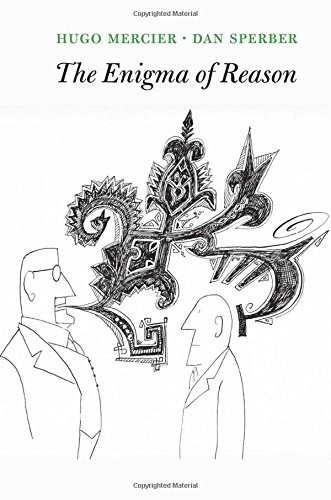
The Enigma of Reason by Hugo Mercier and Dan Sperber is a 2017 psychology book about reasoning, evolutionary psychology, cognitive bias. Reason evolved primarily as a social tool for argument and communication, not as a mechanism for individual belief formation or problem-solving.
Summary
The standard account of human reasoning treats it as a tool for individual problem-solving that happens to malfunction under certain conditions. Hugo Mercier and Dan Sperber propose a fundamentally different account: reason evolved not to help individuals think better alone but to help people argue with each other. Its primary function is social and communicative, not epistemic. This shift in frame recontextualizes what looks like a long list of cognitive defects.
The book's central concept is what they call the "argumentative theory of reasoning." Mercier and Sperber argue that most of the well-documented biases in human reasoning — confirmation bias, motivated reasoning, myside bias — are not bugs but features of a system designed to produce arguments for positions the reasoner already holds. This is useful in a social context: you need to be able to defend your views and evaluate others' arguments. The same faculty that makes us good at finding counterarguments to others' claims makes us bad at finding holes in our own.
The asymmetry is the key. Mercier and Sperber's research shows that people evaluate others' arguments with much more critical scrutiny than they apply to their own reasoning. In group contexts, this asymmetry can be productive: different participants come with different pre-existing positions, and the collective output of argument and counter-argument is often more accurate than any individual's initial view. The failure case is when everyone in a group shares the same prior — then motivated reasoning runs unchecked, and groups become more extreme rather than more accurate.
The Enigma of Reason is an academic book that reads like one. It's rigorous, thorough, and slow. Mercier and Sperber engage in detail with competing accounts of reasoning and the philosophical literature on rationality. Readers who want the core argument can extract it from the first third and the last chapter. Those willing to follow the full argument will find a genuinely novel account of a faculty usually taken for granted.
Talk to The Enigma of Reason like its author wrote you back.
Get the ideas that fit your life — not generic summaries.
- Chat with the book
- Audiobook-style main ideas
- Adapts to your life and goals
- Helps you take action
Key takeaways
- 1.
Reason evolved primarily as a social tool for argument and communication, not as a mechanism for individual belief formation or problem-solving.
- 2.
Confirmation bias and myside bias aren't malfunctions of a reasoning system that should be impartial. They're features of a system designed to advocate.
- 3.
People evaluate others' arguments more critically than their own. This asymmetry is what makes argument-based deliberation in groups potentially productive.
- 4.
Group reasoning only improves on individual reasoning when the group has genuine diversity of prior opinion. Homogeneous groups amplify rather than correct each other's errors.
- 5.
Epistemic vigilance — the tendency to evaluate claims from others with calibrated skepticism — is a separate cognitive capacity that evolved alongside reason.
- 6.
The failure mode of reasoning is not simply that individuals are biased. It's that the system produces accurate conclusions only under specific social conditions that aren't always present.
- 7.
Intuitions are not reasoning. Mercier and Sperber distinguish sharply between fast, non-inferential intuitions and the slow, justificatory process of reasoning. Both matter; they do different things.
- 8.
The book reframes rationality debates: the question is not whether humans are rational, but what reason is for. Once you know the function, the observed behavior makes sense.
Discussion questions
Use these on your own, with a book club, or as chat starters in Superbook. Book club version, ready to copy or print →
- 1.
If reason evolved to argue rather than to find truth, what does that suggest about how you should evaluate your own strongest convictions?
- 2.
Mercier and Sperber argue homogeneous groups amplify rather than correct errors. Can you identify a group you're part of where this is happening?
- 3.
Think of a time you changed your mind after a genuine argument with someone. What made the argument effective? Does the book's framework explain it?
- 4.
The book distinguishes intuitions from reasoning. Which do you trust more? In which domains does your intuition consistently outperform your reasoned analysis?
- 5.
If myside bias is a feature, not a bug, how do you practically compensate for it in decisions that matter?
- 6.
Mercier and Sperber suggest collective reasoning with diverse priors can outperform any individual. Have you experienced a group reaching a better conclusion than any member started with?
- 7.
Epistemic vigilance — calibrated skepticism toward others' claims — is described as a separate faculty. Do you think yours is well-calibrated? Where might it be over- or under-active?
- 8.
The argumentative theory implies that you should be more critical of your own arguments than your opponents' arguments. Is this actually achievable in practice?
- 9.
This book is dense and academic. How does the form of the argument — its exhaustiveness, its engagement with objections — itself demonstrate or illustrate the book's thesis about reasoning?
- 10.
If the book is right, what implications does it have for how schools should teach critical thinking? For how organizations should structure decisions?
- 11.
The book challenges the view that more information and better logic will fix political polarization. If reasoning is social and motivated, what would actually change minds at scale?
- 12.
Do you think the argumentative theory of reasoning is itself an example of the biases Mercier and Sperber describe — a theory that advocates for a position rather than merely explaining evidence?
Themes
Frequently asked questions
-
What is the central argument of The Enigma of Reason?
That human reason evolved as a tool for social argumentation rather than individual truth-finding. The biases associated with reasoning — confirmation bias, myside bias — are features of a system designed to advocate, not bugs in a system designed for accuracy.
-
Is The Enigma of Reason worth reading?
Yes, if you have patience for academic prose and are interested in the evolutionary and cognitive science of reasoning. The core thesis is genuinely novel and well-argued. Readers who want the argument without the full academic treatment can focus on the first several chapters and the conclusion.
-
Who should read The Enigma of Reason?
Cognitive scientists, philosophers, and anyone seriously interested in why humans reason the way they do. Also useful for practitioners working in deliberation, conflict resolution, or argumentation who want a rigorous grounding in how the faculty they're trying to harness actually operates.
-
How long is The Enigma of Reason?
Around 380 pages, roughly six hours at reading pace, but it rewards slower reading. It's an academic text that engages with competing theories in detail, so full comprehension takes longer than the page count suggests.
-
How does this book relate to Kahneman's Thinking, Fast and Slow?
They cover overlapping territory but reach different conclusions. Kahneman's dual-process framework treats System 1 as prone to error and System 2 (reasoning) as the corrective. Mercier and Sperber challenge this: they argue reasoning itself is motivated and social, so the framing of System 2 as a truth-seeker is misleading.
Similar books
Thinking, Fast and Slow
Daniel Kahneman
The Righteous Mind: Why Good People Are Divided by Politics and Religion
Jonathan Haidt

The Art of Thinking Clearly
Rolf Dobelli
You Are Not So Smart
David McRaney
