Amp It Up: Leading for Hypergrowth by Raising Expectations, Increasing Urgency, and Elevating Intensity by Frank Slootman is a 2022 business book about leadership, hypergrowth, organizational culture. Most organizations run far below their potential because they tolerate slow decisions, unclear accountability, and hiring standards that erode over time.
Summary
Amp It Up is Frank Slootman's account of how he approaches leading organizations through rapid growth. Slootman is one of the more unusual figures in enterprise software: he took ServiceNow from $100 million to $1.5 billion in revenue before leaving, then did the same at Snowflake, where he presided over the largest software IPO in history. The book is a direct, sometimes blunt account of what he believes separates organizations that execute consistently from those that don't. It is written as operational advice rather than a business memoir, though his experiences at ServiceNow and Snowflake run through every chapter.
The central argument is that most organizations are running at a fraction of their potential, not because of strategy failures but because of accumulated tolerance for mediocrity — slow decisions, vague accountability, low urgency, and hiring standards that drift downward over time. Slootman's prescription is to reset all of those defaults upward simultaneously. He calls this "amping it up": raising expectations, narrowing focus, accelerating the pace of decision-making, and holding leaders to a harder standard than most companies actually apply.
The book covers hiring with unusual directness. Slootman argues that most companies hire for potential and settle for adequacy, when they should be hiring for demonstrated excellence and be willing to live with positions open for months to find it. He extends this to the boardroom: directors who don't add value should go. The chapters on culture are less about values statements and more about what behaviors get rewarded, what behaviors get tolerated, and how quickly leadership acts when the gap between those two things grows.
Amp It Up is not a systematic framework — it's more like an extended argument from a specific kind of leader for a specific kind of operating philosophy. Slootman is explicitly not advocating for work-life balance or a gentle management style; his model requires high performers who want to move fast. Readers who lead smaller organizations, teams without growth mandates, or organizations with different cultural anchors will need to filter carefully. But for executives leading or joining high-growth companies, the book is one of the more honest accounts of what that environment actually demands.
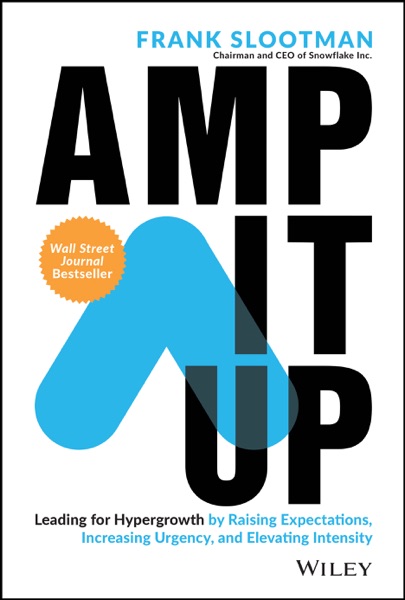
Talk to Amp It Up: Leading for Hypergrowth by Raising Expectations, Increasing Urgency, and Elevating Intensity like its author wrote you back.
Get the ideas that fit your life — not generic summaries.
- Chat with the book
- Audiobook-style main ideas
- Adapts to your life and goals
- Helps you take action
Key takeaways
- 1.
Most organizations run far below their potential because they tolerate slow decisions, unclear accountability, and hiring standards that erode over time.
- 2.
Amping it up means raising expectations, narrowing focus, and accelerating pace simultaneously — not picking one lever and hoping the others follow.
- 3.
Hire for demonstrated excellence, not potential. Hold positions open for months rather than fill them with candidates who are good enough.
- 4.
Mission alignment is more important than process: people who understand the mission and believe in it will solve problems that no process or management structure can anticipate.
- 5.
Focus relentlessly on the one or two things that actually determine whether the company wins or loses. Strategy that spreads effort across ten priorities is not strategy.
- 6.
Culture is not what organizations say about themselves — it is what they reward, tolerate, and remove people for. Most companies' stated values and actual cultures are far apart.
- 7.
Board members, like executives, should be evaluated on the value they add. A board that doesn't push hard on the right questions is a governance failure.
- 8.
Urgency is a leadership behavior, not a corporate policy. If the person at the top doesn't model it, the organization will default to the slower pace of whoever does.
Discussion questions
Use these on your own, with a book club, or as chat starters in Superbook.
- 1.
Slootman argues that most organizations run far below their potential. What specific examples from your own experience match that diagnosis?
- 2.
He says the fix is to raise expectations, narrow focus, and increase urgency simultaneously. Which of those three is hardest to change in your current organization, and why?
- 3.
Slootman advocates holding positions open for months rather than hiring someone who is merely good enough. What are the actual costs and risks of doing that in your context?
- 4.
His model assumes high performers who want to move fast. What kinds of people and organizations is his approach poorly suited for?
- 5.
Culture is what you reward, tolerate, and remove people for. Audit your own organization against that definition: where is the biggest gap between stated and actual culture?
- 6.
He is explicit that Amp It Up is not a model for work-life balance. How do you think about the tradeoff between the performance ceiling of a calm culture versus the burnout risk of a high-intensity one?
- 7.
What does focus actually mean at an organizational level? How do leaders decide what to remove from the priority list when adding a new one?
- 8.
Slootman was brought in as a turnaround CEO at both ServiceNow and Snowflake. How much of his approach depends on a mandate for change that most incumbent leaders don't have?
- 9.
He argues that boards need to be as demanding as the management they oversee. What would a more rigorous board culture look like in an organization you know?
- 10.
Urgency is described as a leadership behavior that propagates downward. What examples from your experience show how leadership pace — fast or slow — shapes the whole organization?
- 11.
The book is written from the perspective of a CEO with an unusual track record. How do you distinguish between advice that is genuinely transferable and advice that only worked in Slootman's specific context?
- 12.
If you could implement one idea from Amp It Up in your current role, what would it be, and what resistance would you expect to encounter?
Themes
Frequently asked questions
-
Is Amp It Up worth reading?
Yes, if you are leading or joining a high-growth organization and want an unusually direct account of what that requires. Slootman doesn't hedge his views or try to make the model comfortable. For readers in slower-moving organizations or roles where intensity is not the primary lever, the book is interesting but less actionable.
-
What is Amp It Up about?
It's Slootman's operating philosophy for leading high-growth companies: raise expectations, increase urgency, narrow focus, and hold everyone — including the board — to a higher standard than most organizations actually apply.
-
How does Amp It Up compare to other CEO leadership books?
More direct and less diplomatic than most. Slootman is not trying to be universally applicable or to avoid controversy. The closest comparisons are Ben Horowitz's The Hard Thing About Hard Things and Andy Grove's High Output Management — both similarly unhedged about what hard business decisions require.
-
Who should read Amp It Up?
CEOs, senior executives, and board members at high-growth or turnaround-stage companies. Also useful for anyone trying to understand why some organizations consistently execute faster than others. Less useful for managers in stable, mature organizations where pace is not the primary constraint.
-
How long does Amp It Up take to read?
About four hours. The chapters are short and direct; the writing is dense but not complex. Most readers can finish it in a single sitting or two short sessions.
Similar books
High Output Management
Andrew S. Grove
Measure What Matters
John Doerr
No Rules Rules: Netflix and the Culture of Reinvention
Reed Hastings and Erin Meyer

Blitzscaling: The Lightning-Fast Path to Building Massively Valuable Companies
Reid Hoffman and Chris Yeh
