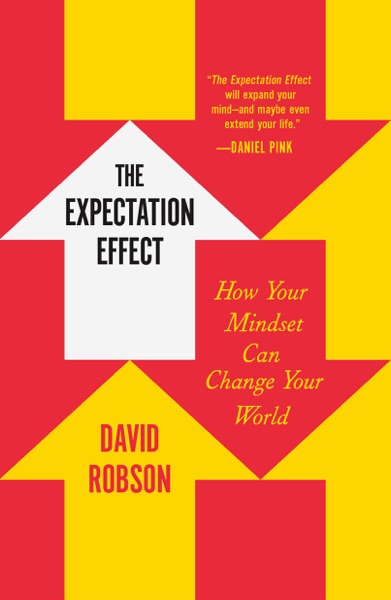
The Expectation Effect: How Your Mindset Can Transform Your Life by David Robson is a 2022 psychology book about mindset, placebo effect, self-fulfilling prophecy. Expectations change biology, not just attitude. What you believe about a treatment, a food, or a stressful situation alters the hormones, neurotransmitters, and immune responses your body actually produces.
Summary
David Robson's central argument is that expectations are not merely attitudes but biological agents. What you believe about a pill, a workout, or a social encounter changes the physiological response your body produces. Robson draws on a wide range of neuroscience and psychology research to show that expectation effects — including but not limited to the placebo effect — are pervasive and powerful enough to alter pain tolerance, immune function, stress hormones, and physical performance.
The book is organized around domains: sleep, aging, stress, food, medicine, and social relationships. In each domain Robson presents controlled studies showing that priming people with positive expectations reliably improves outcomes, while negative priming degrades them. The nocebo effect — the little-discussed mirror image of placebo — demonstrates that being told a treatment will cause side effects often causes those side effects to appear even when the treatment is inert. Fear and pessimism are not neutral; they produce measurable harm.
Robson is careful to distinguish between evidence-based expectation change and wishful thinking. He is not arguing for positive thinking as motivation, but for something more specific: accurate reappraisal. Many negative expectations are based on incorrect models — that stress is purely destructive, that aging means inevitable cognitive decline, that a placebo cannot help when you know it's a placebo. Updating these models with better information produces real biological changes, not just attitude shifts.
The practical implications are spread across the book in the form of research-backed reframings. Treating stress as a performance enhancer rather than a threat shifts the body from a defensive cortisol response toward one that aids action. Open-label placebos — pills patients know are inert — still reduce symptoms in clinical trials, suggesting the ritual of care itself matters. The book's weakest sections are those where Robson stretches the evidence to cover goal-setting and motivation, where expectation research is less conclusive. But the core neuroscientific case is solid and the writing is accessible without being reductive.
Talk to The Expectation Effect: How Your Mindset Can Transform Your Life like its author wrote you back.
Get the ideas that fit your life — not generic summaries.
- Chat with the book
- Audiobook-style main ideas
- Adapts to your life and goals
- Helps you take action
Key takeaways
- 1.
Expectations change biology, not just attitude. What you believe about a treatment, a food, or a stressful situation alters the hormones, neurotransmitters, and immune responses your body actually produces.
- 2.
The nocebo effect is as real as placebo. Being told a drug will cause nausea reliably produces nausea, even from an inert pill. Negative medical framing has measurable physiological costs.
- 3.
Open-label placebos still work. Clinical trials show patients who knowingly take a placebo experience symptom relief, suggesting the expectation of care triggers genuine healing responses independent of deception.
- 4.
Stress framing matters. People told to interpret stress arousal as helpful performance enhancement show better cognitive and physical results than those primed to see stress as damaging.
- 5.
Beliefs about aging shape aging. Older adults primed with positive age stereotypes score better on memory tests and show fewer fear-of-failure responses than those primed with negative stereotypes.
- 6.
Food expectations alter metabolism. Milkshakes labeled as high-calorie indulgences produced a stronger satiety hormone response than identical shakes labeled as low-calorie — the label changed what the body did.
- 7.
Accurate reappraisal beats positive thinking. The goal is not to be unrealistically optimistic but to replace inaccurate negative beliefs with correct models of how the body and mind actually function.
- 8.
Social expectations propagate. Teachers who are told students are high-potential treat them differently and those students perform better — not because of the students' abilities but because of the teacher's changed behavior.
Discussion questions
Use these on your own, with a book club, or as chat starters in Superbook. Book club version, ready to copy or print →
- 1.
Robson distinguishes expectation effects from wishful thinking. In which area of your life do you think you hold an inaccurate negative model that might actually be worth updating?
- 2.
Have you ever experienced what felt like a nocebo — a symptom or outcome you attribute partly to expecting it? What made that expectation feel credible at the time?
- 3.
The stress-as-enhancer reframe is one of the book's most actionable ideas. Does treating stress as preparation rather than damage feel psychologically honest to you, or does it feel like a rationalization?
- 4.
Open-label placebos working even when patients know they're placebos suggests the ritual and context of care matter. What does that imply about how medical consultations should be conducted?
- 5.
How much of your beliefs about your own aging, fitness ceiling, or cognitive capacity came from watching others rather than from your own experience? Are those models accurate?
- 6.
Robson cites research on sleep expectations — people who are told they slept poorly perform worse even when their sleep was fine. How much does your morning narrative about the previous night shape your actual function during the day?
- 7.
The book acknowledges that expectation effects work best when the underlying belief is plausible to the person holding it. What makes a reframe feel credible versus hollow?
- 8.
Teacher expectation effects suggest that the people around us shape our performance through how they treat us, not just how we think. Who in your life holds an expectation of you — positive or negative — that has actually changed what you do?
- 9.
Where do you think the evidence for expectation effects is strongest, and where does it start to feel overstated in the book?
- 10.
If you could change one belief you currently hold about your health or performance with certainty that the new belief is more accurate, what would it be?
- 11.
Robson argues that cultural narratives about stress, aging, and willpower are often based on flawed science. Which of those cultural narratives do you think has done the most damage?
- 12.
How would you design a medical consultation differently if you wanted to maximize the expectation effect for a patient?
Themes
Frequently asked questions
-
Is The Expectation Effect worth reading?
Yes, particularly for readers who are skeptical of positive-thinking literature. Robson grounds expectation effects in neuroscience and controlled trials rather than motivation, making this a more rigorous book than the genre usually produces. Some later chapters stretch the evidence, but the core thesis is well-supported.
-
How long does it take to read The Expectation Effect?
About five to six hours at average reading pace. The chapters are organized by life domain — sleep, stress, aging, medicine — so it works well read in sections with time to apply one idea before moving to the next.
-
What is the difference between placebo effect and expectation effect?
Robson treats placebo as a subset of expectation effects. Placebos work partly because the ritual of taking medicine creates expectations of improvement. The broader expectation effect covers all the ways beliefs about outcomes — from a workout to a meal to an aging process — alter what the body actually does.
-
Does The Expectation Effect claim you can think your way out of serious illness?
No. Robson is explicit that expectation effects modulate symptoms and recovery within a realistic range — they do not cure cancer or replace medication. The book's claim is more modest: negative expectations based on inaccurate models impose real costs, and correcting them produces measurable benefit.
-
Who should read The Expectation Effect?
Anyone in medicine, therapy, coaching, or teaching who communicates about health, performance, or potential would find the practical implications directly useful. General readers interested in how the mind-body connection works beyond clichés will also get a lot from it.
Similar books
Mindset: The New Psychology of Success
Carol S. Dweck
Stumbling on Happiness
Daniel Gilbert
Thinking, Fast and Slow
Daniel Kahneman
Behave: The Biology of Humans at Our Best and Worst
Robert M. Sapolsky
