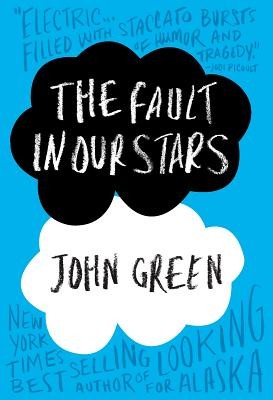
The Fault in Our Stars by John Green is a 2012 contemporary fiction book about mortality and illness, love and loss, meaning-making. The novel's central argument — that a life doesn't need to leave a permanent mark to have mattered — is taken seriously rather than resolved glibly.
Summary
Hazel Grace Lancaster is sixteen, has thyroid cancer that has spread to her lungs, and attends a cancer support group mostly to appease her parents. There she meets Augustus Waters, a seventeen-year-old former basketball player with osteosarcoma who is currently in remission. Their relationship — smart, funny, literary, and unsentimental about what both of them are actually facing — is the engine of a novel that sold over ten million copies and became one of the defining young adult novels of the 2010s.
What John Green is doing in The Fault in Our Stars is harder to dismiss than its YA classification might suggest. The novel takes mortality seriously — not as a backdrop for romance but as the actual subject. Hazel and Augustus are not Hallmark-movie cancer patients; they argue about whether a life needs to leave a permanent mark to matter, they worry about the people they'll leave behind, and they are angry in ways that don't resolve neatly. The novel's central philosophical question — does it matter if no one remembers you? — is borrowed from Peter Van Houten, the reclusive novelist they both worship, and the encounter with Van Houten is one of the better structural choices in the book.
Green writes in Hazel's voice, which is witty, self-aware, and occasionally too perfectly constructed for an anxious teenager. The novel is self-conscious about language and literature in ways that will appeal to readers who like their fiction to notice what it's doing, and irritate readers who find that pose mannered. The romance itself is affecting and handled with more delicacy than the marketing might suggest — Green is not interested in using illness as a cheap emotional shortcut.
This is a book that earns its tears but earns them honestly. Readers who resist YA categorically are usually surprised by it; readers who expect easy comfort will be frustrated. The comparison points are not other cancer novels but books about mortality and meaning: When Breath Becomes Air, The Year of Magical Thinking. The question Green asks — what does a life add up to, and does scale matter? — is a question for all ages.
Talk to The Fault in Our Stars like its author wrote you back.
Get the ideas that fit your life — not generic summaries.
- Chat with the book
- Audiobook-style main ideas
- Adapts to your life and goals
- Helps you take action
Key takeaways
- 1.
The novel's central argument — that a life doesn't need to leave a permanent mark to have mattered — is taken seriously rather than resolved glibly.
- 2.
Hazel's anxiety about being a 'grenade' who will hurt the people who love her is one of the most specifically observed emotional notes in the book.
- 3.
Augustus's preoccupation with heroism and legacy is shown as both touching and adolescent — the novel is clear-eyed about which of them has the more honest relationship with death.
- 4.
Peter Van Houten, the novelist they travel to Amsterdam to meet, is an extraordinary character: bitter, cruel, and ultimately more honest than the heroes.
- 5.
Green doesn't use cancer as a metaphor; it's the actual subject, and the medical specificity (oxygen tanks, PET scans, palliative care conversations) gives the novel weight.
- 6.
The literary self-consciousness — characters who talk about the books they love and what those books owe them — is both the novel's personality and its occasional affectation.
- 7.
The ending is genuinely not happy, and Green doesn't soften it. That honesty is what earned the novel its loyal readership.
- 8.
The title is from Julius Caesar: 'The fault, dear Brutus, is not in our stars / But in ourselves.' Green's novel argues the opposite — sometimes the fault is in the stars, and there is no one to blame.
Discussion questions
Use these on your own, with a book club, or as chat starters in Superbook. Book club version, ready to copy or print →
- 1.
Hazel argues that oblivion is inevitable and that this should shape how we value impact. Augustus wants to matter and leave a trace. Whose position do you find more defensible?
- 2.
Van Houten is a terrible person who may be more honest about mortality than the protagonists. How do you read his role in the novel — is he a cautionary tale or a corrective?
- 3.
Is Hazel's voice believably that of a teenager, or does she sound like a teenager written by a thirty-five-year-old novelist? Does it matter?
- 4.
The Amsterdam section — the wish, the trip, the meeting with Van Houten — is the novel's structural centerpiece. Did it pay off for you?
- 5.
Green doesn't give either character a miraculous cure or a sudden remission. Was that the right choice? What would the book have lost?
- 6.
How does this novel compare to a grief memoir like The Year of Magical Thinking in how it handles loss? What can fiction do that nonfiction can't here?
- 7.
Hazel worries she'll destroy Augustus by letting him love her. Is that a realistic fear or a form of self-protection?
- 8.
The novel is written in Hazel's first person. How much do we miss by not being inside Augustus's head?
- 9.
This is often described as a romance, but it might be more accurately described as a novel about death that happens to have a love story in it. Which framing fits better?
- 10.
The Genie support group and its attendees could easily be manipulative tearjerker material. How well does Green handle that risk?
- 11.
What does the title mean, and do you think it accurately describes the novel's argument?
- 12.
Who in your own life would benefit from reading this book, and why?
Themes
Frequently asked questions
-
Is The Fault in Our Stars worth reading as an adult?
Yes, if you can approach it without prejudice about YA fiction. The philosophical core — what does a life add up to? — is not age-limited, and Green handles mortality with more honesty than most books aimed at adults. Many adult readers who pick it up reluctantly end up genuinely affected.
-
Is The Fault in Our Stars manipulative?
It has the ingredients for emotional manipulation: teenage cancer, doomed romance, tragic ending. Whether Green executes it manipulatively or honestly depends on your tolerance for the genre. The difference, arguably, is that the characters are allowed to be angry and complicated rather than only noble.
-
Is there a movie adaptation of The Fault in Our Stars?
Yes. The 2014 film starring Shailene Woodley and Ansel Elgort was a major commercial success and is widely regarded as one of the better YA adaptations. Most readers who loved the book also liked the film, though the novel's interior monologue loses something in the transition.
-
Who shouldn't read The Fault in Our Stars?
Readers who are currently grieving a major loss and need safe reading material should know this is genuinely sad and does not resolve to comfort. Readers who find YA conventions — the precocious dialogue, the coming-of-age arc — exhausting will not be converted.
-
How accurate is the medical content in The Fault in Our Stars?
Green consulted with medical professionals and patients while writing. The specific cancers depicted, the treatments, and the emotional landscape of a cancer patient's daily life are generally considered accurate by readers who have lived through similar experiences.