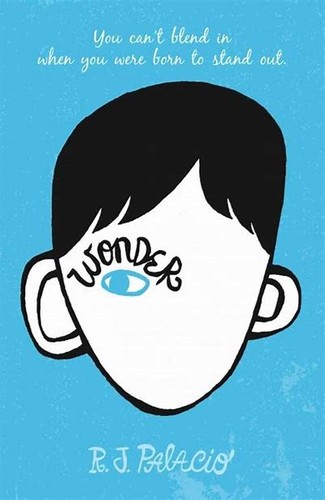
Wonder by R.J. Palacio is a 2012 contemporary fiction book about kindness and cruelty, belonging and difference, family and support. Kindness is not instinctive in the face of social pressure; it requires a specific choice, and the novel takes that choice seriously rather than treating it as easy.
Summary
Auggie Pullman is ten years old and about to start fifth grade at a private school in New York City. He has a facial difference — the result of a rare genetic syndrome — and has been homeschooled his entire life. Wonder follows his first year at Beecher Prep: the cruelties and the kindnesses, the complicated politics of middle school friendships, and the gradual way the community shifts around him.
The novel is structured in multiple voices — Auggie, his sister Via, his friends Jack and Summer, and others — which allows Palacio to show how the same events look different from different vantage points. Each narrator reveals something the others miss or misread, and the cumulative portrait is of an ordinary school community changed by contact with someone who can't hide his difference. The central argument is that kindness is a choice, not a disposition, and that choosing it in the face of social pressure is harder than it sounds.
Wonder works on its audience in ways that are direct and unembarrassed. Palacio is not interested in irony or ambiguity — she wants you to root for Auggie and to think about whether you'd be the person who sat with him at lunch. That directness is both the book's greatest strength and its limitation: the emotional beats are reliable and earned, but the world the novel depicts is ultimately reassuring in ways that real middle schools are not. The characters who are cruel are given enough humanity to complicate the picture, but they are also punished with sufficient tidiness to feel like a moral fable rather than a documentary.
This is a book that is frequently read by children in schools and just as frequently read by adults who want something moving and affirmative. It works for both audiences, though it works differently. For children it's a mirror or a window; for adults it's a reminder that the social dynamics of middle school, the way hierarchies form and cruelties get performed, are not trivial. Anyone who was once twelve will recognize the landscape.
Talk to Wonder like its author wrote you back.
Get the ideas that fit your life — not generic summaries.
- Chat with the book
- Audiobook-style main ideas
- Adapts to your life and goals
- Helps you take action
Key takeaways
- 1.
Kindness is not instinctive in the face of social pressure; it requires a specific choice, and the novel takes that choice seriously rather than treating it as easy.
- 2.
The multiple-narrator structure makes the novel more honest about how differently the same events register — Via's experience of being Auggie's sister is as fully drawn as Auggie's own.
- 3.
Facial difference as a subject forces questions the novel doesn't fully answer: what are we actually looking at when we stare, and what does our discomfort reveal about us?
- 4.
The middle school social world is rendered with enough fidelity that adult readers will find it visceral rather than quaint — the cruelties are recognizable.
- 5.
Palacio gives the bullies enough interiority to make them human without excusing them, which is harder to do than it looks.
- 6.
Via's experience — the sibling who is always slightly in the shadow of a child who needs more — is one of the novel's most underrated threads.
- 7.
The Beecher Prep community's gradual shift around Auggie tracks how moral change actually happens: slowly, through individual choices, not through announcements.
- 8.
The ending is sentimental but earned — it lands because Palacio has done enough work to make you want the payoff.
Discussion questions
Use these on your own, with a book club, or as chat starters in Superbook. Book club version, ready to copy or print →
- 1.
Palacio said she wrote the book after an encounter at an ice cream shop where she handled her own discomfort around a child with a facial difference badly. Does knowing that origin story change how you read it?
- 2.
The multiple-narrator structure includes Jack, Summer, Via, and others. Which narrator gave you the most information you couldn't have gotten from Auggie's perspective alone?
- 3.
Via is the child who doesn't get her parents' full attention because her brother needs more of it. How does the novel treat her resentment — honestly or too neatly?
- 4.
Julian the bully is eventually given backstory that explains his cruelty. Does that explanation satisfy you, or does it feel like the novel letting him off too easily?
- 5.
The school's principal takes Auggie's situation seriously from the beginning. Is that realistic, and does it matter to the novel whether it is?
- 6.
Wonder is frequently assigned in schools as an anti-bullying text. Does that framing help or limit what the book can do?
- 7.
How does this novel compare to The Curious Incident of the Dog in the Night-Time as a portrait of a child navigating a world that wasn't built for them?
- 8.
Auggie's parents are supportive, present, and effective. How much of his success depends on that support? What happens to children who don't have it?
- 9.
The ending ceremony involves an explicit reward for kindness. Did that feel earned or forced to you?
- 10.
Palacio chose to write Auggie's face as undescribed — we get impressions from how others react, not a clinical account. Was that the right choice?
- 11.
Who in the novel do you think was actually the bravest, and why?
- 12.
Would this story work if Auggie were a teenager rather than a ten-year-old? What would change?
Themes
Frequently asked questions
-
Is Wonder appropriate for adults or just children?
Both. It's most commonly read by children ages eight to twelve, but adult readers regularly report being moved by it. The subject matter — what it means to grow up different, how communities form around exclusion — applies across ages. The sentimentality that some adult readers flag as a limitation is what makes it work for younger readers.
-
Is Wonder based on a true story?
Not directly. Palacio was inspired by a real encounter with a child who had a facial difference, but Auggie Pullman is a fictional character. The syndrome depicted is loosely based on Treacher Collins syndrome, though Palacio has noted it is not precisely accurate.
-
Is there a movie adaptation of Wonder?
Yes. The 2017 film starring Jacob Tremblay as Auggie and Julia Roberts and Owen Wilson as his parents was a box office success and received strong reviews. Most readers who love the book also enjoy the film, though the novel's multiple-narrator structure is somewhat compressed in the adaptation.
-
Who shouldn't read Wonder?
Adult readers looking for moral complexity, ambiguity, or dark territory should look elsewhere. The novel's emotional world is essentially affirmative — things work out, kindness wins, the community heals. That's a feature for its intended audience and a limitation for readers who want fiction that doesn't resolve.
-
What is the 'choose kind' message in Wonder?
Throughout the novel, characters reference choosing kindness as an active decision rather than a passive default. The phrase 'choose kind' became something of a cultural touchstone after the book's publication, appearing on school posters and merchandise. Palacio has said it emerged organically from the story rather than being engineered as a slogan.
Similar books
The Curious Incident of the Dog in the Night-Time
Mark Haddon
The Outsiders: Eight Unconventional CEOs and Their Radically Rational Blueprint for Success
William N. Thorndike
A Wrinkle in Time
Madeleine L'Engle
Educated: A Memoir
Tara Westover
