Psychology · Book club
The Fear Factor: How One Emotion Connects Altruists, Psychopaths, and Everyone In-Between book club questions
Here are 12 book club questions for The Fear Factor: How One Emotion Connects Altruists, Psychopaths, and Everyone In-Between by Abigail Marsh, ordered to open easily and end somewhere worth arguing about. Copy them, print them, or bring them up one at a time.
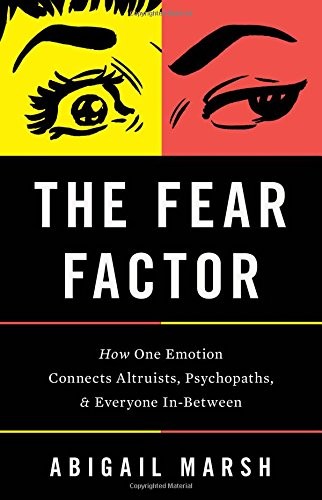
Abigail Marsh is a Georgetown neuroscientist who studies why some people are extraordinarily altruistic and others are not.
Abigail Marsh · 2017 · 4h 45m
Full summary and key takeaways →The 12 questions
- 1.
Marsh argues that extraordinary altruism is partly a function of neurological calibration rather than exceptional character. Does that reduce your admiration for unusually altruistic people, or change it in a different direction?
- 2.
The book suggests that people who show low empathy for others' fear are not choosing to be indifferent — the signal simply doesn't register the same way. How should that understanding change how we respond to people who seem callous?
- 3.
If altruism is rooted in automatic fear-recognition systems, what does that imply about how we try to encourage charitable behavior through campaigns that emphasize facts and statistics rather than emotional appeals?
- 4.
Marsh distinguishes between empathic concern — feeling motivated to help — and personal distress — feeling overwhelmed by others' suffering. Have you experienced both? Which is more characteristic of how you typically respond to others' fear or pain?
- 5.
The amygdala's role in processing both self-directed fear and socially directed fear signals suggests these systems are deeply intertwined. Do people who are personally fearless seem less responsive to others' fear in your experience?
- 6.
Marsh's extraordinary altruists don't describe their kidney donations as heroic — they genuinely didn't find it that difficult. What does that suggest about how we identify and cultivate altruism in society?
- 7.
The book implies that psychopathy is at one end of a normally distributed trait, with extraordinary altruism at the other. Where do most people fall, and is the distribution actually symmetrical?
- 8.
Marsh's research focuses heavily on the amygdala, but she acknowledges it is one node in a complex system. How much does reducing complex social behavior to single brain regions help versus obscure understanding?
- 9.
What does the neuroscience of fear recognition imply about moral education — is teaching children to recognize and respond to others' fear more important than teaching them rules about right and wrong?
- 10.
Marsh became a researcher partly through a near-death experience involving a stranger who helped her without hesitation. How much do you think direct exposure to extreme altruism shifts people's behavior toward altruism themselves?
- 11.
If you could identify the amygdala responsivity level of job candidates for roles like law enforcement, medicine, or finance, would you want to? What would be the problems with that?
- 12.
The book ends with an implicit argument for human goodness. Does the evidence Marsh presents feel reassuring, or does the contingency of goodness on neurological calibration seem fragile?
How to run the discussion
- Pick six to eight, not all of them. An hour of real discussion covers fewer questions than anyone expects, and racing the list is what makes a book club feel like homework.
- Open with what people noticed, not what they concluded. Asking for a verdict first hardens opinions before anyone has heard each other.
- Let the disagreement run. The questions below that split a room are the ones worth the time; the ones everyone answers the same way can be skipped.
- Ask the quiet person a specific question. A direct, narrow question is far easier to answer than an open invitation to contribute.
Themes worth steering toward
If the conversation stalls, these are the threads that usually restart it.
Common questions
What are good book club questions for The Fear Factor: How One Emotion Connects Altruists, Psychopaths, and Everyone In-Between?
Here are 12 book club questions for The Fear Factor: How One Emotion Connects Altruists, Psychopaths, and Everyone In-Between by Abigail Marsh, ordered to open easily and end somewhere worth arguing about. The strongest openers ask what each reader noticed rather than what they concluded, and the discussion usually turns on fear, altruism, psychopathy.
How long should a book club discussion of The Fear Factor: How One Emotion Connects Altruists, Psychopaths, and Everyone In-Between last?
Most groups run 60 to 90 minutes of actual discussion. That is roughly six to eight questions, not all of them, so pick the ones that suit your group rather than working down the list in order.
What are the main themes in The Fear Factor: How One Emotion Connects Altruists, Psychopaths, and Everyone In-Between?
Fear, Altruism, Psychopathy, Empathy, Neuroscience of morality. Those are the threads most likely to divide a room, which makes them the useful places to steer a discussion that has gone quiet.
Picking the next one? See books like The Fear Factor: How One Emotion Connects Altruists, Psychopaths, and Everyone In-Between or questions for other book club picks.
