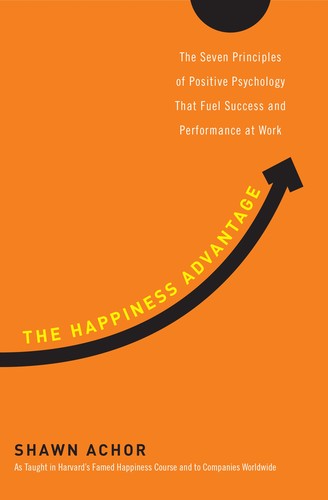
The Happiness Advantage by Shawn Achor is a 2010 psychology book about happiness, positive psychology, performance. Happiness is not the result of success; it's a precondition for it. A positive brain outperforms a neutral one on nearly every measure of intelligence and creativity.
Summary
Shawn Achor's core claim inverts a common assumption about success and happiness. Most people believe that success leads to happiness — achieve the goal, then feel good. Achor argues the research runs the other way: positive affect precedes and enables better performance. A brain primed toward positivity processes more possibilities, solves problems faster, and sustains effort longer than one in neutral or negative states.
The book draws on Achor's decade of research at Harvard and his work as a consultant teaching positive psychology principles to employees at companies including UBS and KPMG. He presents seven principles, among them the Tetris Effect (training the brain to scan for positives rather than deficits), the Fulcrum and Lever (mindset as the lever that shifts how much power you have on a given task), and the 20-Second Rule (reducing the friction for desired behaviors by making them just slightly easier to initiate than the alternatives you want to avoid).
The writing is anecdote-heavy and frequently energetic, which suits the subject. Achor opens with an extended story about convincing himself his broken arm didn't hurt by redirecting a young sibling's attention. Whether that story is literal or illustrative, it sets the tone: the book is less about clinical psychology and more about accessible, immediate practices. Each principle comes with specific interventions — writing down three gratitudes daily, journaling one positive experience, meditating, exercising, performing acts of kindness — all drawn from peer-reviewed research but presented without the hedges.
The book's weakness is the opposite of its strength. The research is real but the effect sizes are rarely mentioned, and Achor's enthusiasm sometimes outruns the evidence. The claim that two minutes of positive journaling can rewire your brain in 21 days is stated confidently but the underlying neuroscience is more contested than the text implies. That said, the practical interventions are low-cost and the principle — that mood shapes cognition — is well-supported. For readers who want a research-backed but readable case for cultivating positivity, Achor delivers.
Talk to The Happiness Advantage like its author wrote you back.
Get the ideas that fit your life — not generic summaries.
- Chat with the book
- Audiobook-style main ideas
- Adapts to your life and goals
- Helps you take action
Key takeaways
- 1.
Happiness is not the result of success; it's a precondition for it. A positive brain outperforms a neutral one on nearly every measure of intelligence and creativity.
- 2.
The Tetris Effect: what you practice attending to shapes what you see. Train your brain to scan for positives and it will find them; train it to scan for threats and it will find those instead.
- 3.
The Fulcrum and Lever principle: changing your mindset about a task changes how much energy and skill you bring to it, independent of the task itself.
- 4.
The 20-Second Rule: reduce the activation energy for desired behaviors by making them marginally easier to start. Put the guitar on a stand; move the remote to another room.
- 5.
Social connection is the greatest predictor of happiness and one of the most reliable buffers against stress. Investing in relationships has measurable cognitive and performance benefits.
- 6.
Falling up: adversity can produce growth, but only when interpreted as a learning experience rather than a fixed defeat. How you explain negative events to yourself matters enormously.
- 7.
Writing down three specific new things you are grateful for each day trains attentional habits toward the positive in a measurable way.
- 8.
The Zorro Circle: when overwhelmed, regain control by starting with small, clearly defined wins before expanding scope.
Discussion questions
Use these on your own, with a book club, or as chat starters in Superbook. Book club version, ready to copy or print →
- 1.
Achor argues that success doesn't produce happiness — happiness enables success. Does this match your experience, or can you think of counterexamples?
- 2.
The Tetris Effect describes a scanning habit. What has your brain been trained to scan for in your daily work environment?
- 3.
Which of the seven principles describes a problem you actually have rather than an abstract concept?
- 4.
The 20-Second Rule is about friction design. What's one behavior you want to start that could be made easier by removing two minutes of setup?
- 5.
Achor says social connection is the greatest predictor of happiness. How much time do you deliberately invest in relationships versus leaving them to chance?
- 6.
Think of a difficult period in your life. Did it produce growth, and if so, did that happen automatically or because of something you did or believed?
- 7.
The book's research base is real but popularized. How do you calibrate trust in books that translate academic findings for a general audience?
- 8.
Which of the five specific interventions — gratitude journaling, positive reflection, meditation, exercise, kindness — have you tried? Which did you abandon, and why?
- 9.
The Zorro Circle suggests starting with a small sphere of control when overwhelmed. When have you experienced the recovery that can come from a small, concrete win?
- 10.
Achor distinguishes between fleeting pleasure and sustained happiness. Where in your life are you optimizing for one when you want the other?
- 11.
The book is used extensively in corporate training programs. Does repackaging positive psychology for the workplace change what it means or how it functions?
- 12.
What's one belief you hold about your work or your capacity that, if you changed it, would change your performance?
Themes
Frequently asked questions
-
Is The Happiness Advantage worth reading?
Yes for most readers, with caveats. The research base is legitimate and the seven principles are practical. The tone is enthusiastic to the point of occasionally oversimplifying the science. If you want a more rigorous version of these ideas, pair it with something like Stumbling on Happiness or Mindset.
-
How long does it take to read The Happiness Advantage?
Around four to five hours. The book is roughly 250 pages and moves quickly. Achor's writing is anecdote-heavy, which makes it fast to read but occasionally thin on supporting detail.
-
What is the happiness advantage?
The finding that positive emotional states improve cognitive performance, creativity, and resilience, which means cultivating happiness before achieving goals rather than after improves outcomes — reversing the conventional success-then-happiness assumption.
-
Who should read this book?
People in high-stress work environments who want practical tools grounded in research. Also useful for managers who want to understand how emotional climate affects team performance. Less useful for readers already familiar with positive psychology literature.
-
Does the research in The Happiness Advantage hold up?
The core direction is well-supported: positive affect improves cognitive outcomes. Some specific claims — particularly around neuroplasticity timelines — are stated more confidently than the science warrants. It's a reliable popularization, not a rigorous review.
Similar books

Mindset: The New Psychology of Success
Carol S. Dweck
Grit: The Power of Passion and Perseverance
Angela Duckworth
Drive: The Surprising Truth About What Motivates Us
Daniel H. Pink
Stumbling on Happiness
Daniel Gilbert
