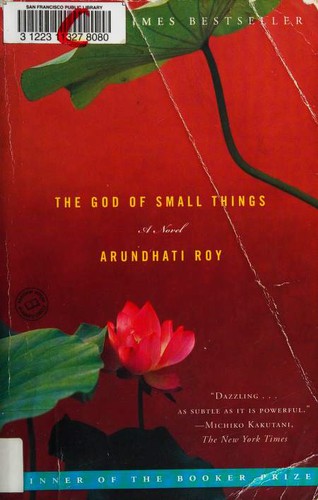
The God of Small Things by Arundhati Roy is a 1997 literary fiction book about caste and its violence, forbidden love, postcolonial india. The Love Laws — Roy's term for the unspoken social codes governing who can love whom — function as the novel's central structure. They are never articulated directly, only enforced catastrophically.
Summary
The God of Small Things opens in 1993, with Rahel returning to her childhood home in Ayemenem, Kerala, to visit her twin brother Estha. Both are damaged people, hollowed out by events that happened when they were seven years old, in 1969. The novel moves between these two time periods in fractured, circling chapters — building toward a catastrophe it keeps deferring, loading each moment before it with an accumulating dread. The central event involves their mother Ammu's love affair with Velutha, an Untouchable man, and the consequences that affair triggers in a family already under multiple pressures.
Roy is writing about caste — about the Love Laws, as she calls them, the laws that dictate who can love whom and how much. These laws are never stated; they are just the structure of the world the characters move through. Velutha's position as an Untouchable makes the affair between him and Ammu not just socially forbidden but politically catastrophic, particularly because his political involvement with a Marxist party has created enemies within the family. The novel shows how private transgression and political violence become entangled in ways that destroy the most vulnerable.
Roy's prose is distinctive and polarizing: she plays with capitalization, sentence fragments, invented compounds, a child's-eye rendering of misunderstood adult language. The novel's voice enacts the twins' perspective — their perception of events they don't fully understand — and the fractured timeline mirrors the experience of living with traumatic memory. These are not neutral stylistic choices; they are formal expressions of what the novel is doing thematically.
The God of Small Things won the Booker Prize in 1997 and became one of the best-selling debut novels in publishing history. It is also one of the most politically charged — the caste critique is specific, rooted in Kerala's particular social geography, and unsparing about the complicity of characters across the ideological spectrum. Readers who want a clear moral map will find one, though it's more complicated than a simple condemnation of caste — Roy is also interested in how people inside oppressive structures participate in their own and others' destruction.
Talk to The God of Small Things like its author wrote you back.
Get the ideas that fit your life — not generic summaries.
- Chat with the book
- Audiobook-style main ideas
- Adapts to your life and goals
- Helps you take action
Key takeaways
- 1.
The Love Laws — Roy's term for the unspoken social codes governing who can love whom — function as the novel's central structure. They are never articulated directly, only enforced catastrophically.
- 2.
The novel uses a child's fractured perception of events as both narrative method and thematic statement: children absorb the consequences of adult political and sexual transgression without the framework to understand them.
- 3.
Velutha is the novel's most fully realized character in some ways, and also the most victimized — Roy is clear that his death is enabled by almost everyone in the novel, including those who claim progressive politics.
- 4.
The time structure (moving between 1969 and 1993, circling the central event) creates a sustained dramatic irony: the reader often knows what happened while the characters are still living toward it.
- 5.
Roy's stylistic innovations — capitalization, compound-words, sentence fragments — are formal expressions of the twins' perspective, a child's language making sense of adult chaos.
- 6.
Kerala's particular political history (a Communist-run state, a Syrian Christian community, a caste system) gives the novel specificity that generalizations about India often miss.
- 7.
The affair between Ammu and Velutha is presented as real and genuine — not explained away as rebellion or pathology — which makes the community's response even more devastating.
- 8.
The novel insists on the political nature of private life: the catastrophe happens at the intersection of caste, family loyalty, political rivalry, and a child's misunderstanding — no single cause.
Discussion questions
Use these on your own, with a book club, or as chat starters in Superbook. Book club version, ready to copy or print →
- 1.
Roy names her rules for social transgression 'the Love Laws.' What are those laws in this novel — where are they visible, and who enforces them?
- 2.
Baby Kochamma is arguably the novel's most active villain — she lies to protect herself. But is she the source of the catastrophe or just a trigger?
- 3.
The Communist Party in the novel is progressive in stated ideology and complicit in Velutha's fate. What is Roy saying about the limits of political ideology when it confronts caste?
- 4.
Both Ammu and Velutha know the affair will have consequences. Do they make their choice with full knowledge? Does the novel ask you to judge them?
- 5.
The children — Rahel and Estha — are damaged for life by events they participated in without understanding. Where does responsibility for that damage lie?
- 6.
Roy's prose style is very distinctive — capitalization, invented words, sentence fragments. Did you find it immersive or distracting?
- 7.
The novel was banned in Kerala and Roy was charged under obscenity laws. Which parts of the novel seem designed to be transgressive, and do they feel transgressive or necessary?
- 8.
The 1969 sections and the 1993 sections are in dialogue throughout. What has changed in twenty-five years — for Kerala, for the characters, for India?
- 9.
Estha and Rahel's childhood is presented with both beauty and horror. How does Roy balance those registers without sentimentalizing childhood or making it merely traumatic?
- 10.
Sophie Mol, the English-raised cousin, is an innocent bystander whose death becomes the lever for everything that follows. What does her presence in the story mean?
- 11.
The novel won the Booker Prize as a debut novel, which was extraordinary. Does the ambition of the novel feel assured or overwrought to you?
- 12.
Roy went on to become primarily a political essayist. Does knowing that affect how you read the novel's political dimensions?
- 13.
Compared to The White Tiger, another Booker-winning Indian novel with caste at its center, what does each book do differently with the same subject?
Themes
Frequently asked questions
-
Is The God of Small Things worth reading?
Yes. It's one of the most formally inventive and politically serious novels to come out of the 1990s, and it rewards careful reading. The prose style takes some adjustment but becomes one of the novel's great pleasures once you're inside it.
-
Is The God of Small Things hard to read?
The fractured timeline and Roy's idiosyncratic prose style make initial entry demanding. The novel circles its central catastrophe for most of its length, deferring what the reader senses is coming. That structure creates genuine dread but requires patience.
-
What is The God of Small Things about, without spoilers?
Twin siblings in Kerala, revisiting a catastrophe from their childhood in 1969 that destroyed their family. The catastrophe involves forbidden love across caste lines, family betrayal, and political violence — all of it tangled together.
-
Why is The God of Small Things considered a classic?
It combined literary ambition — a fragmented timeline, a distinctive prose style, deep political specificity about India — with a narrative powerful enough to reach mass audiences. It was the first big international bestseller by an Indian woman, and its caste critique remains urgent.
-
Who shouldn't read it?
Readers who need linear narrative and conventional prose will struggle. The novel also contains disturbing scenes of violence and a frank treatment of sexuality that have made it controversial. If you want an uncomplicated portrait of India, this is the wrong book.