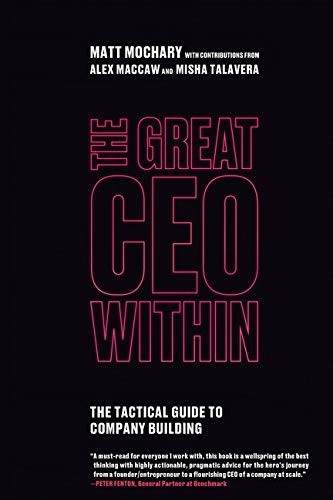
The Great CEO Within by Matt Mochary is a 2019 business book about leadership, startup operations, personal effectiveness. Time-blocking and async communication protect the focus required for high-stakes decisions. Most CEOs underprotect their own time.
Summary
The Great CEO Within is Matt Mochary's operational manual for first-time startup CEOs. Mochary is a Silicon Valley executive coach who has worked with founders at companies including Coinbase, Reddit, and Brex. The book emerged from a coaching document he maintained over years of working with these leaders, and it reads like that: a dense, practical accumulation of frameworks, templates, and explicit procedures organized by the problems a CEO typically faces in the zero-to-fifty-employee stage.
The book covers a wide range: individual time management (Mochary recommends time-blocking and processing email in batches), hiring and firing (do both faster than you think you should), one-on-ones (weekly, structured, focused on emotional clearing before operational discussion), company-wide communication (async by default, documented decisions, meeting-free mornings), and culture (define values early, test against them in hiring). Each section is short and prescriptive. Mochary does not hedge much; he tells you what he recommends and why in the fewest words possible.
The most distinctive thread running through the book is psychological. Mochary argues that most CEO dysfunction is rooted in fear-based behavior: defensiveness, avoidance of difficult feedback, conflict that gets suppressed rather than resolved. He treats emotional intelligence not as a soft complement to operational skill but as a prerequisite for it. Leaders who cannot clear the psychological residue from difficult conversations carry that residue into the next one, and it compounds. The recommendation is structured, direct conversation about feelings before moving to the business problem.
The book's weaknesses are its strengths flipped. The prescriptiveness that makes it immediately useful also makes it brittle — some recommendations will not survive contact with real companies. The psychological framework, while valuable, can feel reductive in cases where interpersonal conflict has organizational roots rather than personal ones. And the book is targeted tightly at a specific archetype: a technically talented first-time CEO at a well-funded startup. Much of it does not translate cleanly outside that context. Within it, however, The Great CEO Within is among the most operationally specific guides available.
Talk to The Great CEO Within like its author wrote you back.
Get the ideas that fit your life — not generic summaries.
- Chat with the book
- Audiobook-style main ideas
- Adapts to your life and goals
- Helps you take action
Key takeaways
- 1.
Time-blocking and async communication protect the focus required for high-stakes decisions. Most CEOs underprotect their own time.
- 2.
Hire and fire faster than feels comfortable. Most CEOs wait too long on both; each week of delay compounds the organizational cost.
- 3.
One-on-ones work better when emotional clearing comes before operational discussion. Unresolved feelings reduce the quality of every decision made afterward.
- 4.
Decisions should be documented and searchable. Organizations that rely on oral memory lose institutional knowledge and create dependency on individuals.
- 5.
Fear-based leadership — defensiveness, avoidance, conflict suppression — is the most common cause of CEO ineffectiveness at early-stage startups.
- 6.
Define company values early and test against them explicitly in hiring. Values defined after a company reaches fifty people are descriptive, not normative.
- 7.
The CEO's job changes at each order-of-magnitude scale. What made you effective at ten people will make you ineffective at fifty. Deliberately updating your operating model is required.
- 8.
Feedback given as 'I feel X when Y happens' lands differently than advice or criticism. Direct, emotionally honest communication reduces defensiveness in the receiver.
Discussion questions
Use these on your own, with a book club, or as chat starters in Superbook. Book club version, ready to copy or print →
- 1.
Mochary argues most CEOs wait too long to fire. From what you have seen or experienced, is that true? What makes the conversation so hard to have?
- 2.
The book treats emotional clearing as operational infrastructure, not soft skill. Do you find that framing persuasive, or does it over-psychologize what are sometimes straightforwardly organizational problems?
- 3.
Mochary's recommendations are prescriptive. How do you apply a highly specific operational playbook in a context with different constraints than the one it was designed for?
- 4.
The advice to document decisions is common but rarely followed. What actually makes organizations default to oral communication, and what would it take to change that?
- 5.
The book targets technically talented first-time CEOs at funded startups. How much of the advice transfers to other kinds of leadership roles?
- 6.
Mochary recommends processing email in batches and protecting morning focus time. What is your actual current practice, and what would you have to change to follow this?
- 7.
The chapter on compensation recommends transparency. In your experience or observation, does pay transparency reduce or create more conflict?
- 8.
Mochary says the CEO's operating model must be deliberately updated at each scale inflection. What does that actually require of a person — what has to change in them, not just in their processes?
- 9.
The psychological framework in the book assumes the main cause of dysfunction is individual fear. When have you seen organizational or incentive problems that looked psychological but weren't?
- 10.
The book emerged from Mochary's private coaching document. How does knowing its origin affect how you read it? What would be different if it had been written for a general audience from the start?
- 11.
Which specific recommendation from the book would you implement first, and what would you have to stop doing to make room for it?
Themes
Frequently asked questions
-
Is The Great CEO Within worth reading if you're not a startup CEO?
Parts of it, yes. The time management, one-on-one, and feedback sections apply broadly. The hiring, fundraising, and company-building sections are tightly calibrated to the venture-backed startup context and transfer less cleanly to other environments.
-
How long is The Great CEO Within?
About 200 pages, four to five hours to read. The book is organized as a reference and works well read in sections rather than cover to cover.
-
What makes The Great CEO Within different from other leadership books?
The prescriptiveness. Mochary does not offer principles and leave implementation to you — he tells you the specific format for a one-on-one, the specific language for a difficult conversation, the specific schedule for processing email. That level of specificity is unusual and useful for new leaders who do not want to invent the wheel.
-
Does the book address company culture?
Yes, with the same prescriptiveness as the operational sections. Mochary recommends defining values early, testing candidates against them explicitly, and treating cultural drift as a firing offense. The culture chapter is one of the most useful for early-stage founders.
-
Is the book available free online?
Yes, in its earlier form. Mochary has made the coaching document that became the book available on his website. The published version is more organized and complete, but the core material has been freely accessible for years.