The Growth Mindset Coach by Annie Brock and Heather Hundley is a 2016 self-help book about growth mindset, education, teaching. Growth mindset is not a personality trait to be installed — it requires ongoing, explicit instruction, modeling, and reinforcement over an extended period.
Summary
The Growth Mindset Coach is a practical guide for teachers and educators who want to bring Carol Dweck's mindset research into actual classroom practice. Where Dweck's Mindset lays out the psychology, Brock and Hundley provide the month-by-month curriculum, lesson plans, scripts, and reflection prompts that let teachers apply it with students from kindergarten through high school.
The book is organized around a school year. Each chapter covers a theme — introducing the concept of neuroplasticity to students, handling failure productively, reframing effort as process rather than outcome, and confronting the particular problem of gifted students who have internalized fixed-mindset beliefs about their own intelligence. The authors are both educators, and the practical suggestions come from that direct experience: they acknowledge when students are skeptical, when parents push back, and when the language of growth mindset becomes performative without changing anything real.
One of the more useful sections addresses the difference between praising effort and praising process. Brock and Hundley argue, following Dweck, that telling students "you worked hard" without connecting effort to strategy is not enough. Students need feedback that names the specific approach that led to progress — the decision to re-read, to try a different method, to ask for help — not just the fact of effort itself. Otherwise the message is that trying hard is virtuous, regardless of whether the trying led anywhere.
The book also spends time on educator mindset, which is easy to overlook in a classroom-focused guide. Teachers who believe their own abilities are fixed are unlikely to teach growth mindset with any conviction, and students notice the gap. Brock and Hundley are honest that shifting a school culture takes longer than a school year, and that individual teachers working in fixed-mindset institutions will find the work harder than the book's optimistic tone sometimes suggests.

Talk to The Growth Mindset Coach like its author wrote you back.
Get the ideas that fit your life — not generic summaries.
- Chat with the book
- Audiobook-style main ideas
- Adapts to your life and goals
- Helps you take action
Key takeaways
- 1.
Growth mindset is not a personality trait to be installed — it requires ongoing, explicit instruction, modeling, and reinforcement over an extended period.
- 2.
Praising effort alone is insufficient. Effective praise names the specific strategy that worked, connecting the student's choice of approach to the outcome.
- 3.
Neuroplasticity — the brain's capacity to grow with challenge — is a concrete, teachable concept that changes how students relate to difficulty when they genuinely understand it.
- 4.
Fixed-mindset beliefs in high-achieving and gifted students are often especially entrenched because those students have succeeded through aptitude alone and fear the challenge that might reveal limits.
- 5.
The language used around failure matters enormously. 'Not yet' as a grade replacement is one example; framing struggle as evidence of learning rather than inadequacy is another.
- 6.
Teacher mindset is as important as student mindset. An educator who believes ability is fixed will undermine growth-mindset instruction without trying.
- 7.
Classroom culture, not individual sessions, is what makes growth mindset durable. One lesson does not change behavior; a consistent environment does.
- 8.
Authentic challenge — work that is actually beyond current skill — is a necessary condition for growth mindset to have anything to act on.
Discussion questions
Use these on your own, with a book club, or as chat starters in Superbook. Book club version, ready to copy or print →
- 1.
The book argues that praising effort is not enough without naming the specific strategy used. Think of a time you received praise that felt hollow. What was missing from it?
- 2.
Gifted students often develop the strongest fixed-mindset beliefs because they have never had to struggle. Did this resonate with your own educational experience?
- 3.
How would you respond to a student or employee who has adopted the language of growth mindset but hasn't changed any of their actual behavior?
- 4.
Brock and Hundley describe teacher mindset as equally important to student mindset. Where do you notice fixed-mindset thinking in yourself when it comes to your own professional growth?
- 5.
The book is organized around an entire school year. What does that imply about how quickly a culture actually changes?
- 6.
What's the difference between a classroom that talks about growth mindset and one that actually embeds it in how grades, feedback, and struggle are handled?
- 7.
The authors acknowledge that individual teachers working within fixed-mindset institutions face structural obstacles. How much can one person shift a culture they didn't design?
- 8.
What would it mean to design an assessment system built around the principle that the grade reflects current level of learning, not final judgment of ability?
- 9.
The book uses the phrase 'not yet' as a reframe for failure. Where else in professional or personal life might that language be genuinely useful rather than just a platitude?
- 10.
What does 'authentic challenge' mean in a field you know well? What distinguishes work that is actually stretching from work that is busy but comfortable?
- 11.
Growth mindset language has become widespread in corporate culture. Where have you seen it used in ways that feel genuine, and where does it feel like decoration?
Themes
Frequently asked questions
-
Is The Growth Mindset Coach worth reading if I've already read Mindset?
Yes, if you work in education or lead a team. Dweck's book makes the case; this one provides the practical tools. The value is in the lesson plans, scripts, and month-by-month structure that Mindset doesn't offer.
-
Is this book only for teachers?
Primarily, but managers, coaches, and parents will find the feedback and praise frameworks applicable. The classroom-specific materials won't all transfer, but the sections on language, culture, and educator mindset are broadly relevant.
-
What is the core message of The Growth Mindset Coach?
That growth mindset requires explicit, sustained instruction embedded in classroom culture — not occasional reminders. The book argues that the gap between knowing what growth mindset is and teaching it effectively is wide, and fills that gap with practical materials.
-
How long is The Growth Mindset Coach?
Around 230 pages. It reads quickly because much of the content is structured as lesson templates, reflection questions, and scripts rather than continuous prose.
-
What distinguishes effective growth mindset feedback from ineffective praise?
Effective feedback names the specific strategy or process that led to progress — 'choosing to re-read that section changed your answer' — rather than generalizing to effort or character. Vague effort praise ('you worked so hard') can reinforce fixed thinking if it doesn't help the student understand what to repeat.
Similar books

Mindset: The New Psychology of Success
Carol S. Dweck

Grit: The Power of Passion and Perseverance
Angela Duckworth
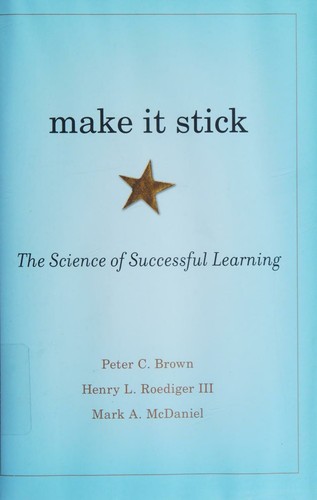
Make It Stick
Peter C. Brown, Henry L. Roediger and Mark A. McDaniel

Peak: Secrets from the New Science of Expertise
Anders Ericsson and Robert Pool
