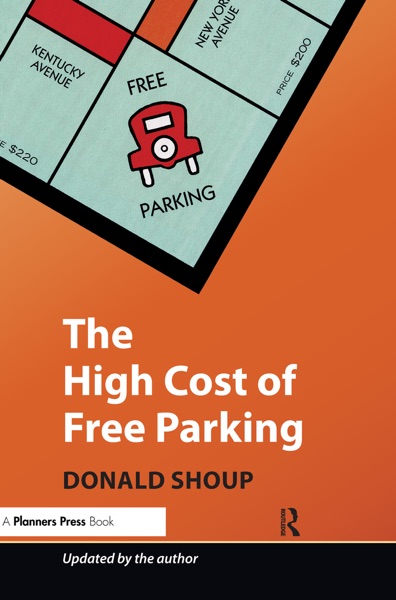
The High Cost of Free Parking by Donald Shoup is a 2005 economics book about urban planning, parking policy, transportation economics. Minimum parking requirements are based on studies of demand for free parking, not market demand. They systematically overproduce parking at the expense of other land uses.
Summary
The High Cost of Free Parking is Donald Shoup's comprehensive argument that parking minimums—the rules requiring developers to provide a set number of parking spaces per building—are among the most damaging and least examined policies in American cities. Shoup, an urban planning professor at UCLA, spent decades studying parking economics before assembling this book, and his thesis is simple if counterintuitive: free parking isn't free. Someone always pays. The question is who, how inefficiently, and at what cost to cities.
The book makes its case on three interlocking fronts. First, minimum parking requirements are derived from engineering studies that predict demand for free parking, which is not the same as actual demand when parking has a market price. Cities use these faulty numbers to mandate more parking than the market would produce, turning vast amounts of land into asphalt. Second, the cost of that parking is bundled invisibly into housing, office rents, and consumer goods. People who don't own cars subsidize those who do. Third, cruising for underpriced curb parking generates significant traffic congestion—Shoup's studies found that cruising for parking in a single Los Angeles block produced traffic equivalent to 30,000 vehicle miles annually.
The solution Shoup proposes has three parts: eliminate off-street parking minimums, charge market-rate prices for curb parking (the price that keeps one or two spaces open on each block), and return the resulting revenue to the neighborhoods where it's collected. That last piece is politically clever: local merchants and residents who might oppose market-rate parking become allies if they see the money spent on neighborhood improvements rather than vanishing into a general fund.
This is a dense, footnote-heavy book of more than 700 pages, and Shoup makes no apology for the length. The academic rigor is a feature for readers interested in the evidence base, but it also means the book rewards selective reading. The core argument is made clearly in the first quarter; the rest builds evidence and applications. Few books have influenced a specific niche of public policy as thoroughly as this one, and its ideas have reshaped how planners in dozens of cities think about parking.
Talk to The High Cost of Free Parking like its author wrote you back.
Get the ideas that fit your life — not generic summaries.
- Chat with the book
- Audiobook-style main ideas
- Adapts to your life and goals
- Helps you take action
Key takeaways
- 1.
Minimum parking requirements are based on studies of demand for free parking, not market demand. They systematically overproduce parking at the expense of other land uses.
- 2.
The real cost of parking is hidden in housing prices, office rents, and consumer goods. Someone always pays; it's just rarely the driver, at the time of parking.
- 3.
Cruising for cheap or free curb parking generates enormous traffic congestion. One underpriced block can generate as much traffic as thousands of additional vehicle miles.
- 4.
Market-rate curb parking—priced to keep one or two spaces open on each block—reduces cruising, raises revenue, and allocates scarce curb space more efficiently than rationing by time limit.
- 5.
Returning parking revenue to the neighborhood where it's collected turns potential opponents of reform into supporters. Local merchants and residents see direct benefit.
- 6.
Minimum parking requirements make infill development harder, drive up housing costs, and make walkable urbanism economically unviable. Removing them is a form of zoning deregulation with large upside.
- 7.
The US devotes more land to parking than to housing in many cities. The total subsidy to drivers through parking policy dwarfs most explicit transportation subsidies.
- 8.
Parking reform is possible: cities from San Francisco to Chicago have implemented performance pricing for curb parking, and the data consistently show reduced congestion and increased parking revenue.
Discussion questions
Use these on your own, with a book club, or as chat starters in Superbook. Book club version, ready to copy or print →
- 1.
Shoup argues that free parking redistributes wealth from non-drivers to drivers. Does that framing change how you think about parking as an equity issue?
- 2.
Have you ever changed your route or destination to find cheaper parking? What does that behavior reveal about how parking pricing actually affects decisions?
- 3.
What would your neighborhood look like if every parking lot were converted to housing or parkland? Is that a desirable vision or a concerning one?
- 4.
Minimum parking requirements are a form of government mandate that most conservatives and progressives alike have ignored. Why do you think that is?
- 5.
Shoup says cruising for parking is a major contributor to urban traffic. Does that match your experience in the cities you've spent time in?
- 6.
The argument that bundled parking costs make non-drivers subsidize drivers is an empirical claim. What evidence would you need to see to find it convincing?
- 7.
Is market-rate curb parking politically feasible in your city? What coalitions would support it and what coalitions would fight it?
- 8.
The book proposes returning parking revenue to neighborhoods. How would you handle the allocation in a diverse neighborhood with conflicting priorities?
- 9.
What industries benefit most from the status quo in parking policy? How does that shape the politics of reform?
- 10.
Shoup focuses on American cities. Do his arguments apply equally in denser European or Asian cities, or does context change the analysis?
- 11.
If parking minimums were eliminated tomorrow, what would actually get built where parking lots currently sit? Is that what you'd want?
Themes
Frequently asked questions
-
Is The High Cost of Free Parking worth reading in full?
The core argument is made in the first 200 pages and is compelling. The full 700-plus pages is for readers who want the academic evidence base or are working on policy in this area. Most readers are well served by the first third and the final policy chapters.
-
What is the main idea of The High Cost of Free Parking?
Minimum parking requirements force cities to overproduce parking, the cost is hidden in prices rather than paid directly by drivers, and market-rate curb pricing with neighborhood revenue return would be a significant improvement.
-
Who should read this book?
Urban planners, housing advocates, municipal elected officials, and anyone living in a city who wants to understand why so much land is devoted to parking and what could be done about it. It's also worth reading for economists interested in how subsidies hide in plain sight.
-
Has Shoup's policy advice actually been implemented anywhere?
Yes. SFpark in San Francisco, Chicago's performance parking program, and several other municipal experiments have implemented versions of demand-based curb pricing. The results broadly support Shoup's predictions about reduced congestion and increased revenue.
-
What does Shoup mean by 'the price of free parking'?
That the cost of providing parking doesn't disappear — it's embedded in higher housing prices, higher retail rents, and higher consumer goods prices. Everyone pays, regardless of whether they park, which makes free parking a hidden subsidy to car owners.
Similar books
The Death and Life of Great American Cities
Jane Jacobs
Freakonomics
Steven D. Levitt and Stephen J. Dubner
Nudge: Improving Decisions About Health, Wealth, and Happiness
Richard H. Thaler and Cass R. Sunstein
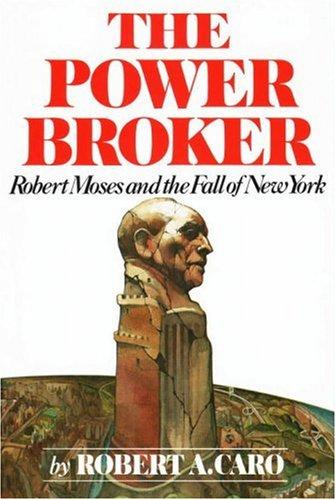
The Power Broker: Robert Moses and the Fall of New York
Robert A. Caro
