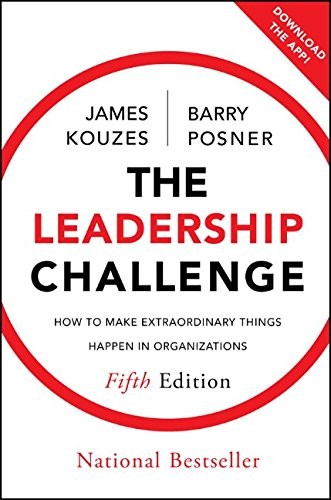
The Leadership Challenge by James M. Kouzes and Barry Z. Posner is a 1987 business book about leadership, character, credibility. The five practices of exemplary leadership: Model the Way, Inspire a Shared Vision, Challenge the Process, Enable Others to Act, and Encourage the Heart.
Summary
The Leadership Challenge is James Kouzes and Barry Posner's evidence-based framework for what leaders actually do when they're at their best, drawn from decades of survey research and thousands of case studies. First published in 1987 and updated repeatedly, the book distills leadership into five practices and ten commitments that appear consistently across cultures, industries, and organizational levels.
The five practices are: Model the Way, Inspire a Shared Vision, Challenge the Process, Enable Others to Act, and Encourage the Heart. Each practice represents a pattern of behavior that emerged from the authors' research into "personal best" leadership experiences — situations where ordinary people produced extraordinary results. The framework is descriptive before it's prescriptive: these are the things people do when they lead most effectively, not aspirational ideals invented by the authors.
Kouzes and Posner's most repeated finding is that credibility is the foundation of all leadership influence. Followers consistently report that what they look for above all in leaders is honesty, forward-looking perspective, inspiration, and competence — but honesty comes first. Leaders who lack credibility — whose actions don't match their words — lose the capacity to lead regardless of their title or formal authority.
The book is also notable for its argument that leadership is not a personality trait or a function of position — it's a set of observable, learnable behaviors. This is borne out by the diversity of the case studies: the best leadership examples come from people at every level of organizations, not just from CEOs and generals. The research consistently finds that leadership emerges from character and commitment, not from charisma.
Talk to The Leadership Challenge like its author wrote you back.
Get the ideas that fit your life — not generic summaries.
- Chat with the book
- Audiobook-style main ideas
- Adapts to your life and goals
- Helps you take action
Key takeaways
- 1.
The five practices of exemplary leadership: Model the Way, Inspire a Shared Vision, Challenge the Process, Enable Others to Act, and Encourage the Heart.
- 2.
Credibility is the foundation of leadership. Followers rate honesty as the most important attribute of admired leaders, above forward-looking vision, inspiration, and competence.
- 3.
Leadership is a set of observable, learnable behaviors — not a personality type or a function of position. The best leaders emerge at every level of organizations.
- 4.
Modeling the Way requires leaders to clarify their own values before they can ask others to share values. You cannot ask people to live by values you haven't articulated yourself.
- 5.
Inspiring a shared vision means enlisting others in a cause — showing people how their interests and aspirations connect to the organization's direction, not just commanding them to follow.
- 6.
Challenging the Process means searching for opportunities to innovate, take risks, and improve. The best leaders don't protect the status quo; they question it continuously.
- 7.
Enabling Others to Act requires building trust and developing competence — creating conditions for genuine collaboration rather than just distributing tasks.
- 8.
Encouraging the Heart is the practice of recognizing contributions and celebrating values in action. It is not sentiment — it's the fuel that keeps people going through long or difficult work.
Discussion questions
Use these on your own, with a book club, or as chat starters in Superbook. Book club version, ready to copy or print →
- 1.
Kouzes and Posner say credibility is the foundation of all leadership influence. Think of a leader you've seen lose credibility. What did it cost them, and was it recoverable?
- 2.
Which of the five practices do you most naturally embody? Which do you most often neglect?
- 3.
Modeling the Way requires clarifying your own values first. Can you state your core leadership values in one or two sentences? Have you stated them explicitly to your team?
- 4.
What's the shared vision for your team right now? Can every member articulate it? Does it connect to what they personally care about?
- 5.
Challenging the Process doesn't mean constant disruption. What's the last time you questioned a process or assumption in your organization that most people had accepted as fixed?
- 6.
Enabling Others to Act is about building conditions for genuine collaboration. What's the biggest structural or cultural barrier to collaboration in your current team?
- 7.
Encouraging the Heart is often described as recognition. What's the most meaningful recognition you've given someone recently — not just a thank-you but something that acknowledged a specific value or commitment?
- 8.
The book has been updated multiple times since 1987. What aspects of the framework feel most current, and where does the age of the original research show?
- 9.
Kouzes and Posner find that leadership emerges at every level of organizations. Who is leading in your organization without a formal leadership title? What are they doing?
- 10.
What was your personal best leadership experience — a time when you led most effectively? Which of the five practices were most present in that experience?
- 11.
The research behind the book draws on what people say about their best leaders. How much weight do you give to what followers say about leaders versus what leaders say about themselves?
Themes
Frequently asked questions
-
Is The Leadership Challenge worth reading after thirty-plus years?
Yes. The research base has been updated across multiple editions, and the core findings about credibility and the five practices have been replicated consistently. Some of the case studies feel dated in the later editions as well, but the framework is well-grounded and the emphasis on observable learnable behaviors still cuts against the charisma myth.
-
How long does it take to read The Leadership Challenge?
Around five hours for the 350-page book. It's organized clearly by practice, so it works well as a reference as well as a cover-to-cover read.
-
What is the Leadership Practices Inventory?
A 360-degree assessment based on the five practices, where observers rate a leader on the behaviors associated with each practice. It's widely used in leadership development programs and gives quantitative feedback on which practices are strongest and which need development.
-
Who should read The Leadership Challenge?
Anyone developing a leadership philosophy, managers who want a research-based framework for thinking about what effective leadership actually looks like, and leadership development professionals who want a model grounded in behavioral research rather than biography.
-
What's the most important finding in the book's research?
That credibility — specifically, honesty — is the single attribute followers most consistently look for in leaders they admire. Not vision, not charisma, not decisiveness. The finding that what you say and what you do must match comes first in the data, and the rest of the five practices follow from it.