Science · Book club
The Information: A History, a Theory, a Flood book club questions
Here are 12 book club questions for The Information: A History, a Theory, a Flood by James Gleick, ordered to open easily and end somewhere worth arguing about. Copy them, print them, or bring them up one at a time.
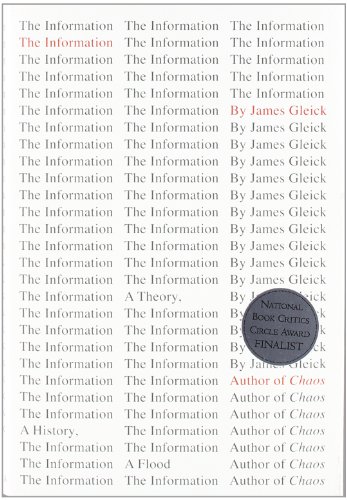
The Information traces the history of information — as a concept, a technology, and a way of understanding the universe — from the talking drums of West Africa through the telegraph, the printing press, the telephone, and into the digital age.
James Gleick · 2011 · 10h 0m
Full summary and key takeaways →The 12 questions
- 1.
Shannon defined information as the reduction of uncertainty rather than as meaning. Does that definition feel right to you, or does it leave out something important?
- 2.
The same mathematics describes thermodynamic entropy and information entropy. What does it mean when two apparently unrelated phenomena obey identical mathematical laws?
- 3.
Gleick traces a long history of information technologies — drums, writing, printing, telegraph, digital. What pattern do you notice in how each new technology changed society?
- 4.
Shannon's work was purely theoretical; it described what was possible without specifying how to achieve it. How important is that kind of theoretical work relative to applied engineering?
- 5.
The book argues that genes are information. Does that metaphor illuminate biology or import a framework that distorts it?
- 6.
Gleick suggests we are drowning in information but starving for knowledge. Does that describe your own experience, and how do you manage it?
- 7.
Ada Lovelace conceptualized programming before any computer existed to program. What does that example tell you about the relationship between ideas and the technology they require?
- 8.
Shannon deliberately separated the meaning of information from its mathematical treatment. Is meaning ultimately irrelevant to how information systems work, or does he leave something important out?
- 9.
Gleick connects information theory to quantum mechanics and the nature of physical reality. Does the idea that the universe is 'made of information' mean anything to you?
- 10.
The telegraph changed the nature of news by making it possible to transmit information faster than physical transport. What current information technology is changing the nature of knowledge in a comparably fundamental way?
- 11.
How does your own information diet — what you read, filter, and trust — compare to Gleick's description of the challenge of navigating information abundance?
- 12.
The book covers a vast historical sweep. Which chapter or period did you find most surprising or illuminating?
How to run the discussion
- Pick six to eight, not all of them. An hour of real discussion covers fewer questions than anyone expects, and racing the list is what makes a book club feel like homework.
- Open with what people noticed, not what they concluded. Asking for a verdict first hardens opinions before anyone has heard each other.
- Let the disagreement run. The questions below that split a room are the ones worth the time; the ones everyone answers the same way can be skipped.
- Ask the quiet person a specific question. A direct, narrow question is far easier to answer than an open invitation to contribute.
Themes worth steering toward
If the conversation stalls, these are the threads that usually restart it.
Common questions
What are good book club questions for The Information: A History, a Theory, a Flood?
Here are 12 book club questions for The Information: A History, a Theory, a Flood by James Gleick, ordered to open easily and end somewhere worth arguing about. The strongest openers ask what each reader noticed rather than what they concluded, and the discussion usually turns on information theory, communication, entropy.
How long should a book club discussion of The Information: A History, a Theory, a Flood last?
Most groups run 60 to 90 minutes of actual discussion. That is roughly six to eight questions, not all of them, so pick the ones that suit your group rather than working down the list in order.
What are the main themes in The Information: A History, a Theory, a Flood?
Information theory, Communication, Entropy, Computing, Knowledge. Those are the threads most likely to divide a room, which makes them the useful places to steer a discussion that has gone quiet.
Picking the next one? See books like The Information: A History, a Theory, a Flood or questions for other book club picks.
