Business · Book club
The Innovator's Solution book club questions
Here are 11 book club questions for The Innovator's Solution by Clayton M. Christensen and Michael E. Raynor, ordered to open easily and end somewhere worth arguing about. Copy them, print them, or bring them up one at a time.
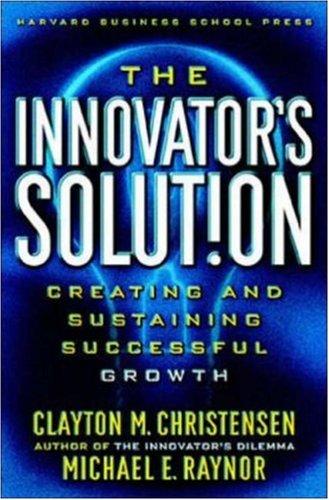
The Innovator's Solution is Christensen and Raynor's follow-up to The Innovator's Dilemma, which explained why great companies fail in the face of disruptive innovation.
Clayton M. Christensen and Michael E. Raynor · 2003 · 5h 20m
Full summary and key takeaways →The 11 questions
- 1.
Apply the Jobs to Be Done lens to a product you use regularly. What job are you hiring it for? Is the product designed around that job, or around a different one?
- 2.
Where do you see non-consumption in a market you know? Who is not being served by existing solutions, and why? What would it take to serve them profitably?
- 3.
The RPV framework says a company's capabilities are defined by its resources, processes, and values. Which of the three is most resistant to change when a company tries to pursue disruptive innovation?
- 4.
Christensen says large companies should spin out disruptive units rather than pursuing disruption within the existing structure. What makes that prescription so difficult to execute?
- 5.
What is the difference between new-market disruption and low-end disruption? Can you find an example of each in a market you follow?
- 6.
The overshooting thesis: performance eventually exceeds what most customers need, creating vulnerability. Where do you see current market leaders that may be overshooting their mainstream customers?
- 7.
How does the Jobs to Be Done framework change how you would conduct customer research? What questions would you ask that you wouldn't otherwise?
- 8.
Christensen argues that most diversification moves fail because companies don't understand which capabilities they actually have that are valuable in new contexts. How do you audit your organization's real capabilities versus its self-described ones?
- 9.
The Innovator's Dilemma described the problem; The Innovator's Solution describes the prescription. Is the prescription sufficient, or are there elements of the dilemma that Christensen hasn't fully solved?
- 10.
What industry are you most familiar with that is currently being disrupted? Identify the disruptors: are they low-end, new-market, or some combination?
- 11.
How does Competing Against Luck differ from The Innovator's Solution in how it uses the Jobs to Be Done concept?
How to run the discussion
- Pick six to eight, not all of them. An hour of real discussion covers fewer questions than anyone expects, and racing the list is what makes a book club feel like homework.
- Open with what people noticed, not what they concluded. Asking for a verdict first hardens opinions before anyone has heard each other.
- Let the disagreement run. The questions below that split a room are the ones worth the time; the ones everyone answers the same way can be skipped.
- Ask the quiet person a specific question. A direct, narrow question is far easier to answer than an open invitation to contribute.
Themes worth steering toward
If the conversation stalls, these are the threads that usually restart it.
Common questions
What are good book club questions for The Innovator's Solution?
Here are 11 book club questions for The Innovator's Solution by Clayton M. Christensen and Michael E. Raynor, ordered to open easily and end somewhere worth arguing about. The strongest openers ask what each reader noticed rather than what they concluded, and the discussion usually turns on innovation, strategy, startups.
How long should a book club discussion of The Innovator's Solution last?
Most groups run 60 to 90 minutes of actual discussion. That is roughly six to eight questions, not all of them, so pick the ones that suit your group rather than working down the list in order.
What are the main themes in The Innovator's Solution?
Innovation, Strategy, Startups, Competitive advantage, Market creation. Those are the threads most likely to divide a room, which makes them the useful places to steer a discussion that has gone quiet.
Picking the next one? See books like The Innovator's Solution or questions for other book club picks.
