Science · Book club
The Innovators: How a Group of Hackers, Geniuses, and Geeks Created the Digital Revolution book club questions
Here are 12 book club questions for The Innovators: How a Group of Hackers, Geniuses, and Geeks Created the Digital Revolution by Walter Isaacson, ordered to open easily and end somewhere worth arguing about. Copy them, print them, or bring them up one at a time.
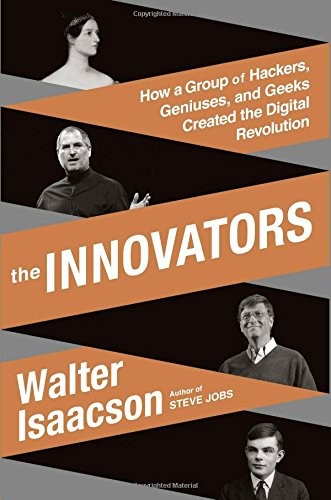
The Innovators is Walter Isaacson's history of the digital revolution, tracing the development of computers and the internet from Ada Lovelace's conceptualization of programming in the 1840s through the emergence of the modern internet, personal computer, and smartphone.
Walter Isaacson · 2014 · 12h 0m
Full summary and key takeaways →The 12 questions
- 1.
Isaacson argues collaboration rather than lone genius drove the digital revolution. Does that argument change how you think about innovation in other fields?
- 2.
Ada Lovelace conceptualized programming before programmable computers existed. What does that example tell you about the relationship between ideas and the technology they require?
- 3.
Bell Labs produced the transistor, information theory, and numerous other foundational innovations. What made that environment so fertile, and can it be reproduced?
- 4.
ARPANET was designed to survive nuclear attack through distributed routing. How does an infrastructure decision made for one reason shape how a technology develops for entirely different reasons?
- 5.
Xerox PARC invented the GUI but failed to commercialize it. What does that story tell you about the difference between invention and innovation?
- 6.
The book traces ideas from Lovelace through the smartphone. Are there threads that Isaacson's emphasis on collaboration makes harder to see?
- 7.
Several women — Lovelace, Grace Hopper, the ENIAC programmers — made foundational contributions that were obscured for decades. What does that pattern say about how innovation communities operate?
- 8.
What is the most important factor that led different groups — often working in parallel — to arrive at similar innovations at roughly the same time?
- 9.
The internet was built largely with public funding before being released for commercial use. What does that pattern suggest about the relationship between public and private investment in innovation?
- 10.
Tim Berners-Lee chose not to patent the World Wide Web. Was that the right decision?
- 11.
What innovation from this history do you think is most underappreciated, and why?
- 12.
Isaacson makes heroes of the people he writes about. Does the admiration ever make the narrative feel uncritical?
How to run the discussion
- Pick six to eight, not all of them. An hour of real discussion covers fewer questions than anyone expects, and racing the list is what makes a book club feel like homework.
- Open with what people noticed, not what they concluded. Asking for a verdict first hardens opinions before anyone has heard each other.
- Let the disagreement run. The questions below that split a room are the ones worth the time; the ones everyone answers the same way can be skipped.
- Ask the quiet person a specific question. A direct, narrow question is far easier to answer than an open invitation to contribute.
Themes worth steering toward
If the conversation stalls, these are the threads that usually restart it.
Common questions
What are good book club questions for The Innovators: How a Group of Hackers, Geniuses, and Geeks Created the Digital Revolution?
Here are 12 book club questions for The Innovators: How a Group of Hackers, Geniuses, and Geeks Created the Digital Revolution by Walter Isaacson, ordered to open easily and end somewhere worth arguing about. The strongest openers ask what each reader noticed rather than what they concluded, and the discussion usually turns on technology history, collaboration, computing.
How long should a book club discussion of The Innovators: How a Group of Hackers, Geniuses, and Geeks Created the Digital Revolution last?
Most groups run 60 to 90 minutes of actual discussion. That is roughly six to eight questions, not all of them, so pick the ones that suit your group rather than working down the list in order.
What are the main themes in The Innovators: How a Group of Hackers, Geniuses, and Geeks Created the Digital Revolution?
Technology history, Collaboration, Computing, Innovation, Digital revolution. Those are the threads most likely to divide a room, which makes them the useful places to steer a discussion that has gone quiet.
Picking the next one? See books like The Innovators: How a Group of Hackers, Geniuses, and Geeks Created the Digital Revolution or questions for other book club picks.
