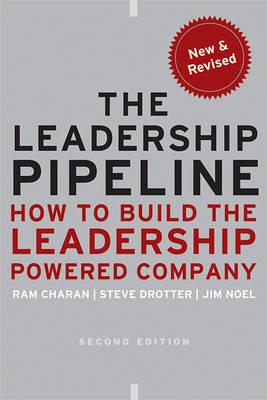
The Leadership Pipeline by Ram Charan, Stephen Drotter, and James Noel is a 2000 business book about leadership development, succession planning, management. Leadership development is not a smooth continuum but a series of distinct passages, each requiring new skills, new time priorities, and a genuine shift in what you value.
Summary
The Leadership Pipeline describes a framework for how leaders develop through six distinct career passages, each requiring a fundamental shift in time application, work values, and skill requirements. The authors — all with long careers at General Electric and Citibank — argue that most leadership failures are not failures of character or intelligence but failures of transition: someone promoted to a new level is still doing the work of the previous level.
The six passages run from managing oneself, to managing others, to managing managers, to functional manager, to business manager, to group manager, and finally to enterprise manager. Each transition demands something more than expanded scope. A first-time manager who was a strong individual contributor must genuinely stop valuing individual work and start valuing the work of others. A functional manager must stop valuing just one function and start valuing the whole business. The failure to make this mental shift — what the authors call being "clogged in the pipeline" — is described as one of the most common and costly problems in large organizations.
The book is grounded in GE-style talent management thinking from the 1970s and 1980s. It assumes large, multi-layered organizations with relatively stable career paths — a context that fits Fortune 500 corporations better than startups or flat organizations. The framework is prescriptive about what skills matter at each level, which is its strength and also its limitation: real careers rarely follow the sequential model the authors describe.
The most durable insight is the distinction between doing work and leading work. Organizations routinely reward individual performance with management promotions, then express surprise when the new manager continues doing individual work instead of developing their team. The Pipeline model makes explicit what the promotion implicitly demands and gives organizations a vocabulary for discussing leadership gaps that doesn't rely entirely on vague assessments of potential.
Talk to The Leadership Pipeline like its author wrote you back.
Get the ideas that fit your life — not generic summaries.
- Chat with the book
- Audiobook-style main ideas
- Adapts to your life and goals
- Helps you take action
Key takeaways
- 1.
Leadership development is not a smooth continuum but a series of distinct passages, each requiring new skills, new time priorities, and a genuine shift in what you value.
- 2.
The most common leadership failure is not incompetence at the new level but reluctance to let go of work and values from the previous level.
- 3.
A first-time manager's primary job is to make their team effective, not to be the team's best individual performer. Many managers never fully accept this shift.
- 4.
Each passage has a specific set of skills, time horizons, and work values. Promoting someone who hasn't mastered the current passage accelerates the problem.
- 5.
Clogged pipelines — where leaders at one level are still doing the work of the level below — are often invisible until a performance crisis forces examination.
- 6.
Succession planning should map not just who will fill roles but whether candidates have genuinely completed each passage, not just spent time in it.
- 7.
Enterprise leaders must work primarily through culture and context-setting rather than direct instruction. The inability to shift to that level of abstraction is why many senior executives fail.
- 8.
Organizations that promote primarily on technical merit, without assessing readiness for the next passage, systematically build underperforming management layers.
Discussion questions
Use these on your own, with a book club, or as chat starters in Superbook. Book club version, ready to copy or print →
- 1.
Which passage in the pipeline model best describes where you are now? What does the model say you should be valuing that you aren't yet?
- 2.
Think of a manager you've seen fail. Looking back, which passage were they clogged in, and what made it hard to see at the time?
- 3.
The model assumes people want to move up the pipeline. What does it mean for someone who is genuinely content at their current level?
- 4.
GE's talent management system is the implicit backdrop here. How much of the framework transfers to smaller organizations or ones with flatter structures?
- 5.
How does your organization currently assess whether someone has completed a passage, rather than simply served time in a role?
- 6.
The authors argue that functional managers must learn to value the whole business, not just their own function. What does that actually look like in practice?
- 7.
First-time managers are often told to delegate but rarely helped to see why they still do individual work. What emotional or cultural factors keep people doing the work of the level below?
- 8.
Enterprise leaders work primarily through context-setting and culture. What does that mean concretely, and how would you know if someone was doing it well or poorly?
- 9.
The framework is largely built on GE in the 1970s. What aspects of modern knowledge work — remote teams, flat hierarchies, project-based roles — does it fail to account for?
- 10.
If you were designing a leadership development program using this framework, what would you do differently from what your current organization does?
- 11.
The book treats readiness for each passage as something that can be assessed and developed. Is that realistic, or are some transitions primarily a matter of temperament?
Themes
Frequently asked questions
-
Is The Leadership Pipeline still relevant?
The core insight — that each leadership level requires a genuine shift in values and time priorities, not just more experience — remains sound. The specific structure fits large traditional organizations best; the passages need translation for startups or flat organizations.
-
What is the main idea of The Leadership Pipeline?
That leadership development happens through six distinct passages, each demanding a shift in skills, time application, and what you value. Most leadership failures result from being stuck between passages rather than from lacking talent.
-
Who should read The Leadership Pipeline?
HR professionals and senior leaders responsible for succession planning will find it most directly useful. First-time managers may benefit from understanding what they're actually being asked to value when promoted into management.
-
How does The Leadership Pipeline compare to High Output Management?
Grove's book focuses on the practical mechanics of managing a team; The Leadership Pipeline focuses on how to move through multiple management levels over a career. Both assume a corporate context but at different scales and timescales.
-
What's the most actionable idea in the book?
The concept of clogging: explicitly checking whether a leader is still doing the work of the previous level. In performance conversations, asking 'what have you stopped doing since your last promotion?' can reveal more than any competency framework.