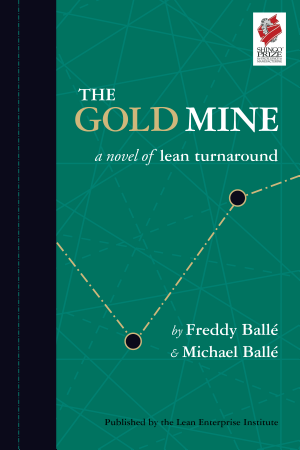
The Lean Manager by Michael Ballé and Freddy Ballé is a 2009 business book about lean management, operations, leadership. Lean is a management system, not a toolkit. Copying kanban boards without changing how managers think and develop people will not produce lasting results.
Summary
The Lean Manager is a business novel that follows Andy Ward, a plant manager struggling to turn around a failing automotive components facility. His mentor, Bob Woods, is a grizzled lean practitioner who refuses to give Andy answers, instead pressing him to observe his factory floor directly, talk to workers, and understand each problem before reaching for solutions. The novel format lets the Ballés dramatize lean practice rather than just describe it, showing what it actually looks like when a manager shifts from firefighting to systematic problem-solving.
The central argument is that lean is not a toolkit — it's a management discipline. Companies typically adopt lean by copying surface-level practices: kanban cards, 5S audits, andon cords. What they miss is the underlying logic, which demands that managers develop people through problem-solving rather than just chase efficiency targets. Bob consistently redirects Andy away from spreadsheets and toward the gemba — the actual place where work happens — insisting that sustainable improvement only comes from understanding root causes, not from imposing solutions from above.
The book covers the core lean concepts with enough depth to be useful: value stream mapping, takt time, pull systems, standardized work, and the PDCA cycle. But the Ballés integrate these tools into Andy's story rather than listing them as a catalog. Each concept appears when Andy confronts a real operational problem, so readers see how the tools connect and when they apply. The novel also shows the human side: resistance from workers, pressure from headquarters, the temptation to take shortcuts, and the slow trust-building that precedes real change.
The Lean Manager works best as a companion to practice, not a standalone introduction. Readers without any shop-floor experience may find the manufacturing specifics dense. But for operations managers, plant managers, and anyone trying to understand why lean transformations fail, the book captures something most business texts miss — that lean is ultimately about developing people, not deploying methods. The father-son authorship (Michael is an executive coach, Freddy a lean practitioner) gives the book an unusual combination of theoretical depth and operational credibility.
Talk to The Lean Manager like its author wrote you back.
Get the ideas that fit your life — not generic summaries.
- Chat with the book
- Audiobook-style main ideas
- Adapts to your life and goals
- Helps you take action
Key takeaways
- 1.
Lean is a management system, not a toolkit. Copying kanban boards without changing how managers think and develop people will not produce lasting results.
- 2.
Go to the gemba: sustainable improvement starts with direct observation of where work actually happens, not with analyzing reports or issuing directives.
- 3.
Managers develop people by teaching them to solve problems, not by solving problems for them. The sensei's job is to ask questions, not provide answers.
- 4.
Value stream mapping shows where waste accumulates in a process, but identifying waste is only the first step — eliminating it requires understanding why it exists.
- 5.
Pull systems tied to customer takt time replace push production schedules, reducing overproduction and making problems visible rather than hiding them in inventory.
- 6.
Standardized work is not a constraint on operators — it is the baseline that makes improvement measurable and sustainable.
- 7.
Real lean transformation is slow, requires building trust with workers, and involves far more management development than most executives expect when they sign up for it.
- 8.
The PDCA cycle — plan, do, check, act — is not a project management method but a daily habit of scientific thinking at every level of the organization.
Discussion questions
Use these on your own, with a book club, or as chat starters in Superbook. Book club version, ready to copy or print →
- 1.
The book argues that most lean initiatives fail because managers copy tools without changing their thinking. Where have you seen this pattern in your own organization?
- 2.
Bob refuses to give Andy direct answers, forcing him to find solutions himself. What is the tradeoff between that kind of coaching and the pressure to solve problems fast?
- 3.
When did you last go to the place where work actually happens to understand a problem, rather than relying on data or reports? What did you find there?
- 4.
The Ballés portray standardized work as enabling improvement rather than constraining it. Does that match your experience of how standards are used in your workplace?
- 5.
Andy faces resistance from workers who have been burned by previous improvement initiatives. How do you rebuild trust after failed change efforts?
- 6.
Which is harder for you: identifying waste in a process, or addressing the organizational reasons why that waste persists?
- 7.
The novel shows that lean requires developing people, not just optimizing processes. Who in your organization is developing others through problem-solving?
- 8.
Bob applies pressure to Andy while refusing to rescue him from difficulty. What does it take for that kind of coaching relationship to work?
- 9.
The book is written as a novel rather than a business text. Does that format make the ideas more or less useful to you? What do you gain or lose?
- 10.
Pull systems make problems visible rather than hiding them in inventory buffers. What buffers does your organization use to hide problems, and what would it take to remove them?
- 11.
The Ballés argue that lean is ultimately about people development, not waste elimination. How does framing it that way change what you would actually do differently?
- 12.
Andy wants quick wins to satisfy headquarters, but Bob insists on slow, deep change. How do you balance the short-term pressure for results with the slow work of real improvement?
Themes
Frequently asked questions
-
Is The Lean Manager worth reading if I'm not in manufacturing?
Partly. The operational details are manufacturing-heavy, and readers outside that context will need to translate. The management development ideas — coaching through questioning, observing actual work, developing people via problem-solving — apply broadly. But if you want lean concepts without the factory floor context, there are more accessible entry points.
-
What is The Lean Manager about?
It's a business novel following a plant manager learning lean management from a seasoned practitioner. The book dramatizes how lean thinking actually works in practice: going to the gemba, developing people through problems, and building pull systems that reveal rather than hide operational issues.
-
How does The Lean Manager compare to The Goal by Eliyahu Goldratt?
Both use the business novel format to teach operational thinking. The Goal focuses on the theory of constraints; The Lean Manager focuses on lean management. The Goal's narrative is tighter and the concept simpler; The Lean Manager covers more ground but can feel denser. Readers interested in operations would benefit from both.
-
Who should read The Lean Manager?
Operations managers, plant managers, and anyone leading or advising a lean transformation. It's most valuable for readers who already have some exposure to lean tools and want to understand why implementations stall — the book's real subject is leadership and people development, not process improvement.
-
How long does it take to read The Lean Manager?
About six hours at a typical reading pace. The novel format makes it faster than a technical text on the same material, though the operational details require attention.
Similar books
The Lean Startup
Eric Ries
The Goal: A Process of Ongoing Improvement
Eliyahu M. Goldratt and Jeff Cox
High Output Management
Andrew S. Grove
The Phoenix Project: A Novel About IT, DevOps, and Helping Your Business Win
Gene Kim, Kevin Behr, and George Spafford
