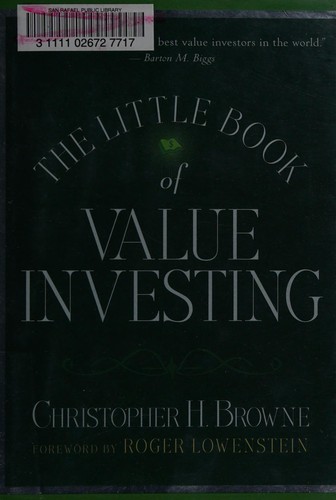
The Little Book of Value Investing by Christopher H. Browne is a 2006 economics book about value investing, stock selection, margin of safety. A stock is an ownership stake in a real business. Evaluating a stock means evaluating the underlying business, not predicting short-term price movements.
Summary
The Little Book of Value Investing is Christopher Browne's distillation of the Graham-and-Dodd value investing approach for a general audience. Browne was a managing director at Tweedy, Browne Company, a firm with direct lineage to Benjamin Graham, and the book carries the conviction of someone who built a career on a single, consistent philosophy. The argument is simple: buy good businesses at prices below their intrinsic worth, wait for the market to recognize the value, and resist the temptation to do anything clever in between.
Browne explains the mechanics of value investing accessibly. A stock is a fractional ownership of a business, not a ticket in a market lottery. The price you pay determines your return; buying at a discount to intrinsic value provides the margin of safety Graham described. Browne walks through how to estimate intrinsic value using earnings, book value, and cash flow, and how to identify businesses that are temporarily out of favor rather than permanently impaired. The screens are blunt but durable: low price-to-earnings ratios, low price-to-book, stocks near 52-week lows.
A large portion of the book is behavioral. Browne is candid that value investing is psychologically difficult. Markets go down and good businesses go down with them. Cheap stocks often look cheap for a reason, and holding a falling stock while pundits declare the thesis broken requires a level of conviction most investors don't sustain. He argues that the discipline required is less about analytical ability and more about temperament — the capacity to hold a position through discomfort when the analysis is sound.
The book is short, deliberately so, and doesn't pretend to cover every scenario. Readers who already know Graham's work will find little new here. But for investors who want the core of value investing without working through Security Analysis, Browne offers a clean, honest account. The cases he uses are dated but the logic they illustrate is not.
Talk to The Little Book of Value Investing like its author wrote you back.
Get the ideas that fit your life — not generic summaries.
- Chat with the book
- Audiobook-style main ideas
- Adapts to your life and goals
- Helps you take action
Key takeaways
- 1.
A stock is an ownership stake in a real business. Evaluating a stock means evaluating the underlying business, not predicting short-term price movements.
- 2.
Margin of safety — buying below intrinsic value — is the single most protective principle in investing. It limits permanent loss and creates the conditions for superior returns.
- 3.
Intrinsic value can be estimated using earnings power, asset value, and free cash flow. The estimate doesn't need to be precise; it needs to be conservative enough to support a margin of safety.
- 4.
Low price-to-earnings and low price-to-book ratios are blunt but historically effective screens for value. They systematically identify what the market has temporarily abandoned.
- 5.
Value investing is primarily a behavioral discipline. Most investors who understand the logic still cannot hold a depressed stock through the volatility required to realize the value.
- 6.
Diversification within value portfolios — across sectors and geographies — reduces the risk that any single error of analysis is catastrophic.
- 7.
Patience is the operating variable. Value realization often takes two to four years, and the discipline to hold across that timeframe separates value investors from speculators who happen to buy cheap.
- 8.
The market periodically offers stocks at irrational prices driven by fear or fashion. The value investor's job is to be prepared to act when others are selling in panic.
Discussion questions
Use these on your own, with a book club, or as chat starters in Superbook. Book club version, ready to copy or print →
- 1.
Browne argues that stock market participation is really business ownership. Does that framing change how you think about the stocks you own or are considering?
- 2.
How would you estimate the intrinsic value of a business you know well — say, a local competitor to a public company?
- 3.
Margin of safety is a buffer against being wrong. In what other areas of your financial or professional life do you deliberately build in a margin of safety?
- 4.
Browne says value investing is more about temperament than intelligence. Do you think you have the temperament? What evidence do you have from past investing behavior?
- 5.
He describes holding a declining stock through years of underperformance while maintaining conviction. Have you ever done that? What happened?
- 6.
Low P/E and low price-to-book screens are simple. Why do most investors not use them consistently?
- 7.
The book acknowledges that cheap stocks often look cheap for a reason. How do you distinguish between temporary and permanent impairment?
- 8.
Browne manages money globally and advocates international diversification. How much international exposure do you currently have, and why?
- 9.
He argues patience is the operating variable in value investing. What in your investing behavior most frequently undermines your patience?
- 10.
If you applied value investing logic to your career — finding undervalued opportunities others have overlooked — where would you look?
- 11.
The book was written in 2006. Which of its core arguments do you think holds fully, and which might need updating for current market conditions?
Themes
Frequently asked questions
-
Is The Little Book of Value Investing still relevant?
Yes. The core principles — buying below intrinsic value, maintaining a margin of safety, holding through volatility — are as applicable as they were when Graham articulated them. The specific examples are dated, but the logic holds.
-
How long does it take to read this book?
Around three hours. It's one of the shorter entries in the 'little book' series and is intentionally accessible. A second read-through focused on the behavioral chapters adds value.
-
How does this compare to The Intelligent Investor?
Browne's book is shorter, simpler, and more focused on practical application. The Intelligent Investor is the foundational text; this is a concise summary for readers who want the core principles without the full depth of Graham's original.
-
Who should read this book?
Investors who want to understand value investing from someone who practiced it professionally for decades. It's best for people early in their investing education who want a clear, honest account of a single, consistent approach.
-
What is the most actionable idea in this book?
Use low P/E and low price-to-book screens as a starting point for identifying candidates, then assess whether the business is temporarily depressed or permanently impaired. Buy what's temporarily depressed and hold with patience.
Similar books
The Intelligent Investor
Benjamin Graham
The Little Book of Common Sense Investing
John C. Bogle
Common Stocks and Uncommon Profits
Philip A. Fisher
A Random Walk Down Wall Street
Burton G. Malkiel
