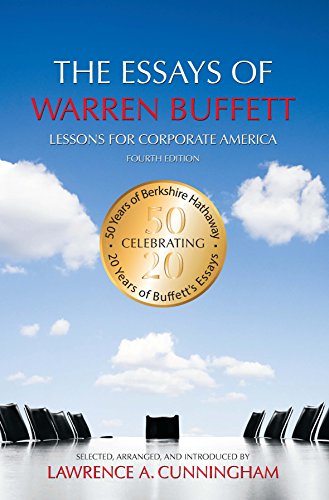
The Essays of Warren Buffett by Warren Buffett is a 1997 economics book about value investing, corporate governance, business ownership. Owner earnings — not reported net income — reflect the true cash generation of a business. Accounting earnings systematically overstate or understate economic reality in ways that matter for valuation.
Summary
The Essays of Warren Buffett is Lawrence Cunningham's thematic compilation of Warren Buffett's annual letters to Berkshire Hathaway shareholders, spanning from the 1970s through the year of publication. The letters themselves are widely considered the best annual reports written by any CEO in history — clear, honest, occasionally funny, and full of direct explanation of how Buffett thinks about business, accounting, corporate governance, and investing. Cunningham reorganized the material from chronological to thematic, which makes the book a more useful reference than reading the raw letters.
The compilation covers Buffett's investment philosophy in its fullest articulation: the difference between price and value, the importance of understanding businesses before owning their shares, the role of competitive advantage (what Buffett calls the economic "moat"), his preference for buying wonderful companies at fair prices over mediocre companies at cheap prices, and the irreplaceable importance of management integrity. These themes recur across decades of letters as Buffett returns to the same ideas with different examples.
The corporate governance sections are distinctive. Buffett is unusually direct about the failures of the typical American board — directors who treat their roles as social positions, who are unwilling to challenge management, who lack genuine economic skin in the game. He is equally critical of accounting practices that inflate reported earnings and of financial engineering that creates the appearance of progress without the substance. These sections read as prescient against the backdrop of the accounting scandals of the early 2000s.
The accounting discussion is perhaps the most technically demanding part of the book. Buffett distinguishes between reported earnings and owner earnings — the cash a business actually generates for its owners after reinvestment — and argues that accounting-driven earnings analysis often misleads more than it illuminates. His critique of goodwill amortization, pooling-of-interests accounting, and stock option expensing (written when options were not required to be expensed) demonstrates that he understood the gap between accounting reality and economic reality decades before it became a mainstream concern.
Talk to The Essays of Warren Buffett like its author wrote you back.
Get the ideas that fit your life — not generic summaries.
- Chat with the book
- Audiobook-style main ideas
- Adapts to your life and goals
- Helps you take action
Key takeaways
- 1.
Owner earnings — not reported net income — reflect the true cash generation of a business. Accounting earnings systematically overstate or understate economic reality in ways that matter for valuation.
- 2.
A business with a durable competitive moat — pricing power, switching costs, network effects — is worth paying a fair price for, not just a cheap price.
- 3.
Most stock repurchases are economically destructive when done at prices above intrinsic value. They enrich selling shareholders at the expense of continuing shareholders.
- 4.
Board independence means the willingness to challenge management, not just the absence of formal conflicts. Most boards fail this test because directors are selected for congeniality, not courage.
- 5.
The best businesses require minimal capital reinvestment to maintain their earnings power. The surplus capital they generate can be deployed into other opportunities.
- 6.
Accounting rules around goodwill and acquisitions create significant distortions. Acquisitions done through stock swaps rather than cash often obscure true costs.
- 7.
Great managers who run mediocre businesses produce mediocre results. The economics of the business matter more than the quality of the management in the long run.
- 8.
Inflation is a tax on capital. Businesses that can raise prices to maintain real returns on equity are far more valuable than businesses with high nominal returns that inflation erodes.
Discussion questions
Use these on your own, with a book club, or as chat starters in Superbook. Book club version, ready to copy or print →
- 1.
Buffett writes that he tries to buy wonderful businesses at fair prices rather than fair businesses at wonderful prices. How do you evaluate the difference between a wonderful business and a fair one?
- 2.
The corporate governance sections are unusually direct about the failures of typical boards. Have you ever seen board behavior, as an employee, investor, or observer, that matched the pattern Buffett criticizes?
- 3.
Buffett distinguishes between owner earnings and reported earnings. How much of the financial reporting you typically read reflects economic reality, and how much is accounting convention?
- 4.
Buffett has explained his investment approach in these letters for decades. If the approach is this clearly articulated, why don't more professional investors replicate it successfully?
- 5.
The book spans several decades. Does Buffett's investment philosophy change over time in ways the compilation reveals, or is there genuine continuity across the letters?
- 6.
Buffett is critical of stock option accounting — the practice of not expensing options — long before it became required. Where do you see similar gaps today between what accounting reports and what is economically true?
- 7.
The economic moat concept identifies businesses that can defend their returns on capital from competition. What businesses in your own experience have genuine moats, and what creates those moats?
- 8.
Buffett argues that most acquisitions destroy value because they are done at excessive prices. What does that imply about how executives and boards actually make capital allocation decisions?
- 9.
The letters are addressed to a specific audience — Berkshire shareholders — but have been read by millions of investors who own no Berkshire stock. Does that audience shift change how you read the advice?
- 10.
Buffett's writing voice is distinctive: folksy, self-deprecating, unusually honest about mistakes. How much of his credibility comes from that voice versus the underlying track record?
- 11.
What specific idea from the essays has most directly influenced how you think about evaluating a business or an investment?
- 12.
Buffett has written that if he were starting with a small amount of capital today, his approach would be quite different. What do you think he means, and does it change how applicable the essays are for individual investors?
Themes
Frequently asked questions
-
Are the annual letters available for free?
Yes, Berkshire Hathaway posts all annual letters on its website. Cunningham's compilation is valuable because it reorganizes the material thematically, making it easier to follow specific threads across many years. The raw letters read chronologically; the book reads by topic.
-
What is the most important concept in the Essays?
Owner earnings — Buffett's framework for understanding the true cash generation of a business as distinct from reported accounting earnings. Almost everything else in the book follows from having a clear picture of what a business actually earns for its owners.
-
Is this book for beginners?
Not as a first book. The material assumes familiarity with financial statements, accounting concepts, and basic investment vocabulary. Readers who have not read The Intelligent Investor first will find some of the discussions opaque. For investors who understand the basics, the essays provide an unmatched practical education in business evaluation.
-
How is this different from biographies of Buffett like The Snowball?
The Essays is Buffett's own writing on investing, accounting, and governance — primary source material. Biographies provide context about his life and personality. Both are worth reading, but the Essays are more directly useful as an investment education. The Snowball is better for understanding how the philosophy developed in practice.
-
Does Buffett's approach apply to small investors?
The principles apply broadly: understand what you own, buy good businesses at reasonable prices, think long-term, ignore short-term price movements. Buffett has said the actual execution would look different with a small portfolio than with Berkshire's scale, but the framework translates. The Essays are more applicable to the individual investor than the size of Berkshire might suggest.