Psychology · Book club
The Lucifer Effect: Understanding How Good People Turn Evil book club questions
Here are 11 book club questions for The Lucifer Effect: Understanding How Good People Turn Evil by Philip Zimbardo, ordered to open easily and end somewhere worth arguing about. Copy them, print them, or bring them up one at a time.
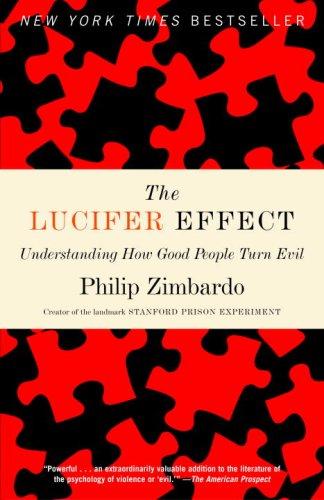
Philip Zimbardo designed the Stanford Prison Experiment in 1971, then watched it spin out of control within days.
Philip Zimbardo · 2007 · 8h 40m
Full summary and key takeaways →The 11 questions
- 1.
Zimbardo argues that most evil is situational rather than dispositional. Do you find that argument convincing, and does it change how you think about moral responsibility?
- 2.
He describes how he himself lost perspective as the Stanford Prison Experiment's superintendent. What does that suggest about the possibility of institutional oversight from within a system?
- 3.
The Abu Ghraib parallel is central to the book. Do you think the situationist analysis lets individual actors off the hook, or does it provide a more accurate account of where responsibility actually lies?
- 4.
The fundamental attribution error is the tendency to explain others' behavior by their character. Can you identify a recent case where you made that error?
- 5.
Zimbardo ends with a focus on heroism. What does a psychology of heroism look like, and can it be taught in any practical sense?
- 6.
The experiment was stopped partly because Zimbardo's girlfriend challenged what he was seeing. What does that suggest about the importance of people outside a system in providing moral clarity?
- 7.
If the barrel explanation is correct, what does that imply about how prisons, military units, and other total institutions should be designed?
- 8.
Situationism has been criticized for diminishing individual agency. Where do you think the right balance is between situational and dispositional explanations of behavior?
- 9.
Think of a time you behaved in a way you later found hard to recognize. Can you understand that behavior situationally in Zimbardo's framework?
- 10.
He argues that anonymity and dehumanizing language are specific situational enablers of cruelty. How do you see those factors operating in contemporary contexts?
- 11.
What role does role does the concept of a 'just following orders' defense play in your moral intuitions, and how does the situationist framework complicate or support it?
How to run the discussion
- Pick six to eight, not all of them. An hour of real discussion covers fewer questions than anyone expects, and racing the list is what makes a book club feel like homework.
- Open with what people noticed, not what they concluded. Asking for a verdict first hardens opinions before anyone has heard each other.
- Let the disagreement run. The questions below that split a room are the ones worth the time; the ones everyone answers the same way can be skipped.
- Ask the quiet person a specific question. A direct, narrow question is far easier to answer than an open invitation to contribute.
Themes worth steering toward
If the conversation stalls, these are the threads that usually restart it.
Common questions
What are good book club questions for The Lucifer Effect: Understanding How Good People Turn Evil?
Here are 11 book club questions for The Lucifer Effect: Understanding How Good People Turn Evil by Philip Zimbardo, ordered to open easily and end somewhere worth arguing about. The strongest openers ask what each reader noticed rather than what they concluded, and the discussion usually turns on situational behavior, evil, social psychology.
How long should a book club discussion of The Lucifer Effect: Understanding How Good People Turn Evil last?
Most groups run 60 to 90 minutes of actual discussion. That is roughly six to eight questions, not all of them, so pick the ones that suit your group rather than working down the list in order.
What are the main themes in The Lucifer Effect: Understanding How Good People Turn Evil?
Situational behavior, Evil, Social psychology, Power, Moral psychology. Those are the threads most likely to divide a room, which makes them the useful places to steer a discussion that has gone quiet.
Picking the next one? See books like The Lucifer Effect: Understanding How Good People Turn Evil or questions for other book club picks.
