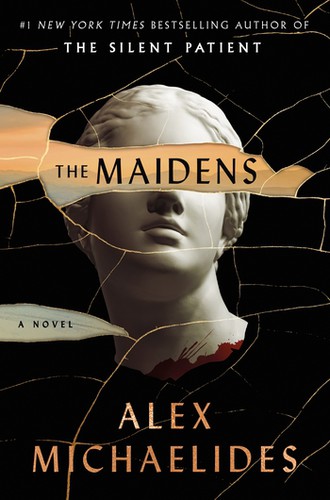
The Maidens by Alex Michaelides is a 2021 thriller book about obsession, mythology and power, grief. Grief distorts judgment in ways that feel like insight. Mariana's certainty about Fosca reads as both understandable and unreliable simultaneously.
Summary
The Maidens opens on Mariana Andros, a group therapist living in London, still raw from the sudden death of her husband. When her niece Zoe, a student at Cambridge, calls in panic after a fellow student is murdered, Mariana travels to the university — and becomes convinced that the killer is Edward Fosca, a charismatic professor of Greek tragedy who holds an inexplicable sway over a circle of female students he calls the Maidens. The police see no evidence. Everyone she talks to insists Fosca is brilliant and blameless. Mariana becomes more certain, and more isolated in her certainty.
The book is about the grip that obsession takes on a grieving person. Mariana's fixation on Fosca is entangled with her loss — she is looking for a puzzle to solve at a moment when the most important thing in her life had no explanation. Michaelides layers Greek tragedy throughout: Euripides, Tennyson's Elsinore, the myth of Persephone and the underworld. Fosca lectures on how tragedy functions as a container for dangerous emotion, which is exactly what the novel is attempting on its reader.
Michaelides writes propulsive, short-chapter commercial fiction in the tradition of Agatha Christie. The plot moves fast and the Cambridge setting — the courts, the Backs, formal dinners — is used atmospherically without becoming a travelogue. The identity of the killer is withheld in a way that will feel either satisfying or mechanical depending on your tolerance for thriller conventions. Character interiority is functional rather than deep, and Mariana's psychology is sketched in broad strokes. This is a book that wants to sweep you along, not sit with you.
Readers who loved The Silent Patient, Michaelides's debut, will likely enjoy this one for the same reasons: the pace, the gothic atmosphere, the mythology scaffolding, the last-act reveal. Those who were frustrated by the Silent Patient's twist will find similar patterns here. Literary fiction readers expecting the psychological depth of, say, Donna Tartt will be disappointed. This is genre thriller wearing academic costume, and it does that job enjoyably.
Talk to The Maidens like its author wrote you back.
Get the ideas that fit your life — not generic summaries.
- Chat with the book
- Audiobook-style main ideas
- Adapts to your life and goals
- Helps you take action
Key takeaways
- 1.
Grief distorts judgment in ways that feel like insight. Mariana's certainty about Fosca reads as both understandable and unreliable simultaneously.
- 2.
Greek tragedy is used as thematic scaffolding — the story explicitly rhymes with Persephone, Electra, and the Dionysian. Whether you find this enriching or heavy-handed depends on how much you enjoy theatrical irony.
- 3.
Charismatic authority figures who cultivate exclusive groups of devoted followers are a recurring feature of literary thrillers, and Michaelides is interested in why smart women fall for it.
- 4.
Cambridge is treated as a place where surface civility and institutional prestige cover a great deal of darkness — the setting is doing symbolic work.
- 5.
The novel's plot turns on the gap between what observers see and what is actually happening, which is also the central question about Mariana herself.
- 6.
Short chapters and thriller pacing are a choice about what kind of reading experience to create. Michaelides is optimizing for propulsion over depth.
- 7.
The cult dynamics around Fosca gesture at questions about intellectual seduction and the ethics of influence that the novel raises but doesn't fully explore.
- 8.
The ending recontextualizes everything that came before — which is both the payoff the genre promises and the thing that makes some readers feel the journey was retroactively cheapened.
Discussion questions
Use these on your own, with a book club, or as chat starters in Superbook. Book club version, ready to copy or print →
- 1.
Mariana is both a therapist and a deeply unreliable observer. At what point, if ever, did you stop trusting her read on events?
- 2.
Fosca holds seminars on Greek tragedy and uses that framework explicitly. Does the mythological overlay deepen the story or feel like imposed significance?
- 3.
The Maidens — the group of women devoted to Fosca — are given almost no individual interiority. Is that a flaw, or is their collective anonymity part of the point?
- 4.
Mariana's grief is the engine of the novel, but it's diagnosed more than felt. How much did you find yourself inside her emotional experience versus observing it from outside?
- 5.
Cambridge here is both a real place and a gothic stage set. Did the setting feel authentic to you, or is it the Cambridge of fantasy?
- 6.
The Silent Patient was Michaelides's debut. Compared to that book, does The Maidens feel like a step forward, a lateral move, or a retreat to formula?
- 7.
The novel repeatedly invokes the idea that tragedy provides a container for dangerous emotion. Did reading this book do that for you in any way?
- 8.
How much does the thriller genre's requirement for a single killer and a satisfying reveal work against the kind of psychological ambiguity this book seems to want?
- 9.
Fosca's relationship with the Maidens raises questions about power in academic settings. Did the novel feel like it was taking that seriously, or using it as atmosphere?
- 10.
The ending requires a significant withholding from the reader. Did that feel fair in retrospect, or did you feel manipulated?
- 11.
Who in the novel understands what is actually happening, and who is genuinely deceived? Does that distinction shift after the reveal?
- 12.
What does the novel say about grief as an altered state? Is Mariana's obsession a symptom of her loss or something else?
Themes
Frequently asked questions
-
Is The Maidens worth reading if I loved The Silent Patient?
Probably yes. It's built on the same template: a compelling unreliable narrator, a charismatic villain, an atmospheric setting, and a third-act reveal. If that formula worked for you before it will likely work here, though some readers find the pattern more visible the second time.
-
Do I need to know Greek mythology to enjoy The Maidens?
No, but it helps. Michaelides uses the mythology accessibly — you don't need a classics background. Knowing the myth of Persephone adds some resonance, but the thriller plot functions without it.
-
Is The Maidens scary or disturbing?
It's unsettling rather than scary. The violence is mostly off-page. The unease comes from the psychological dynamics — the cult-like devotion, the sense that no one believes Mariana — rather than graphic content.
-
Who shouldn't read this book?
Readers who dislike stories built entirely around a withheld revelation will find it frustrating. If you've grown impatient with thriller formulas or want character interiority over plot mechanics, this book will test your patience.
-
Is there an adaptation of The Maidens?
As of 2024, film rights were optioned and a television adaptation was in development, though no completed production had been released.