Economics · Book club
The Millionaire Next Door book club questions
Here are 12 book club questions for The Millionaire Next Door by Thomas J. Stanley, ordered to open easily and end somewhere worth arguing about. Copy them, print them, or bring them up one at a time.
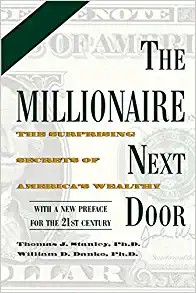
The Millionaire Next Door is Thomas Stanley and William Danko's report on a decade of research into who actually has wealth in America, and their findings are consistently surprising.
Thomas J. Stanley · 1996 · 4h 45m
Full summary and key takeaways →The 12 questions
- 1.
Stanley and Danko's research found that most millionaires are unrecognizable as wealthy. Does that match the wealthy people you actually know, or is your mental model of wealth different?
- 2.
What is your current net worth relative to the book's expected net worth formula? Does the gap or surplus tell you anything useful about your financial habits?
- 3.
The book argues that lifestyle inflation is one of the primary wealth destroyers. At what points in your own life have you increased spending significantly after an income increase? What drove those decisions?
- 4.
Stanley distinguishes between occupations that generate high income and those that generate high wealth. Where does your own career sit on that spectrum?
- 5.
The concept of economic outpatient care suggests that helping adult children financially can harm them in the long run. How do you think about the line between genuine support and dependence-creating transfers?
- 6.
Which of your regular expenses are driven by actual preference, and which are driven by the social environment you live in? What would you spend differently if you lived among people with less income?
- 7.
The book came out in 1996. Is its portrait of the typical millionaire still accurate in an era of tech wealth, equity compensation, and social media-driven status consumption?
- 8.
Stanley and Danko found that budgeting — knowing where your money goes each month — is strongly associated with wealth accumulation. Do you track your spending? What do you think you would discover if you did?
- 9.
The book profiles PAWs and UAWs. Which pattern do you see more clearly in your own financial life right now, and what specific behavior is driving it?
- 10.
The authors argue that looking wealthy and being wealthy are often in direct conflict. How much of your own consumption is shaped by wanting to appear financially comfortable to others?
- 11.
Most of the millionaires in the study are first-generation wealth builders. What made it possible for them to accumulate wealth when their peers with similar incomes did not?
- 12.
What would you have to give up, in terms of current lifestyle, to become a prodigious accumulator of wealth? Is that tradeoff worth it to you?
How to run the discussion
- Pick six to eight, not all of them. An hour of real discussion covers fewer questions than anyone expects, and racing the list is what makes a book club feel like homework.
- Open with what people noticed, not what they concluded. Asking for a verdict first hardens opinions before anyone has heard each other.
- Let the disagreement run. The questions below that split a room are the ones worth the time; the ones everyone answers the same way can be skipped.
- Ask the quiet person a specific question. A direct, narrow question is far easier to answer than an open invitation to contribute.
Themes worth steering toward
If the conversation stalls, these are the threads that usually restart it.
Common questions
What are good book club questions for The Millionaire Next Door?
Here are 12 book club questions for The Millionaire Next Door by Thomas J. Stanley, ordered to open easily and end somewhere worth arguing about. The strongest openers ask what each reader noticed rather than what they concluded, and the discussion usually turns on wealth accumulation, frugality, financial independence.
How long should a book club discussion of The Millionaire Next Door last?
Most groups run 60 to 90 minutes of actual discussion. That is roughly six to eight questions, not all of them, so pick the ones that suit your group rather than working down the list in order.
What are the main themes in The Millionaire Next Door?
Wealth accumulation, Frugality, Financial independence, Consumer behavior, Income vs. wealth. Those are the threads most likely to divide a room, which makes them the useful places to steer a discussion that has gone quiet.
Picking the next one? See books like The Millionaire Next Door or questions for other book club picks.
