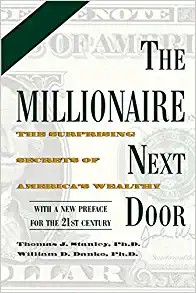
The Millionaire Next Door by Thomas J. Stanley is a 1996 economics book about wealth accumulation, frugality, financial independence. Wealth and income are different things. High earners who spend lavishly often have less net worth than modest earners who save and invest consistently.
Summary
The Millionaire Next Door is Thomas Stanley and William Danko's report on a decade of research into who actually has wealth in America, and their findings are consistently surprising. Millionaires in the United States are disproportionately found among people who live modestly, drive used cars, own ordinary homes, and spend carefully. They are not the conspicuous consumers the culture depicts as rich. The people who look wealthy — who buy luxury cars and live in expensive neighborhoods — are often running on high income with little accumulated wealth.
The central finding is the distinction between income and wealth. High income does not reliably produce wealth; frugality and investment do. Stanley and Danko develop a formula for expected net worth (age multiplied by realized pretax income, divided by ten) and divide their subjects into "prodigious accumulators of wealth" (PAWs) and "under accumulators of wealth" (UAWs). PAWs tend to live below their means, plan carefully, and avoid the lifestyle inflation that consumes the income of UAWs. UAWs, despite often earning substantial salaries, spend most of what they make and have little to show for it.
The research covers the specific behaviors that distinguish wealth accumulators: they budget, track spending, live in modest neighborhoods where they are not pressured to keep up with neighbors, are self-employed or run small businesses, and prioritize financial independence over status consumption. Stanley and Danko give particular attention to the dangers of "economic outpatient care" — the pattern of wealthy parents who transfer money to adult children, inadvertently undermining those children's ability to accumulate wealth themselves. Adult children who receive significant financial gifts tend to accumulate less wealth than those who don't.
The book's value is its empirical grounding. The authors interviewed hundreds of millionaires to build their profile, and the portrait that emerges punctures common assumptions about wealth. It's not glamorous — the typical millionaire is a first-generation wealth builder who drives a used pickup truck and has never spent more than $400 on a suit. The critique of status consumption runs throughout, and the book asks readers to consider whether their spending reflects their actual values or social pressure they have accepted uncritically.
Talk to The Millionaire Next Door like its author wrote you back.
Get the ideas that fit your life — not generic summaries.
- Chat with the book
- Audiobook-style main ideas
- Adapts to your life and goals
- Helps you take action
Key takeaways
- 1.
Wealth and income are different things. High earners who spend lavishly often have less net worth than modest earners who save and invest consistently.
- 2.
Most millionaires live far below their means. They do not drive luxury cars, wear expensive watches, or live in the most prestigious neighborhoods they can afford.
- 3.
The expected net worth formula (age x income / 10) gives a quick benchmark for whether you are accumulating wealth in proportion to your earnings.
- 4.
Frugality is not about deprivation — it's about intentionality. PAWs spend time planning finances and resisting social pressure to upgrade their lifestyle.
- 5.
Economic outpatient care (gifting money to adult children) often weakens the recipients' ability to build their own wealth. Well-meaning transfers can create dependency.
- 6.
Self-employment and small business ownership appear disproportionately among millionaires. Owning a business provides both income and asset appreciation.
- 7.
Your neighborhood shapes your spending. Living among people who earn significantly more than you creates continuous pressure to consume at their level.
- 8.
First-generation wealth builders make up the majority of American millionaires. Wealth is created more often than it is inherited.
Discussion questions
Use these on your own, with a book club, or as chat starters in Superbook. Book club version, ready to copy or print →
- 1.
Stanley and Danko's research found that most millionaires are unrecognizable as wealthy. Does that match the wealthy people you actually know, or is your mental model of wealth different?
- 2.
What is your current net worth relative to the book's expected net worth formula? Does the gap or surplus tell you anything useful about your financial habits?
- 3.
The book argues that lifestyle inflation is one of the primary wealth destroyers. At what points in your own life have you increased spending significantly after an income increase? What drove those decisions?
- 4.
Stanley distinguishes between occupations that generate high income and those that generate high wealth. Where does your own career sit on that spectrum?
- 5.
The concept of economic outpatient care suggests that helping adult children financially can harm them in the long run. How do you think about the line between genuine support and dependence-creating transfers?
- 6.
Which of your regular expenses are driven by actual preference, and which are driven by the social environment you live in? What would you spend differently if you lived among people with less income?
- 7.
The book came out in 1996. Is its portrait of the typical millionaire still accurate in an era of tech wealth, equity compensation, and social media-driven status consumption?
- 8.
Stanley and Danko found that budgeting — knowing where your money goes each month — is strongly associated with wealth accumulation. Do you track your spending? What do you think you would discover if you did?
- 9.
The book profiles PAWs and UAWs. Which pattern do you see more clearly in your own financial life right now, and what specific behavior is driving it?
- 10.
The authors argue that looking wealthy and being wealthy are often in direct conflict. How much of your own consumption is shaped by wanting to appear financially comfortable to others?
- 11.
Most of the millionaires in the study are first-generation wealth builders. What made it possible for them to accumulate wealth when their peers with similar incomes did not?
- 12.
What would you have to give up, in terms of current lifestyle, to become a prodigious accumulator of wealth? Is that tradeoff worth it to you?
Themes
Frequently asked questions
-
What is the main argument of The Millionaire Next Door?
That most wealthy Americans are not conspicuous consumers. They are ordinary-looking people who accumulated wealth through consistent frugality, careful budgeting, and investment over time — not through inheritance or high-glamour careers. The book distinguishes sharply between income and net worth.
-
Is The Millionaire Next Door still accurate?
The core behavioral findings hold up, though the specific wealth benchmarks are dated for current asset prices. The book's argument that living below your means is the primary driver of wealth accumulation is well-supported by subsequent research. Some of the business ownership data is less relevant in an era of equity compensation and tech startups.
-
Who are PAWs and UAWs?
Prodigious Accumulators of Wealth (PAWs) are people whose net worth significantly exceeds what their income would predict; they save aggressively and live below their means. Under Accumulators of Wealth (UAWs) have net worth well below the expected level despite often earning high incomes; they spend most of what they make on lifestyle.
-
What is economic outpatient care?
The pattern of wealthy parents who provide significant financial transfers to their adult children, often intended as help but frequently undermining the children's financial self-sufficiency. The book's research found that adult children who receive regular financial gifts tend to save less and accumulate less wealth than those who don't.
-
Should I read The Millionaire Next Door if I already index invest?
Yes, because it addresses the spending side of wealth accumulation, not just the investing side. Even people who invest wisely can fail to build meaningful wealth if their lifestyle spending consumes most of their income. The book's behavioral and psychological insights complement purely investment-focused books.