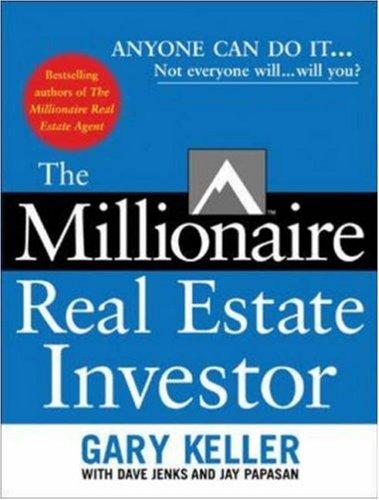
The Millionaire Real Estate Investor by Gary Keller is a 2005 business book about real estate investing, wealth building, financial independence. The biggest obstacle to building wealth through real estate is not capital or knowledge — it's limiting beliefs about what's possible and who gets to do it.
Summary
Gary Keller, co-founder of Keller Williams Realty, wrote this book after interviewing over 100 millionaire real estate investors to identify common patterns in how they built their wealth. The result is part research summary, part practical framework, and part mindset guide. Keller's central argument is that real estate is not a get-rich-quick vehicle but a reliable wealth-building engine for anyone willing to operate with enough patience and discipline.
The book opens with what Keller calls "myths" about real estate investing — that you need a lot of money, that it's too risky, that you have to be a financial genius. He dismantles each with data and examples from the investors he interviewed. The dominant theme in the first section is that the biggest obstacle is not capital or knowledge but the mental model investors bring to the table. Those who succeed think in terms of net worth and asset accumulation; those who stall think in terms of income replacement.
The middle section covers Keller's four stages of investor evolution: Think a Million, Earn a Million, Net a Million, and Receive a Million. Each stage has its own priorities, tools, and pitfalls. The framework is useful for diagnosing where you are and what the next bottleneck is rather than trying to apply millionaire tactics to a beginner situation. The accompanying models — criteria, terms, and network — provide a repeatable system for evaluating and closing deals.
The book's age shows in some of its market assumptions, and Keller's focus on single-family residential may feel narrow for investors interested in multifamily or commercial. But the core wealth-building logic — buy right, hold long, reinvest cash flow, build equity — remains sound. For new investors, the most enduring contribution is Keller's insistence that real estate rewards those who think about it as a lifetime wealth strategy rather than a series of individual transactions.
Talk to The Millionaire Real Estate Investor like its author wrote you back.
Get the ideas that fit your life — not generic summaries.
- Chat with the book
- Audiobook-style main ideas
- Adapts to your life and goals
- Helps you take action
Key takeaways
- 1.
The biggest obstacle to building wealth through real estate is not capital or knowledge — it's limiting beliefs about what's possible and who gets to do it.
- 2.
Keller's four stages of investor evolution (Think, Earn, Net, Receive a Million) describe distinct priorities. Strategies that work in stage three can be counterproductive in stage one.
- 3.
Buying right — getting the price, terms, and property quality correct — is the foundation. You make money when you buy, not when you sell.
- 4.
Cash flow is the measure of a deal's health, but equity and net worth are the measures of a portfolio's health. Conflating the two leads to under-investing.
- 5.
Network is a competitive advantage. Agents, lenders, contractors, and property managers who trust you bring you better deals and better service than strangers get.
- 6.
Real estate's four wealth drivers — appreciation, cash flow, loan paydown, and tax benefits — compound together over time in ways that individual drivers don't suggest.
- 7.
Holding long is more important than timing the market. Most of the millionaires Keller interviewed held their properties for decades.
- 8.
Reinvesting cash flow to buy more properties accelerates the compounding. Spending it slows or stops the wealth accumulation cycle.
Discussion questions
Use these on your own, with a book club, or as chat starters in Superbook. Book club version, ready to copy or print →
- 1.
Keller interviewed over 100 millionaire investors to find common patterns. Which of those patterns surprised you most?
- 2.
The book argues the biggest obstacle is mental, not financial. Do you believe that? Where does limited capital actually constrain you versus where does it become an excuse?
- 3.
Keller's four stages imply that strategy should evolve. What stage do you think you're at right now, and what does that mean for your next decision?
- 4.
The 'buy right' principle says you make money on the purchase. How do you define 'right' in your local market right now?
- 5.
Keller emphasizes holding long over timing the market. What would it take for you to hold a property for 20 years without flinching?
- 6.
The investors Keller profiles reinvest cash flow rather than spend it. What would you have to change about your current spending to do the same?
- 7.
Real estate is illiquid compared to stocks. How does that illiquidity change the psychological experience of holding through a downturn?
- 8.
Keller argues network is a competitive advantage. How would you start building a real estate network from scratch in a city where you know nobody?
- 9.
The book was written in 2005, before the 2008 financial crisis. Which parts of the advice feel most dated, and which hold up unchanged?
- 10.
If you had to commit to one property type for a 20-year strategy, what would it be and why?
- 11.
Keller says most investors fail because they treat real estate as a transaction rather than a business. What does running it as a business actually require?
- 12.
How would you explain the difference between cash flow investing and equity investing to someone who has never owned a rental property?
Themes
Frequently asked questions
-
Is The Millionaire Real Estate Investor still relevant today?
The core frameworks — buy right, hold long, reinvest cash flow — remain sound. Some market assumptions and financing examples are dated, and the 2008 financial crisis is a notable gap in the narrative. Treat the book as a strategic guide rather than a tactical playbook and the relevance holds up.
-
How long does it take to read this book?
Around six to seven hours for the roughly 370-page book. It's structured with recurring frameworks and summary tables that let you skim the examples and focus on the models if time is short.
-
Who should read The Millionaire Real Estate Investor?
People who are intellectually convinced that real estate can build wealth but haven't yet built a framework for how to do it in a deliberate way. The four-stage model is particularly useful for diagnosing where you are and what the next priority should be.
-
What is the most important idea in the book?
Buying right. Keller's interviewees consistently identified the quality of the initial purchase as the foundation of every successful investment. Everything else — management, tenants, market timing — matters less than getting the acquisition right.
-
Does the book cover commercial real estate?
Primarily no. Keller focuses on single-family and small residential properties. Investors interested in multifamily, retail, or industrial properties will need supplementary reading. The wealth-building principles transfer, but the specific models and numbers assume residential.