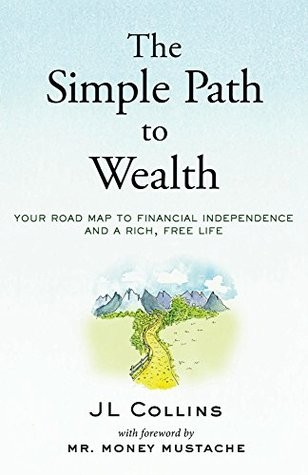
The Simple Path to Wealth by JL Collins is a 2016 self-help book about financial independence, index investing, debt avoidance. The single-fund solution: a total stock market index fund handles the wealth-accumulation need for most people in the accumulation phase. Complexity beyond this produces more risk than it eliminates.
Summary
The Simple Path to Wealth is JL Collins's guide to building wealth and financial independence through a deliberately simple investment approach, originally written as a series of letters to his daughter. Collins is best known for his blog, jlcollinsnh.com, and the "stock series" of posts that became the foundation for this book. His approach is unapologetically simple: avoid debt, save aggressively, invest in a single low-cost total stock market index fund, and don't touch it.
Collins's investment thesis centers on VTSAX, Vanguard's Total Stock Market Index Fund, as a single-fund solution for wealth accumulation. His argument is that the US stock market has historically outperformed over long periods, that diversification across the entire market eliminates stock-specific risk, that Vanguard's ownership structure (owned by its funds, not by outside shareholders) uniquely aligns with investor interests, and that simplicity removes the behavioral temptation to tinker. He presents the case for holding a single fund against various objections and addresses the international diversification question specifically.
The book addresses the two phases of the investment lifecycle separately: the accumulation phase, during which you add money and let compounding work, and the distribution phase, during which you draw down the portfolio in retirement. The distribution phase is where the 4 percent rule appears — Collins discusses the research on sustainable withdrawal rates and explains why a portfolio that generates returns above inflation can, in most historical scenarios, support indefinite withdrawals at roughly 4 percent per year.
Collins writes with the directness and occasional bluntness of someone who has strong convictions and is not interested in false balance. He argues against bond allocations for younger investors, against international diversification, and against any investment complexity beyond the single-fund core. These positions are more aggressive than most evidence-based personal finance books would recommend, and readers should understand that they represent Collins's view rather than consensus. The book's value is in its clarity, its persuasive force, and its accessible treatment of financial independence as an achievable goal rather than an abstract aspiration.
Talk to The Simple Path to Wealth like its author wrote you back.
Get the ideas that fit your life — not generic summaries.
- Chat with the book
- Audiobook-style main ideas
- Adapts to your life and goals
- Helps you take action
Key takeaways
- 1.
The single-fund solution: a total stock market index fund handles the wealth-accumulation need for most people in the accumulation phase. Complexity beyond this produces more risk than it eliminates.
- 2.
Avoid debt. Debt creates fragility, transfers wealth to lenders, and reduces the capital available for investment. The exception Collins makes is for mortgages on primary residences held to term.
- 3.
The 4 percent rule: a diversified portfolio can support withdrawals of 4 percent of the initial balance annually (adjusted for inflation) indefinitely in most historical scenarios.
- 4.
F-you money — having enough financial independence to walk away from any situation — changes your relationship with work, with employers, and with risk. Accumulating it is worth pursuing independent of whether you ever use it.
- 5.
The market always goes up over long time periods, despite short-term crashes that can be severe. Staying invested through those crashes is the primary behavioral challenge.
- 6.
Stocks are more volatile and more risky than bonds in the short run and dramatically less risky over long periods. For investors with long time horizons, bonds dilute returns without providing proportionate safety.
- 7.
The accumulation number — the portfolio balance at which you are financially independent — is 25 times your annual spending. Reducing spending is as powerful as increasing investment returns in reaching that number.
- 8.
Owning your own business through an index fund means owning a piece of every major public company. You participate in the aggregate profit generation of the global economy without having to pick individual winners.
Discussion questions
Use these on your own, with a book club, or as chat starters in Superbook. Book club version, ready to copy or print →
- 1.
Collins's single-fund recommendation — one total stock market index fund — is simpler than most professional recommendations. What do you gain and what do you give up with that level of simplicity?
- 2.
The book was originally written as letters to Collins's daughter. Does that origin change how you read the advice — does it feel more personal, more opinionated, or more applicable to your situation?
- 3.
Collins argues against international diversification, which puts him at odds with most portfolio theory. What's the strongest argument for his position, and what's the strongest argument against it?
- 4.
F-you money is one of the book's most emotionally resonant concepts. Have you ever been in a situation where financial independence would have materially changed your choices?
- 5.
Collins's accumulation target — 25 times annual spending — implies that reducing spending is as powerful as increasing investment returns in reaching financial independence. How does that framing change your priorities?
- 6.
The 4 percent rule emerged from research on historical US market returns. Does that research translate to your specific situation — retirement age, spending needs, asset mix, global market exposure?
- 7.
Collins says stocks are less risky than bonds over long time horizons. Have you internalized that statement enough to hold a stock-heavy portfolio through a 50 percent decline without selling?
- 8.
The book's emphasis on a single fund simplifies decisions but means your portfolio looks like everyone else's. Does the lack of differentiation bother you, or is homogeneity the point?
- 9.
Collins is explicit that his approach is not the only path. What specifically in your financial situation makes the simple path harder or easier to follow?
- 10.
The distribution phase — actually spending down the portfolio — requires a different psychological orientation than accumulation. Have you thought through what that transition would feel like for you?
- 11.
Collins writes with unusual directness and is willing to disagree with mainstream advice on bonds and international stocks. How do you evaluate contrarian positions in personal finance — when is disagreement a signal of insight and when is it overconfidence?
- 12.
The FIRE community that this book is part of has been criticized for being available mainly to high-income professionals. Is the book's path genuinely accessible across income levels, or does it assume a level of earnings that makes the numbers work easily?
Themes
Frequently asked questions
-
Is VTSAX the only fund I need?
Collins argues yes, for US investors in the accumulation phase. VTSAX (or its equivalent at any major low-cost broker) provides total US market exposure in a single fund. Collins's case against international diversification and for simplicity argues against adding more funds. Most mainstream portfolio theory recommends adding international exposure, so this is a genuine point of disagreement worth understanding.
-
What is F-you money?
Collins's term for financial independence sufficient to walk away from any situation — job, relationship, location — without financial pressure constraining the decision. It is not necessarily full retirement; it is the cushion that changes your negotiating position and your psychological relationship with obligation.
-
What is the 4 percent rule?
A guideline from the Trinity Study suggesting that a portfolio of stocks and bonds can support annual withdrawals of 4 percent of the initial balance (adjusted for inflation) indefinitely in most historical scenarios. The underlying research assumed a 30-year retirement and a roughly 50-50 stock-bond allocation. Collins discusses it in the context of potentially much longer retirement periods.
-
Is The Simple Path to Wealth good for beginners?
Yes. The book is accessible, direct, and opinionated enough to be actionable. Beginners who are overwhelmed by the volume of personal finance advice will find Collins's clear recommendations a relief. More experienced investors may want to explore the areas where Collins is more aggressive than mainstream advice — no international diversification, minimal bonds for long time horizons — before adopting his approach wholesale.
-
Does the simple path work outside the United States?
The specific fund recommendations are US-centric. The principles — low costs, broad diversification, long holding periods, debt avoidance — translate globally. Non-US investors would need to adapt the specific fund and account recommendations to their own tax and brokerage environment, but the framework applies broadly.