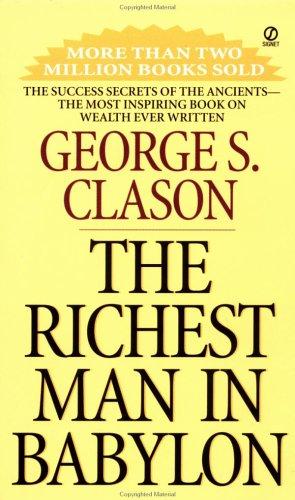
The Richest Man in Babylon by George S. Clason is a 1926 self-help book about saving, financial principles, wealth building. Pay yourself first: save at least one-tenth of everything you earn before you spend anything. This single rule, maintained consistently, builds wealth regardless of income.
Summary
The Richest Man in Babylon is George S. Clason's collection of parables set in ancient Babylon, each illustrating a financial principle through the stories of merchants, tradesmen, and scholars. First published as pamphlets distributed through banks and insurance companies beginning in 1926, the stories were eventually collected into this book, which has sold millions of copies over nearly a century. The setting is deliberately timeless — the problems of saving, debt, and wealth that Babylonian artisans face are identical to the problems modern readers face.
The central figure is Arkad, the richest man in Babylon, who shares his principles with those who seek his counsel. The most famous is "pay yourself first" — save at least one-tenth of everything you earn before spending on anything else. This principle, simple to state and difficult to maintain, is the foundation of wealth accumulation regardless of income level. Arkad argues that a man who saves a portion of every coin that comes to him will accumulate wealth, while a man who spends everything regardless of income will remain poor.
The other principles follow naturally: control your expenditures so that you live within your means and save the required tenth, make your savings work by investing it wisely, protect your savings from loss by learning before you invest and avoiding promises of high returns that cannot be explained, own your own home, insure against future loss and old age, and improve your earning ability through knowledge and skill development. These principles are organized across several parables, each dramatizing a different dimension of financial wisdom.
The book is explicitly a moral text as well as a financial one. Clason frames financial responsibility as a form of character — the man who pays his debts, saves consistently, and learns his trade thoroughly is the same man who succeeds financially. The parables include stories of debt, of misfortune, and of character tested by adversity, and in each case the financial outcome tracks the moral one. The ancient setting removes the modern financial context entirely, which makes the principles feel universal rather than tied to specific market conditions or products.
Talk to The Richest Man in Babylon like its author wrote you back.
Get the ideas that fit your life — not generic summaries.
- Chat with the book
- Audiobook-style main ideas
- Adapts to your life and goals
- Helps you take action
Key takeaways
- 1.
Pay yourself first: save at least one-tenth of everything you earn before you spend anything. This single rule, maintained consistently, builds wealth regardless of income.
- 2.
Control your expenditures. The size of your purse grows through spending less than you earn, not through earning more. Lifestyle inflation defeats every income increase.
- 3.
Make your gold work for you. Savings that sit idle produce nothing. Money invested produces more money without requiring your labor.
- 4.
Guard your gold from loss. The desire for high returns leads to bad investments. Better a modest certain return than a high uncertain one.
- 5.
Own your dwelling. Paying rent enriches the landlord. Paying a mortgage builds equity. The home owner's monthly expense goes toward an asset.
- 6.
Insure against misfortune and old age. Provide for the future now. A man who saves for old age is not a burden to himself or his family.
- 7.
Increase your ability to earn. Learning your trade thoroughly, developing expertise, and improving your productivity increases income faster than any investment.
- 8.
Where you find determination to do, you will also find the means. Financial principles are straightforward; what makes them difficult is the discipline to apply them consistently.
Discussion questions
Use these on your own, with a book club, or as chat starters in Superbook. Book club version, ready to copy or print →
- 1.
Clason's parables suggest that the principles of wealth are the same in ancient Babylon as in the modern world. Do you find that argument convincing, or has the financial landscape changed enough that the advice needs updating?
- 2.
The 'pay yourself first' principle — saving one-tenth before anything else — is simple. Why do you think most people who know this principle don't consistently follow it?
- 3.
The book treats financial responsibility and personal character as the same thing. Do you agree that they are, or is that a moralistic conflation of two distinct qualities?
- 4.
Arkad became the richest man in Babylon by applying principles he was taught, not through exceptional talent or luck. Is that story of wealth accumulation realistic, or does it underestimate the role of advantage and circumstance?
- 5.
The parable of the five laws of gold — save, invest, invest wisely, guard against loss, and don't be seduced by impossible returns — covers the same territory as modern personal finance. What has changed most in how those laws apply today?
- 6.
Clason recommends owning your home as a wealth-building step. Given current home prices and interest rates in many markets, is that advice still sound?
- 7.
The book frames debt as a trap that reduces your freedom to save and invest. How does that framing apply to different kinds of debt — mortgage, student loans, credit cards, business loans?
- 8.
The parables use the ancient world as a setting to strip away modern complexity. Does the simplification help you see the principles more clearly, or does it make the advice feel less applicable to your actual situation?
- 9.
Which of the seven principles in the book do you follow consistently right now, and which do you struggle with?
- 10.
Clason's book was originally distributed through banks and insurance companies. Does the origin affect how you read the advice? Are there principles it would be in those institutions' interests to promote?
- 11.
The improving-your-ability-to-earn principle suggests that investing in yourself often has better returns than investing in markets. What investment in your own skills or knowledge has produced the best return?
- 12.
The book's longevity — nearly a hundred years in print — is itself an argument for the universality of the principles. What would make a personal finance book irrelevant quickly versus relevant across generations?
Themes
Frequently asked questions
-
Is The Richest Man in Babylon appropriate for teenagers?
Yes, it is one of the best first books on money for young people. The parable format is accessible, the principles are clear, and the ancient setting makes it feel less intimidating than a conventional personal finance book. Parents who want their children to have a framework for thinking about money before they start earning often recommend it.
-
What is the central financial lesson of the book?
Pay yourself first: save at least ten percent of everything you earn before spending on anything else. Everything else in the book follows from that single habit, maintained consistently over time.
-
How long does The Richest Man in Babylon take to read?
Around two to three hours. It is one of the shortest books in personal finance and can be read in an afternoon. Many readers re-read it periodically because the principles are worth revisiting.
-
Is The Richest Man in Babylon too simple?
The principles are simple. Whether that's a strength or a weakness depends on what you're looking for. For readers who need a framework and are overwhelmed by detail, the simplicity is valuable. For readers who want investment-specific guidance or analysis of complex financial situations, the book is deliberately and appropriately incomplete.
-
Does the ancient Babylonian setting make the book harder to take seriously?
For most readers, the setting actually makes the principles more memorable. The parables create narrative hooks for each idea, and the ancient context strips away modern product-specific noise to focus on underlying principles. A few readers find the faux-ancient dialogue distracting, but most adapt quickly.
Similar books
The Richest Man in Babylon vs.
Deciding between two books? The Richest Man in Babylon vs Rich Dad Poor Dad .
