Philosophy · Book club
The Mind's I book club questions
Here are 12 book club questions for The Mind's I by Douglas Hofstadter & Daniel Dennett, ordered to open easily and end somewhere worth arguing about. Copy them, print them, or bring them up one at a time.
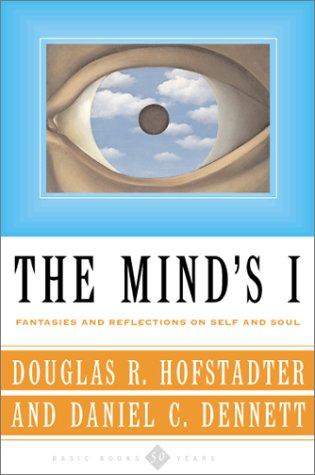
The Mind's I is a collaborative anthology edited by Douglas Hofstadter and Daniel Dennett, two of the most influential thinkers on consciousness and mind of the late twentieth century.
Douglas Hofstadter & Daniel Dennett · 1981 · 8h 45m
Full summary and key takeaways →The 12 questions
- 1.
Hofstadter argues that the self is an emergent pattern, not a unitary thing. Does that view change anything about how you think about your own decisions or moral responsibility?
- 2.
Searle's Chinese Room claims a computer can pass any behavior test while still not understanding. Hofstadter's counter-argues the system as a whole can understand even if no part does. Which position do you find more compelling, and why?
- 3.
Several thought experiments in the book involve copying or duplicating a person. If an exact copy of you woke up tomorrow, would it be you? What hangs on the answer?
- 4.
Nagel asks what it is like to be a bat — and answers that we can't know from outside. Does the same argument apply to other humans? To very different cultures or minds?
- 5.
The book includes fiction alongside analytic philosophy. Do you think the fictional pieces carry philosophical weight, or are they illustrations rather than arguments?
- 6.
As AI has advanced since 1981, which thought experiments in the book feel more relevant than ever, and which feel dated or resolved?
- 7.
Hofstadter and Dennett seem to think the self is an illusion in some technical sense, while also acting as if it matters morally and practically. Is that coherent?
- 8.
The book treats AI and consciousness as deeply connected questions. How does that framing hold up now that large language models exist and behave in ways that were not anticipated in 1981?
- 9.
Borges's fiction is included because it captures something philosophy struggles to express directly. What does literature give you that argument cannot?
- 10.
If you could ask Hofstadter one question about consciousness that this book doesn't answer, what would it be?
- 11.
The editors argue that philosophy of mind requires breadth — science, fiction, thought experiments, formal argument. Is that argument about method convincing, or does it risk diluting rigor?
- 12.
Personal identity and continuity of self across time is one of the book's central puzzles. How does your own experience of memory and change relate to the philosophical accounts offered here?
How to run the discussion
- Pick six to eight, not all of them. An hour of real discussion covers fewer questions than anyone expects, and racing the list is what makes a book club feel like homework.
- Open with what people noticed, not what they concluded. Asking for a verdict first hardens opinions before anyone has heard each other.
- Let the disagreement run. The questions below that split a room are the ones worth the time; the ones everyone answers the same way can be skipped.
- Ask the quiet person a specific question. A direct, narrow question is far easier to answer than an open invitation to contribute.
Themes worth steering toward
If the conversation stalls, these are the threads that usually restart it.
Common questions
What are good book club questions for The Mind's I?
Here are 12 book club questions for The Mind's I by Douglas Hofstadter & Daniel Dennett, ordered to open easily and end somewhere worth arguing about. The strongest openers ask what each reader noticed rather than what they concluded, and the discussion usually turns on consciousness, identity, artificial intelligence.
How long should a book club discussion of The Mind's I last?
Most groups run 60 to 90 minutes of actual discussion. That is roughly six to eight questions, not all of them, so pick the ones that suit your group rather than working down the list in order.
What are the main themes in The Mind's I?
Consciousness, Identity, Artificial intelligence, Self-reference, Philosophy of mind. Those are the threads most likely to divide a room, which makes them the useful places to steer a discussion that has gone quiet.
Picking the next one? See books like The Mind's I or questions for other book club picks.
