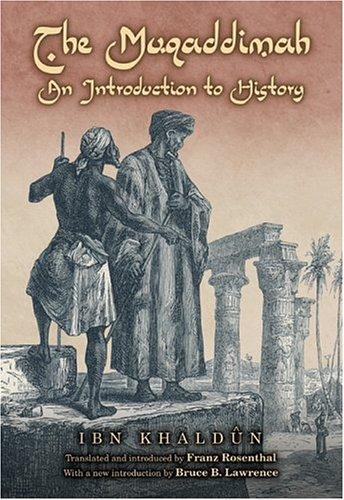
The Muqaddimah by Ibn Khaldun is a 1958 history book about civilization, political cycles, social cohesion. Asabiyya — group solidarity and shared purpose — is the engine of political power. Dynasties rise on strong asabiyya and fall as it decays through luxury and internal factional competition.
Summary
The Muqaddimah, written by the North African historian and statesman Ibn Khaldun in 1377, is the introduction to a projected universal history of the world. In practice it became something far more consequential: the first systematic attempt to identify the laws governing the rise and fall of civilizations. Written before the European Renaissance and centuries before the disciplines of sociology, economics, and political science existed as formal fields, the Muqaddimah anticipates arguments in all three.
Ibn Khaldun's central concept is asabiyya — usually translated as group feeling, social solidarity, or tribal cohesion. His argument is that political power depends on asabiyya: a ruling group holds power only as long as it maintains the shared purpose and mutual loyalty that allowed it to seize power in the first place. Dynasties follow a predictable cycle. A new group with strong asabiyya — often from the desert or the margins, uncorrupted by luxury — overthrows an existing dynasty whose solidarity has decayed into factional infighting and dependence on mercenaries. The new rulers consolidate power, build cities, patronize arts and learning, and generate wealth. Over three or four generations, that wealth and comfort erode the asabiyya that created it, and the dynasty becomes vulnerable to the next group from the margins.
Beyond political cycles, Ibn Khaldun writes with remarkable sophistication about economics, arguing that taxation beyond a certain threshold depresses production and ultimately reduces total revenue — a precursor to what is now called the Laffer Curve. He writes about the division of labor, the relationship between population density and productivity, the effects of plague and famine on civilizations, the psychology of historical memory and myth, and the epistemology of historical method — his skepticism about miraculous and implausible reports in history is methodologically modern.
The complete Muqaddimah is very long and was written for an educated medieval Arabic-reading audience. The Rosenthal translation is comprehensive; the abridged version edited by N.J. Dawood is more accessible. Either way, Ibn Khaldun rewards the patience the text demands. Few books written before the twentieth century anticipate so much of what social science would later formalize.
Talk to The Muqaddimah like its author wrote you back.
Get the ideas that fit your life — not generic summaries.
- Chat with the book
- Audiobook-style main ideas
- Adapts to your life and goals
- Helps you take action
Key takeaways
- 1.
Asabiyya — group solidarity and shared purpose — is the engine of political power. Dynasties rise on strong asabiyya and fall as it decays through luxury and internal factional competition.
- 2.
The cycle of dynasties typically lasts three to four generations: conquest, consolidation, luxury, and decline. This is not fate but a predictable consequence of how prosperity affects solidarity.
- 3.
Excessive taxation destroys the productive base it depends on. Ibn Khaldun's analysis of declining tax revenue under high rates anticipates modern supply-side economics by six centuries.
- 4.
Cities and settled civilization depend on surplus production from the countryside and hinterland. The relationship between nomadic and settled populations is not simply conflict but mutual dependence.
- 5.
Historical method requires skepticism about implausible reports. Ibn Khaldun argues historians should evaluate claims against what is known about human nature and political reality, not just accept them as transmitted.
- 6.
The division of labor — the idea that coordinated specialization produces more than individual self-sufficiency — is central to his account of how cities and economies grow.
- 7.
Plague, famine, and demographic collapse reshape civilizations on timescales that outlast any single dynasty. Ibn Khaldun wrote after the Black Death devastated the Islamic world and understood its civilizational effects.
- 8.
Education, scholarship, and cultural production flourish in stable, prosperous dynasties but often outlast them — the intellectual heritage of a declining dynasty can be absorbed by its successors.
Discussion questions
Use these on your own, with a book club, or as chat starters in Superbook. Book club version, ready to copy or print →
- 1.
Ibn Khaldun argues that the prosperity a dynasty creates inevitably erodes the solidarity that built it. Do you see this pattern in organizations, movements, or communities you know?
- 2.
His concept of asabiyya — group cohesion — is central but contested. What creates strong asabiyya in a contemporary organization or community? What destroys it?
- 3.
He was writing about fourteenth-century North Africa and the Islamic world. How well does the model translate to contemporary political and business cycles?
- 4.
His skepticism about miraculous or implausible historical reports was methodologically radical for his time. What are the equivalents of implausible reports in contemporary media and information?
- 5.
The Laffer Curve — the idea that excessive taxation reduces total revenue — is often associated with twentieth-century American conservatism. Does knowing Ibn Khaldun anticipated it change how you think about the argument?
- 6.
He argues that groups from the margins, with less exposure to comfort and luxury, tend to have stronger asabiyya than established elites. Is that pattern visible in contemporary business or politics?
- 7.
Ibn Khaldun was himself a statesman who served multiple competing dynasties and was held prisoner by Tamerlane. How does that biography shape your reading of his arguments?
- 8.
He emphasizes the role of geography and climate in shaping political culture. How much do you think physical environment shapes civilization compared to human choices?
- 9.
The complete Muqaddimah is one of the longest books in this catalog. Is depth of a single thinker's systematic argument more valuable to you than reading multiple shorter books on related themes?
- 10.
His model of historical cycles is deterministic in outline but not in detail — the timing and shape vary. Does a cyclical model of history feel more or less truthful to you than progressive or linear models?
- 11.
What modern institution or organization do you think is currently in which phase of Ibn Khaldun's dynasty cycle?
Themes
Frequently asked questions
-
What is the Muqaddimah?
The introduction to Ibn Khaldun's projected universal history, which became the most important work of social theory written before the European Enlightenment. It develops a systematic account of how and why civilizations rise and fall, drawing on political theory, economics, sociology, and the philosophy of history.
-
Do I need to read the full Muqaddimah or is there an abridged version?
The abridged version edited by N.J. Dawood and translated by Franz Rosenthal is around 450 pages and covers the core arguments fully. The complete Rosenthal translation runs to three volumes. Start with the abridgment; read the complete version if it opens questions you want to pursue further.
-
Why does Ibn Khaldun matter in the twenty-first century?
His model of political cycles, group solidarity, and the self-defeating dynamics of concentrated power describes patterns that remain recognizable in contemporary politics and business. His methodological skepticism about transmitted historical claims is more relevant than ever in an information-rich environment.
-
What does asabiyya mean?
Ibn Khaldun's term for the group solidarity, shared purpose, and mutual loyalty that enables collective political action. Usually translated as 'group feeling' or 'social cohesion.' He argues it is the fundamental driver of political power — without it, no dynasty survives.
-
Is this accessible to a general reader?
With some patience, yes. The abridged version in translation is challenging but manageable. The concepts are not technically difficult; the challenge is the density of historical examples from a world most Western readers know little about. The core arguments reward the effort.
Similar books
Guns, Germs, and Steel
Jared Diamond
Sapiens: A Brief History of Humankind
Yuval Noah Harari
The Lessons of History
Will & Ariel Durant

The Decline and Fall of the Roman Empire
Edward Gibbon
